

Financial planning is built on trust, education, and long-term relationships.
Before someone entrusts a financial advisor with their investments, retirement planning, or wealth management, they want confidence that the advisor understands their goals and can explain complex financial concepts clearly.
Traditional marketing methods such as brochures, advertisements, and static social posts often struggle to build that confidence.
Short-form educational videos, however, allow advisors to demonstrate expertise before a prospect ever schedules a meeting.
This raises an important question:
How do educational reels increase consultations for financial advisors?
The answer lies in reducing uncertainty.
Educational reels simplify complex financial topics, establish credibility, answer common questions, and position advisors as trusted experts. By providing valuable insights upfront, advisors make it easier for prospects to move from curiosity to consultation.
This guide explains how educational reels generate more consultation bookings and how financial advisors can build an effective content strategy around them.
Direct Answer
Educational reels increase consultations for financial advisors by building trust through education, demonstrating expertise, answering common financial questions, and encouraging prospects to take the next step with greater confidence.
Instead of immediately promoting services, educational reels provide value first.
This approach helps advisors:
- Increase credibility
- Improve audience engagement
- Build trust faster
- Reduce common objections
- Generate qualified leads
- Increase consultation bookings
According to HubSpot Research, educational video content consistently ranks among the highest-performing content formats for customer engagement and decision-making.
For financial advisors, every educational reel becomes an opportunity to establish expertise before the first conversation.
Why Financial Education Builds Trust
Financial Decisions Feel Complicated
Many prospective clients hesitate because they do not fully understand:
- Retirement planning
- Investment strategies
- Tax efficiency
- Wealth preservation
- Estate planning
- Market volatility
Confusion often delays action.
Educational content removes uncertainty.
People Prefer Advisors Who Teach
Consumers increasingly value professionals who educate rather than simply sell.
Educational reels demonstrate:
- Expertise
- Communication ability
- Transparency
- Problem-solving
According to Edelman Trust Barometer, transparency and expertise remain among the strongest drivers of trust.
Financial advisors who consistently educate become more credible over time.
Video Accelerates Familiarity
Prospects who regularly watch an advisor’s videos become familiar with:
- Communication style
- Personality
- Professional philosophy
- Financial approach
This familiarity reduces hesitation before booking consultations.
Step-by-Step Breakdown: How Educational Reels Generate More Consultations
Step 1: Answer Frequently Asked Financial Questions
Every advisor hears recurring questions.
Examples include:
- When should I start investing?
- How much do I need for retirement?
- What is dollar-cost averaging?
- Should I pay off debt first?
- How does compound interest work?
Each question becomes an educational reel.
Answering common concerns publicly helps multiple prospects simultaneously.
Step 2: Simplify Complex Topics
Financial planning often involves technical language.
Educational reels should simplify topics using:
- Visual examples
- Everyday analogies
- Simple graphics
- Real-life scenarios
The easier the explanation, the more likely viewers are to understand and remember it.
Understanding builds confidence.
Confidence encourages consultations.
Step 3: Address Common Objections
Educational reels can proactively answer concerns such as:
- “I don’t have enough money to invest.”
- “The market is too risky.”
- “Financial planning is only for wealthy people.”
- “I’m too young to need an advisor.”
Removing misconceptions reduces barriers to taking action.
Step 4: Demonstrate Expertise Through Consistency
One helpful reel builds interest.
Dozens of educational reels build authority.
Topics may include:
- Retirement planning
- Investment basics
- Tax planning
- Budgeting
- Wealth building
- Risk management
Consistent publishing reinforces expertise over time.
Step 5: Use AI to Identify High-Interest Topics
Modern advisors increasingly use AI-powered tools to analyze:
- Search behavior
- Social engagement
- Client questions
- Website analytics
- CRM data
According to McKinsey & Company, AI-driven customer insights frequently improve content relevance and marketing effectiveness.
These insights help advisors prioritize educational topics that resonate most with prospective clients.
Step 6: End Every Reel With a Clear Next Step
Educational content should naturally guide viewers toward action.
Examples include:
- Schedule a consultation
- Download a retirement checklist
- Read a detailed guide
- Watch the next educational reel
- Subscribe for weekly financial tips
A strong call-to-action converts attention into opportunity.
Supporting Data and Real-World Examples
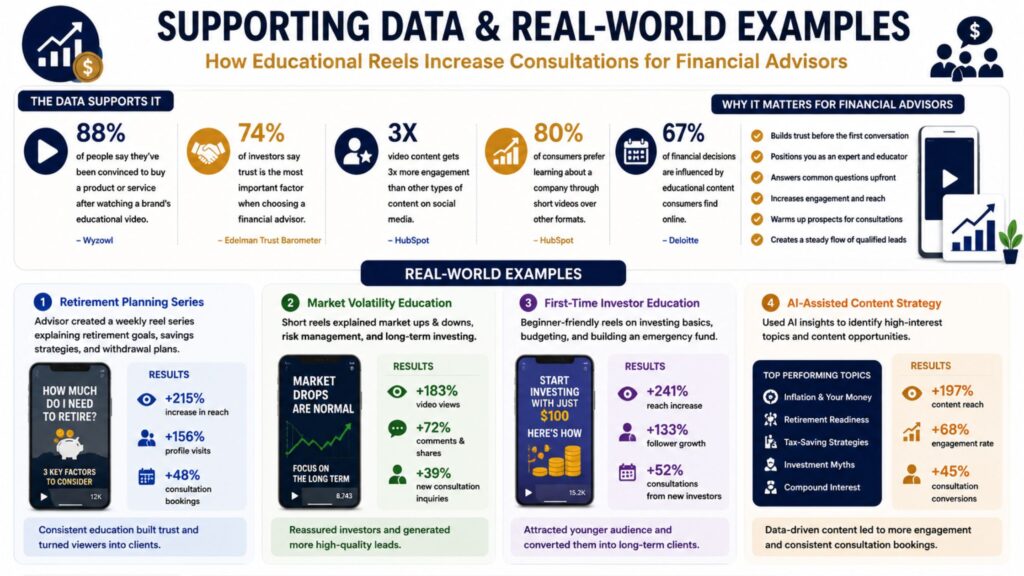
Example 1: Retirement Planning Series
A financial advisor creates a weekly reel series covering:
- Retirement savings goals
- Investment timelines
- Withdrawal strategies
- Common retirement mistakes
Prospective clients begin following the series and later schedule consultations after gaining confidence in the advisor’s expertise.
Example 2: Market Volatility Education
Rather than reacting to market headlines with promotional content, an advisor creates educational reels explaining:
- Market cycles
- Long-term investing
- Risk management
- Portfolio diversification
The educational approach reassures investors and generates consultation requests during uncertain market conditions.
Example 3: First-Time Investor Education
A financial planner develops beginner-friendly reels covering:
- Investment terminology
- Budgeting basics
- Building an emergency fund
- Starting retirement savings
These videos attract younger professionals seeking approachable financial guidance.
Example 4: AI-Assisted Content Optimization
An advisory firm analyzes audience behavior using AI-powered analytics.
The data reveals high engagement for reels covering:
- Inflation
- Retirement readiness
- Tax-saving strategies
- Investment myths
Future educational content focuses on these topics, resulting in increased engagement and more consultation inquiries.
Common Educational Reel Mistakes
Making Videos Too Technical
Prospects want clarity.
Avoid excessive financial jargon.
Simple explanations increase retention.
Focusing Only on Market News
Timeless educational content often delivers longer-term value than reactive commentary.
Balance current events with evergreen financial education.
Forgetting Calls-to-Action
Every reel should provide a clear next step.
Education creates trust.
Calls-to-action create consultations.
Posting Inconsistently
Trust develops over time.
Consistent publishing strengthens familiarity and authority.
Conclusion
Educational reels can significantly increase consultations for financial advisors because they simplify complex financial topics, reduce uncertainty, and build trust before prospects ever schedule a meeting.
The most effective educational reel strategies focus on:
- Frequently asked questions
- Simple financial education
- Objection handling
- Consistent expertise
- AI-driven topic selection
- Clear calls-to-action
As consumers increasingly research financial advisors online before making contact, educational video content provides a scalable way to demonstrate knowledge, communication skills, and credibility.
The goal is not simply to explain financial concepts.
The goal is to build enough trust that prospects feel confident scheduling a consultation and beginning their financial planning journey with your firm.