
Freelance graphic design is one of the most talent-dense and referral-dependent professional service categories in existence.
The designer with the strongest portfolio is not always the one with the fullest client calendar.
The one with the fullest client calendar is almost always the one who has built the most consistent and visible professional presence in the environments where their ideal clients spend their working attention.
In 2026, that environment is LinkedIn, and the designers who are generating a predictable flow of inbound enquiries from it are not necessarily posting more content than their peers.
They are posting smarter content, and in a growing number of cases, they are using AI content creation tools to produce it at a volume and consistency that manual effort alone could not sustain alongside a full client workload.
For a freelance graphic designer, time spent creating LinkedIn content is time not spent on billable work.
AI content creation removes this trade-off by compressing the production time of a well-structured LinkedIn post, carousel, or article from hours to minutes, freeing the designer to maintain a consistent publishing cadence without sacrificing the client delivery hours that pay the bills.
The result is a LinkedIn presence that generates enquiries on a schedule that the designer controls, rather than a referral pipeline that fluctuates with the social activity of their existing client base.
The Visibility Gap That Prevents Inbound Enquiries
The single most common reason a freelance graphic designer with a strong portfolio fails to generate consistent LinkedIn enquiries is not quality.
It is visibility frequency. LinkedIn’s algorithm distributes content to a fraction of a creator’s existing connections on initial publication and expands that distribution based on early engagement signals.
A designer who publishes once a month, regardless of how strong that single piece of content is, is giving the algorithm one opportunity per month to distribute their name and their work to the professional audience that could commission them.
A designer who publishes three to four times per week is giving the algorithm twelve to sixteen distribution opportunities in the same period.
The compound visibility difference between these two cadences is not proportional.
It is exponential, because each piece of content that generates engagement expands the algorithm’s confidence in the designer’s profile and increases the reach of every subsequent piece.
AI content creation enables the higher cadence without the higher time cost.
A designer who uses AI tools to generate first drafts of their content, which they then edit and personalise with their own voice and visual judgment, can maintain a three-times-per-week publishing schedule in the time it previously took to produce one carefully crafted post.
The AI handles the structural and copywriting labour. The designer contributes the creative perspective and professional authenticity that makes the content worth engaging with.
The Content Architecture That Converts Visibility Into Enquiries
Visibility on LinkedIn is a necessary but not sufficient condition for generating design enquiries.
A post that reaches a thousand marketing managers is only valuable if the content of that post moves a proportion of those marketing managers from passive awareness of the designer’s existence to active consideration of their availability.
This conversion from visibility to enquiry is the function of content architecture, and AI content creation tools are particularly effective at building it because the architecture follows a repeatable strategic logic that AI can apply consistently across every content type.
The awareness layer of the architecture consists of posts that are broadly relevant to the problems the designer’s target clients are experiencing.
A designer who specialises in brand identity for DTC food brands publishes content about the visual mistakes that cost food brands shelf presence, the packaging trends that are driving purchase decisions in the natural grocery segment, and the brand identity signals that distinguish premium positioning from mid-market in a 0.3 second glance.
This content reaches the marketing directors and brand managers who will one day need a designer like this one, and it positions the designer as a category authority before any commission conversation has begun.
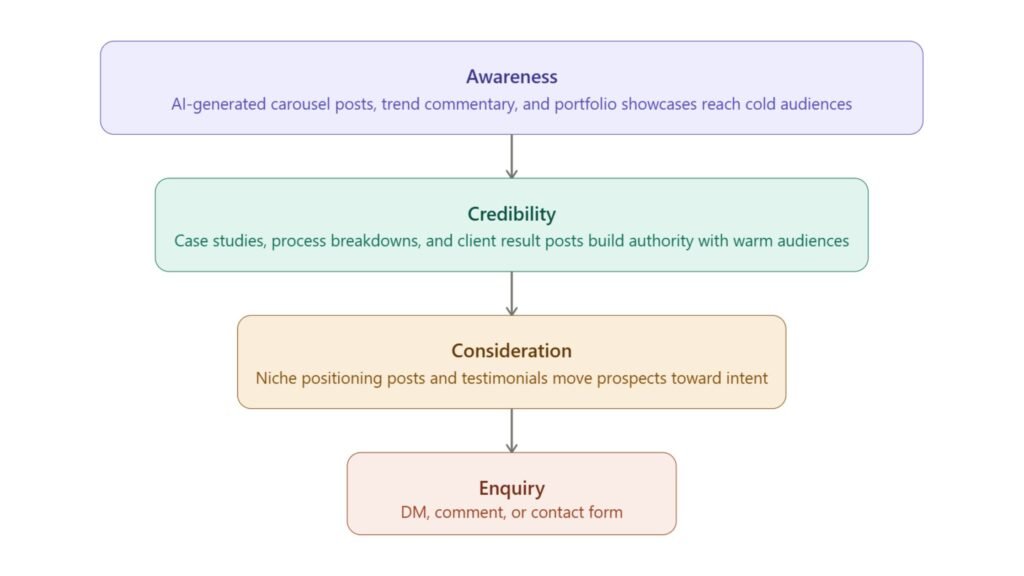
The credibility layer consists of case studies, process breakdowns, and outcome-specific posts that demonstrate the designer’s methodology and the tangible business results their work has produced for previous clients.
This layer is where most freelance designers underinvest because producing case study content requires structuring complex project narratives into digestible LinkedIn formats, which is exactly the kind of structural writing task that AI content creation handles with speed and consistency.
The consideration layer consists of posts that speak directly to the decision a prospective client is approaching, including when to hire a freelance designer versus a studio, what a good design brief looks like, how to evaluate creative proposals, and what a healthy client-designer working relationship requires from both sides.
This content addresses the specific cognitive work a prospect is doing in the weeks before they reach out, which makes the designer’s name the most recent and most relevant one in their consideration set at the moment they are ready to make contact.
Niche Positioning as the Enquiry Multiplier
The counterintuitive truth about LinkedIn content for freelance graphic designers is that broader content reaches more people and generates fewer enquiries, while narrower content reaches fewer people and generates more relevant ones.
A post about graphic design in general competes with every other designer on the platform for the attention of everyone who might theoretically need design work.
A post about the specific visual communication challenges of B2B SaaS onboarding flows reaches a much smaller audience but one in which every member is a potential client for a designer who has positioned themselves in that niche.
AI content creation accelerates the niche positioning process by enabling a designer to produce a high volume of content within their specific category quickly enough to establish topical authority before a competitor with the same positioning does.
The designer who has published 40 pieces of content specifically about packaging design for independent spirits brands over a six-month period owns that topic on LinkedIn in a way that no amount of generalist design content could replicate.
This owned niche is what transforms LinkedIn from a networking platform into an enquiry engine.
When a craft distillery’s marketing manager types “packaging designer” into LinkedIn search, the designer whose content has consistently addressed the specific visual and regulatory challenges of spirits packaging is not simply a search result.
They are a familiar and trusted voice whose work the prospect has already been consuming for months, which makes the enquiry feel like a natural next step rather than a cold outreach to a stranger.
The Personal Brand Layer That AI Cannot Write For You
AI content creation is a production tool, not a voice replacement.
The posts that generate the highest engagement and the most direct enquiries on LinkedIn are invariably the ones that contain a perspective, a professional opinion, or a personal observation that could only have come from the specific designer who published them. AI can structure, draft, suggest, and optimise.
It cannot manufacture the point of view that makes a designer’s content worth following rather than simply worth skimming.
The most effective workflow for a freelance graphic designer using AI content creation tools combines the efficiency of AI production with the irreplaceability of human creative perspective.
The designer provides the idea, the opinion, the project insight, or the professional observation.
The AI develops it into a fully structured post, carousel script, or article outline.
The designer reviews, personalises the voice, adds the specific visual or professional detail that grounds the content in authentic experience, and publishes.
This workflow produces content that is structurally strong enough to perform well in the algorithm and personally specific enough to convert a follower into an enquiry.
Neither element alone produces that outcome at the cadence that LinkedIn’s distribution model rewards.
The Enquiry Conversion Moment That Content Builds Toward
Every LinkedIn post a freelance graphic designer publishes is not an advertisement.
It is a micro-deposit into a trust account that a prospective client holds in the designer’s name.
When that trust account accumulates enough deposits, it crosses the threshold at which the prospect feels comfortable making a direct approach.
This threshold is different for every prospect and is influenced by the relevance of the content to their specific situation, the consistency of the publishing cadence, and the degree to which the designer’s voice and perspective have come to feel familiar and credible.
AI content creation accelerates the rate at which deposits are made into that trust account by enabling a higher and more consistent publishing cadence without a proportional increase in production time.
A designer who was making four deposits per month is now making sixteen.
The trust threshold that previously took six months to reach is now reached in six weeks, and the enquiries that follow are warmer, more specific, and more likely to convert into commissioned work because the prospective client arrives already convinced of the designer’s credibility and already aligned with their positioning.
For freelance graphic designers who have built their business on the unpredictability of referrals and the anxiety of feast-and-famine project cycles, AI-assisted LinkedIn content creation is the infrastructure that replaces unpredictability with a system.
It does not guarantee every post will go viral or that every enquiry will convert.
It does guarantee that the designer is consistently visible, consistently credible, and consistently present in the professional attention of the clients most likely to commission their work, which is the only reliable foundation that an inbound enquiry pipeline can be built on.
Schedule a free consultation to explore what an AI-assisted LinkedIn content strategy would look like for your freelance design practice. You will receive a complete audit of your current LinkedIn presence and the positioning gaps your content architecture is creating, a custom content framework built around your design niche and target client profile, and a 60 day publishing roadmap designed to compound your visibility and generate consistent design enquiries from the first month of deployment, entirely obligation-free.
– Blog written by Pranit Kamble