

Most SaaS companies are running awareness campaigns and calling them performance marketing.
They are measuring impressions, click-through rates, and cost per click. They are optimising for traffic. And they are wondering why the pipeline is not filling.
The problem is not the budget. It is the objective.
Conversion-focused advertising is built around a fundamentally different question. Not “how many people saw the ad?” but “how many people took the next step in the buying journey?”
In 2026, SaaS companies that have rebuilt their ad architecture around conversion objectives are consistently outperforming competitors on cost per trial, cost per qualified lead, and ultimately revenue per dollar of ad spend.
The Gap Between a Click and a Conversion
A SaaS buyer who clicks an ad is not a lead. They are curious.
Curiosity does not pay a subscription. Intent does.
The gap between curiosity and intent is where most SaaS ad spend disappears. A prospect clicks through to a homepage that was not built for the traffic source that sent them. They encounter generic messaging that does not speak to the specific problem the ad promised to solve. They leave.
Conversion focused ads close this gap by treating the post-click experience as part of the ad itself.
Every element of the conversion path is engineered for a single outcome:
- The ad targets a specific job title, pain point, or use case
- The landing page reflects the exact language and promise of the ad
- The call to action is specific, low-friction, and tied to a single conversion event
- The follow-up sequence is triggered immediately and personalised to the entry point
When the ad and the destination are built as one continuous experience, conversion rates improve dramatically without increasing spend.
Funnel Stage Targeting as the Revenue Multiplier
Not everyone in a SaaS buying audience is at the same stage of the decision process.
Running the same ad to a cold audience and a warm retargeting pool is the most common and most expensive mistake in SaaS advertising.
A prospect who has never heard of the product needs a different message than one who visited the pricing page three times last week.
Conversion focused ad architecture segments the audience by funnel stage and serves a different ad to each:
- Top of funnel: Problem-aware content that positions the brand as the authority on the challenge the product solves
- Middle of funnel: Product-specific proof, including case studies, demo previews, and ROI calculators, for prospects who are evaluating options
- Bottom of funnel: Direct conversion offers such as free trials, demos, or limited-time onboarding incentives for prospects who have demonstrated purchase intent
- Retargeting: Highly specific ads that reference the exact feature, pricing tier, or use case the prospect engaged with before dropping off
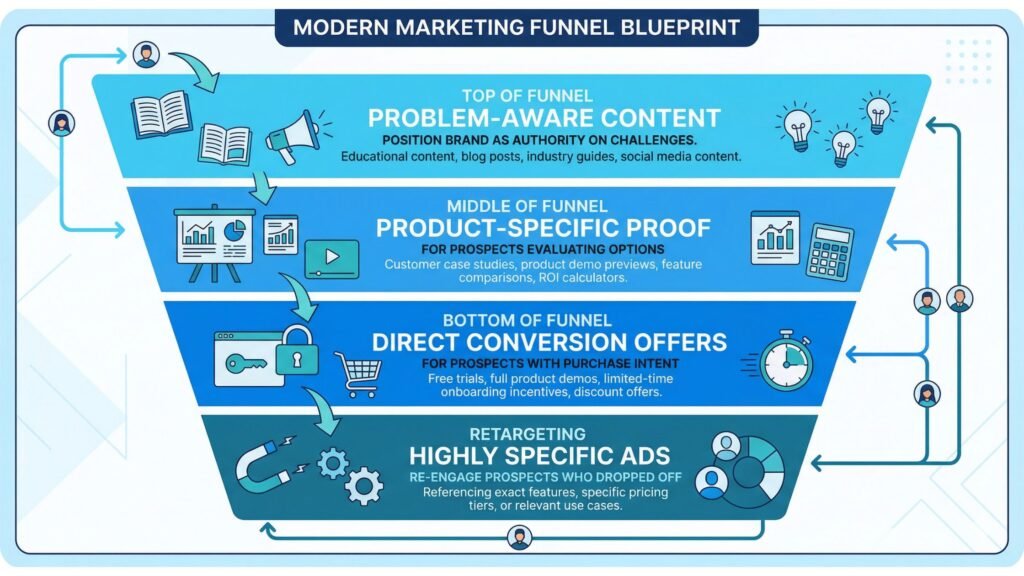
Each layer works independently. Together they compress the sales cycle by advancing prospects through the funnel faster than organic touchpoints alone.
The Trial and Demo Conversion Architecture
For most SaaS companies, the most valuable conversion event is not a purchase. It is a trial start or a demo booking.
These are the moments where a prospect moves from evaluation to experience, and experience is what closes SaaS deals.
Conversion focused ads are built to deliver as many high-quality trial starts and demo bookings as possible at the lowest sustainable cost per conversion.
This requires three things to work together:
A frictionless conversion path. Every step between seeing the ad and completing the desired action should be evaluated and reduced. A demo booking that requires five form fields converts at a lower rate than one that requires two. A trial that requires credit card details upfront converts at a lower rate than one that does not.
A qualification layer. High volume at low quality destroys sales team efficiency. Conversion focused ads use targeting parameters, landing page copy, and form questions to qualify intent before the conversion event rather than relying on the sales team to filter unqualified leads after the fact.
An immediate nurture response. A trial that starts and receives no contact for 48 hours churns before it converts. A demo booking that is not confirmed within hours risks a no-show. The conversion event is the beginning of the revenue process, not the end of the advertising process.
LinkedIn and Google as the Primary SaaS Conversion Channels
SaaS buyers live in two places online: LinkedIn and Google.
LinkedIn is where they consume professional content, follow industry thinking, and encounter vendor messaging during their working day.
It is the platform where job title and company-level targeting allows a SaaS advertiser to serve ads exclusively to the specific decision makers whose signature is required on the contract.
Google is where they search for solutions when a pain point becomes urgent. Search intent advertising captures this moment with precision.
A prospect typing “best project management software for remote teams” is not browsing. They are buying.
A conversion focused search ad that appears at this moment, leads to a landing page that speaks directly to remote team management, and offers a free trial with a single click is capturing the highest-intent moment in the entire buying journey.
The SaaS companies generating the highest advertising ROI in 2026 are running LinkedIn and Google simultaneously, with each platform serving its appropriate funnel stage and both feeding into a unified conversion and nurture architecture.
The Metrics That Actually Measure Conversion Advertising Performance
SaaS advertising performance is often measured on metrics that feel meaningful but do not connect to revenue.
Click-through rate. Cost per click. Impressions. These are engagement signals, not revenue signals.
The metrics that conversion focused advertising is held accountable to are different:
- Cost per trial start: How much does it cost to acquire one active trial user?
- Cost per demo booked: How much does it cost to get one qualified prospect into a product demonstration?
- Trial to paid conversion rate: What proportion of ad-acquired trials convert to paying customers?
- Pipeline contribution: What percentage of total qualified pipeline originated from paid advertising?
- CAC payback period: How many months of subscription revenue does it take to recover the cost of acquiring a customer through paid channels?
When advertising investment is measured against these metrics, the budget allocation decisions become clear.
Channels and campaigns that produce efficient cost per trial and high trial-to-paid conversion receive more investment. Those that do not are restructured or cut.
This measurement discipline is what separates SaaS companies that scale their ad spend efficiently from those that scale it and watch margins deteriorate.
The Compounding Effect of Conversion Data on Future Campaigns
Every conversion event that a SaaS advertising campaign generates produces data.
Data about which audience segments convert at the highest rate. Which ad creative generates the most qualified trials. Which landing page variants produce the lowest cost per demo. Which geographic markets deliver the most efficient CAC.
This data compounds over time.
A SaaS company that has been running conversion focused advertising for 12 months has a significantly more efficient campaign than one that launched last month, because the accumulated conversion data has trained the platform algorithms to find more of the same high-converting audience at a lower cost per acquisition.
The companies that delay building a conversion focused ad architecture are not just missing revenue in the short term.
They are falling further behind in the data accumulation race that determines long-term advertising efficiency.
Starting later means paying more, for longer, to catch up.
Schedule a free consultation to explore what a conversion-focused advertising strategy would look like for your SaaS company.
You will receive a complete audit of your current ad performance and the conversion gaps your existing campaigns are creating, a custom funnel architecture built around your trial and demo conversion objectives, and a 60-day campaign roadmap designed to reduce cost per acquisition and increase pipeline contribution from the first month of deployment, entirely obligation-free.
– Blog written by Pranit Kamble