

Quick commerce runs on a promise.
Ten minutes. Fifteen minutes. Before the thought becomes regret.
The entire value proposition is speed. And the entire reputation of a quick commerce company lives or dies on how consistently that promise is kept, and how visibly and credibly the company responds when it is not.
A missed delivery window. A substituted item. A damaged product. A rider who was rude. These are not exceptional events in a high-volume, time-pressured fulfilment operation. They are statistical certainties.
What separates quick commerce companies with strong goodwill from those in perpetual damage control is not the absence of these incidents. It is the reputation management infrastructure that surrounds them.
In 2026, reputation management for quick commerce is not a PR function that activates during a crisis. It is a daily operational system that monitors, responds to, and shapes the public perception of the brand across every platform where customers form and share opinions.
The Goodwill Equation in Quick Commerce
Goodwill in quick commerce is built on two variables.
The first is the quality of the delivery experience. Fast, accurate, and friendly. This is the product.
The second is the quality of the response when the delivery experience falls short. Fast, empathetic, and resolved. This is the reputation management.
Most quick commerce companies invest heavily in the first variable. Very few invest proportionally in the second.
But for the customer who received a wrong order, the quality of the response is the entire experience. They will not remember the 47 deliveries that arrived correctly. They will remember this one.
And they will review it.
A customer who receives a wrong order and a resolution within ten minutes from a human who acknowledged the failure specifically is almost more loyal after the incident than before it.
A customer who receives a wrong order and a templated email promising a review within five business days is a one-star review, a churned user, and a negative word-of-mouth event.
The difference between these two outcomes is reputation management.
Why Review Velocity Matters More Than Average Rating
Most quick commerce companies track their average star rating.
Fewer track review velocity: the rate at which new reviews are arriving, and the ratio of recent positive to recent negative reviews.
This matters because platform algorithms and prospective customer behaviour are both more influenced by recent reviews than by historical averages.
A quick commerce company with a 4.1 average across 50,000 reviews but 60 negative reviews in the past two weeks is in a worse reputational position than one with a 3.9 average but strong recent momentum.
Prospective customers filter by recent reviews, not lifetime averages.
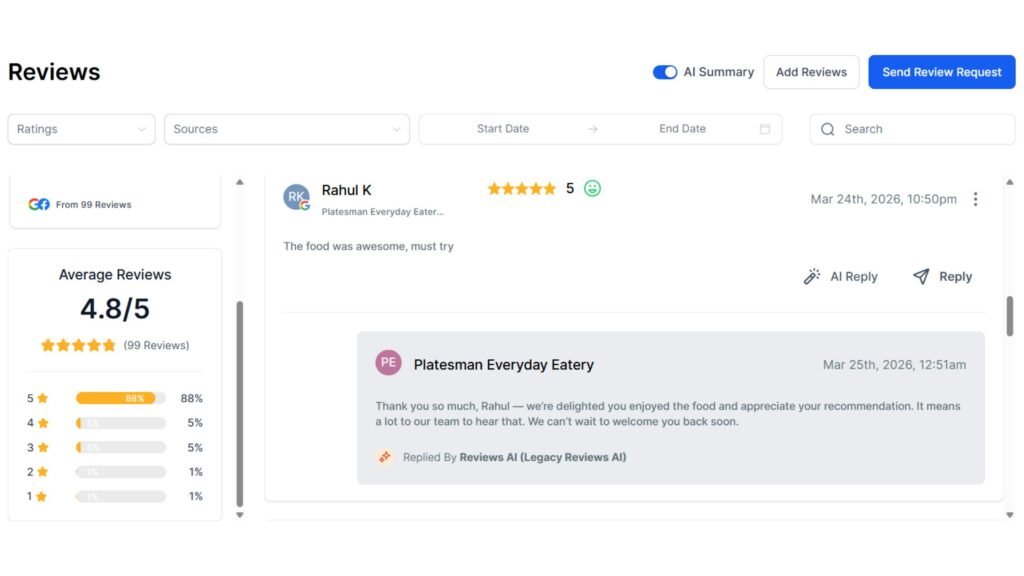
Platform ranking algorithms weight recency heavily.
Reputation management for quick commerce companies therefore operates on a real-time basis:
- Monitoring review platforms, app stores, and social channels for incoming reviews as they arrive
- Responding to negative reviews within hours rather than days
- Identifying and resolving the operational issues generating clusters of negative feedback before they compound
- Actively encouraging satisfied customers to leave reviews at the peak satisfaction moment, which for quick commerce is immediately after a successful delivery
Review velocity is not a vanity metric. It is the real-time pulse of operational health and customer goodwill.
Social Media as the Uncontrolled Reputation Battlefield
App store reviews and Google ratings are visible and manageable.
Social media is neither.
A frustrated quick commerce customer who does not bother to leave a formal review will often post instead. A tweet about a melted ice cream. An Instagram story about a missing item. A TikTok of a damaged delivery bag. A Reddit thread about a pattern of late deliveries in a specific postcode.
Each of these posts reaches a social audience that the quick commerce company has no direct contact with. And each one that goes without acknowledgment compounds the perception that the company does not care.
The quick commerce companies with the strongest social reputations are the ones with the fastest and most human social listening operations:
- Social monitoring tools that flag every brand mention across Twitter/X, Instagram, TikTok, and Reddit in near real time
- A response protocol that distinguishes between posts that require a public reply, posts that require a private resolution, and posts that require escalation to operations
- A tone guide that ensures every public response sounds like a person rather than a policy
- A weekly review of social sentiment trends that surfaces operational patterns before they become reputation events
Social media cannot be controlled. But it can be monitored, responded to, and shaped by the quality and speed of the company’s engagement with it.
The Operational Feedback Loop That Reputation Management Creates
Reputation management for quick commerce is not only a brand protection activity.
It is an operational intelligence system.
Every cluster of negative reviews around a specific delivery window, postcode, rider ID, or product category is a signal about an operational failure that the logistics team needs to see.
A reputation management programme that is disconnected from the operations team produces polite responses to complaints that keep recurring because the root cause was never addressed.
A reputation management programme that feeds review trends and complaint clusters directly into the operations review creates a continuous improvement loop:
- Negative reviews about late deliveries in a specific area trigger a logistics capacity review for that zone
- Repeated complaints about a specific product category trigger a sourcing or packaging quality check
- A spike in substitution complaints triggers an inventory management review
When reputation management and operations are connected in this way, the company is not just responding to failures. It is using the feedback to prevent them.
This is what separates a reputation management programme that maintains goodwill from one that simply manages the optics of it.
Building a Proactive Reputation Architecture
Reactive reputation management responds to problems.
Proactive reputation management builds the goodwill reserve that makes problems less damaging when they occur.
A proactive architecture for quick commerce reputation includes:
- Post-delivery satisfaction surveys sent automatically at the peak satisfaction moment after a successful delivery, capturing feedback before it goes public and creating a channel for quiet resolution
- Loyalty and acknowledgement communications that recognise customers who have been with the platform for a significant period, creating a relational context that makes them more tolerant of the occasional service failure
- Transparent operations communication that proactively notifies customers of delays, substitutions, or issues before the delivery arrives, rather than waiting for the complaint
- Community management on brand social channels that creates a positive, engaged community presence rather than a passive broadcast account
Each of these activities builds goodwill in advance of the incidents that will inevitably occur.
Goodwill is a buffer. The more of it a quick commerce company has accumulated before a service failure, the less damage that failure does to the brand’s standing.
The Long-Term Competitive Value of a Strong Reputation
Quick commerce is a category with thin margins, high churn risk, and fierce competition.
The differentiation between platforms on delivery speed, product range, and pricing is becoming narrower as the category matures.
The differentiation on reputation and trust is not.
A quick commerce company with a strong and consistently managed reputation benefits from:
- Higher customer lifetime value, because trusted brands retain customers through the inevitable service failures that would otherwise drive churn
- Lower customer acquisition cost, because strong reviews and word-of-mouth referrals reduce the paid advertising spend required to acquire new users
- Greater retailer and brand partner confidence, because partners choose platforms whose reputation reflects well on their products
- A more resilient response to negative press or viral complaint events, because a strong baseline of goodwill provides context that isolated incidents cannot easily override
Reputation is not a soft metric in quick commerce. It is a revenue driver, a retention mechanism, and a competitive moat that compounds over time in a way that speed and pricing advantages cannot.
Schedule a free consultation to explore what a reputation management strategy would look like for your quick commerce company. You will receive a complete audit of your current review profile, social sentiment, and response infrastructure, a custom reputation management framework covering platform monitoring, response protocols, and operational feedback integration, and a 90 day roadmap designed to improve your review velocity, reduce churn from service failure events, and build the goodwill reserve that makes your brand the trusted choice in your market, entirely obligation-free.
– Blog written by Pranit Kamble