
Specialty tea is often marketed through the finished product: elegant packaging, colourful loose leaves, steaming cups, and carefully styled brewing scenes.
But customers considering a premium tea may want to know more.
Where was the tea grown? Who produced it? What makes this particular origin different? When was it harvested? How did it travel from the producer to the brand? And what actually justifies paying more for it?
Sourcing story posts can answer those questions.
So, can sourcing story posts increase trust for specialty tea brands?
Yes. Sourcing stories can build trust by making the supply chain more visible, connecting products with real origins and producers, explaining quality differences, and giving customers evidence behind claims about craftsmanship, sustainability, or traceability.
Research published in the Journal of Consumer Marketing in 2025 supports this connection. A study of 430 consumers found that supply-chain transparency and traceability can positively influence consumer trust and purchasing behaviour, with accurate information playing an important role in perceptions of authenticity and product safety.
For specialty tea brands, sourcing therefore should not remain hidden on an About page.
It can become part of the marketing strategy.
Direct Answer: How Do Sourcing Stories Build Trust?
Sourcing story posts increase trust for specialty tea brands by showing customers where tea originates, how it is produced, why a particular batch is distinctive, and what evidence supports the brand’s sourcing claims.
Instead of saying:
“Premium single-origin tea.”
A brand could explain:
“This tea comes from a specific growing region where elevation, harvest timing, and processing contribute to its flavour profile.”
The second version gives customers information they can evaluate.
That distinction is particularly important in specialty categories where origin, processing, harvest, producer relationships, and quality can influence both the product and its price.
Sourcing stories also fit current social media behaviour. HubSpot’s 2026 research found that 76% of marketers say authentic content performs better than highly produced content, while short-form video remains the highest-ROI content format, cited by 48.6% of marketers.
A real story from a tea garden can therefore accomplish something polished product photography often cannot: provide context.
Step 1: Start With the Tea’s Exact Origin
Avoid vague sourcing language.
Instead of:
“Sourced from the finest tea gardens.”
Give customers meaningful details that you can verify.
Depending on the tea, that might include:
- Country
- Region
- Estate or garden
- Elevation
- Harvest season
- Tea cultivar
- Processing method
- Producer or cooperative
For example:
“This spring tea was harvested in [region] and produced by [estate/producer].”
Then explain why that information matters.
Perhaps the elevation affects growing conditions. Maybe the harvest period contributes to the tea’s characteristics. Perhaps the producer uses a particular processing technique.
Specificity makes the story credible.
The objective is not to overwhelm customers with technical details. It is to provide enough verifiable information to make “specialty” meaningful.
Step 2: Introduce the People Behind the Tea
Products become easier to understand when customers can connect them with people.
Where permission and accurate information are available, sourcing content can introduce:
- Tea growers
- Estate managers
- Pickers
- Producers
- Processing teams
- Buyers
- Tea blenders
Instead of presenting sourcing as an anonymous transaction, show the human side of the supply chain.
For example:
“Meet the team behind this season’s batch.”
The post could explain what they produce, where they work, and one relevant part of the production process.
This human-led approach is especially valuable in 2026 because AI has dramatically increased the amount of content brands can produce. HubSpot reports that 73% of marketers already use generative AI for social content, while 76% say authentic content outperforms highly produced content.
Specialty tea brands have something AI cannot manufacture authentically:
real farms, real harvests, real producers, and real products.
Those should become content assets.
Step 3: Show the Journey From Leaf to Cup
Many customers only see the final packaged tea.
Sourcing stories can reveal what happens before that.
A simple content sequence might be:
Tea garden → harvesting → processing → sorting → sourcing → packaging → brewing
Each stage provides a different educational opportunity.
A Reel could begin in the tea garden and end with the finished cup.
A carousel could dedicate one slide to each stage.
A longer caption could explain one part of the journey in more detail.
The strategy works because it makes an unfamiliar supply chain understandable.
It also provides evidence that the brand understands the product beyond packaging and selling it.
Step 4: Explain Why Origin Affects the Product
Do not assume customers already understand tea terminology.
If you mention elevation, cultivar, oxidation, harvest period, or processing style, explain why it matters.
For example:
“This batch was harvested during [period], which contributes to the characteristics we look for in this tea.”
Or:
“The leaves undergo this processing stage before drying, which helps create the final style.”
This transforms sourcing content into product education.
It also gives customers a stronger basis for comparing products.
Instead of choosing between two packages based entirely on design, they can understand why the teas may taste different or command different prices.
That educational role aligns with the broader value of social content as a discovery and decision-making channel. HubSpot’s 2026 research notes that social platforms increasingly combine search, product discovery, shopping, and customer interaction rather than functioning only as entertainment feeds.
Step 5: Provide Evidence Behind Sustainability Claims
Sustainability claims require particular care.
Avoid vague phrases such as:
“Ethically sourced.”
“Environmentally friendly.”
“Sustainable tea.”
unless the brand can explain and substantiate what those terms mean.
Instead, provide specific evidence.
This could include recognized certification, documented sourcing standards, long-term producer relationships, traceability systems, or clearly defined environmental practices.
For example, Tata Consumer Products reports that 100% of Tetley Tea and Good Earth in its international markets, along with its plantations in India, are Rainforest Alliance certified, while 63% of the tea it procured during FY2025-26 was certified by trustea.
A smaller specialty brand may operate very differently, but the lesson is useful:
specific sourcing information is stronger than generic ethical language.
Show what the business actually does and link to relevant certification or sourcing documentation when available.
Step 6: Turn Individual Tea Batches Into Stories
Specialty tea brands can create content around individual lots or batches.
For example:
“Meet This Season’s Darjeeling”
The post could explain:
Origin → harvest → producer → processing → tasting characteristics → brewing recommendation
Another series could be:
“Why This Oolong Tastes Different”
Explain the production decisions that distinguish the tea.
Or:
“From Garden to Cup”
Follow one product through several sourcing and production stages.
This strategy gives individual products identities.
Instead of having a catalogue filled with similar-looking tea pouches, customers encounter distinct stories.
Those stories can also give the brand more reasons to communicate with customers between launches and promotions.
Step 7: Use Sourcing Stories to Explain Premium Pricing
Price can become an objection in specialty tea.
A customer may see one tea priced considerably higher than supermarket tea and wonder why.
Sourcing content can explain relevant factors without simply claiming that the tea is “premium.”
Depending on the product, legitimate factors might include:
- Limited harvest
- Specific origin
- Smaller production
- Labour-intensive processing
- Specialized craftsmanship
- Quality selection
- Import and sourcing requirements
Show the factors that genuinely apply.
For example:
“This batch comes from a limited seasonal harvest, and here is what makes that harvest different.”
Now price has context.
Transparency research suggests this matters. The 2025 Journal of Consumer Marketing study found that ethical and accurate disclosure can strengthen consumer trust and encourage positive purchasing behaviour.
Sourcing content therefore helps customers evaluate value rather than simply react to price.
Step 8: Show the Brand’s Own Role in Sourcing
Do not make every sourcing post about distant farms.
Show what the tea brand actually does.
For example:
How do you select teas?
Do you taste samples before purchasing?
How do you evaluate quality?
How do you choose producers?
How do you store tea after arrival?
How do you decide whether to reorder a batch?
A useful Reel could show several samples being brewed side by side while the buyer explains what they are evaluating.
This demonstrates expertise.
It also shows that sourcing is an active process rather than a marketing phrase added after the product arrives.
Step 9: Use AI to Identify Which Sourcing Questions Customers Care About
AI can make sourcing content more efficient without replacing authentic stories.
A specialty tea brand can analyze:
- Instagram comments
- Direct messages
- Customer service questions
- Website searches
- Product reviews
- Post saves
- Product-page visits
- Purchase behaviour
Suppose customers repeatedly ask:
“Where exactly is this tea grown?”
“What does first flush mean?”
“Why does this tea cost more?”
“Is this tea certified?”
“How fresh is this batch?”
Those questions should become sourcing posts.
AI can categorize recurring questions and help the marketing team prioritize them.
The technology is already deeply embedded in marketing. HubSpot’s 2026 research reports that 73% of marketers use generative AI for social content, while McKinsey found that roughly three-quarters of advertisers expect AI to increase media spending and one-third expect AI to improve return on ad spend by at least 10%.
AI can assist with:
- Content outlines
- Caption variations
- FAQ analysis
- Translation
- Performance analysis
- Repurposing interviews
- Turning sourcing notes into content ideas
But it should never invent producer stories, certifications, harvest details, or sustainability claims.
For sourcing content, factual accuracy is fundamental to trust.
Step 10: Connect the Sourcing Story to the Product
Do not let the story end without giving interested customers a next step.
For example:
“Taste this season’s batch through the link in our bio.”
“Explore the full origin story and brewing guide on the product page.”
“Compare this tea with our other single-origin selections.”
The CTA should feel like a continuation of the story.
A viewer has learned about the tea, producer, region, or process.
Now give them an opportunity to experience the product.
Supporting Data and Real-World Examples
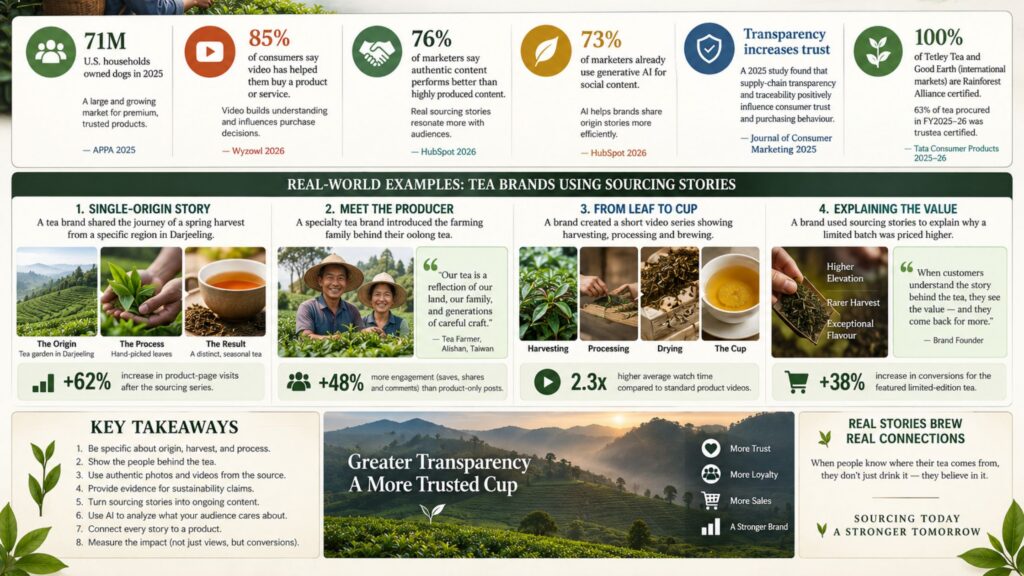
Example 1: Single-Origin Tea Story
A specialty brand introduces a new tea by showing the region where it was grown.
The content explains the harvest, producer, processing method, and what customers can expect from the cup.
The final post links directly to that batch.
Instead of launching another “new tea,” the brand launches a product with context.
Example 2: Meet the Producer
A brand creates a short Reel introducing one of its tea producers.
The video shows the growing environment and selected production stages while the caption provides verified information about the producer.
The product page then links customers back to the same sourcing story.
This creates continuity between social discovery and ecommerce.
Example 3: Why This Tea Costs More
A specialty tea has a noticeably higher price than other products.
Instead of avoiding the issue, the brand creates a carousel explaining the specific harvest, production process, sourcing arrangement, and limited availability behind that product.
Customers now have information with which to judge value.
Example 4: AI-Assisted Content Analysis
Imagine a tea brand reviews three months of sourcing content and discovers:
Tea garden videos: highest reach.
Producer stories: highest saves.
Processing explainers: highest engagement.
Sustainability posts: highest website clicks.
Batch-specific sourcing stories: highest product-page conversions.
The business can use AI-assisted analysis to identify those patterns and create more content associated with meaningful customer behaviour.
This is more useful than assuming the most-viewed post automatically creates the most trust or revenue.
Why Instagram Works for Specialty Tea Sourcing Stories
Instagram combines imagery, short-form video, carousels, captions, social search, and shopping-oriented discovery.
HubSpot’s 2026 State of Marketing found that Instagram is now used by 70% of brands, slightly ahead of Facebook. Forty-eight percent of marketers also rank Instagram among their top three platforms for ROI.
Short-form video is particularly important, with 48.6% of marketers identifying it among the highest-ROI formats.
But tea brands should not interpret that as a reason to produce generic Reels.
The stronger opportunity is human, origin-specific content.
HubSpot found that 76% of marketers say authentic content performs better than highly produced content.
A real tea garden filmed on a phone can therefore be more useful than an elaborate studio advertisement if it gives customers information they genuinely care about.
Turn One Sourcing Trip Into Multiple Content Assets
A single producer visit or sourcing trip can generate months of content.
Capture:
- Tea garden overview
- Producer introduction
- Harvesting footage
- Processing demonstration
- Tea leaves before and after processing
- Tasting session
- Quality-selection process
- Producer interview
- Sustainability practices
- Finished tea brewing
The brand can turn these assets into Reels, carousels, Stories, blog posts, emails, product-page content, and educational posts.
AI can help organize and repurpose the material.
However, the source material should remain real.
This balance matters in an environment flooded with AI-assisted content. HubSpot reports that 71% of marketers say AI helps them produce significantly more content, while its research simultaneously emphasizes the importance of authentic differentiation.
For specialty tea brands, the sourcing story itself can provide that differentiation.
Businesses looking to turn authentic behind-the-scenes stories into a repeatable social media strategy can explore Socinova and internally connect this article to relevant social media marketing, content creation, video marketing, or Instagram marketing services.
Measure Whether Sourcing Content Actually Builds Trust
Trust is harder to measure than views, but there are useful signals.
Monitor:
- Saves
- Shares
- Meaningful comments
- Profile visits
- Product-page visits
- Email sign-ups
- Repeat purchases
- Direct messages
- Conversion rate
- Customer questions about origin
Also compare sourcing content with ordinary promotional posts.
For example:
Product photo → product-page conversion
versus
Producer story → product-page conversion
If sourcing stories consistently generate more saves, deeper website sessions, repeat visits, or conversions, they are contributing commercially.
HubSpot recommends viewing social ROI broadly, including brand awareness, loyalty, customer satisfaction, reputation, and direct revenue rather than relying on one engagement metric.
For specialty tea brands, that broader view is especially useful because trust may influence multiple purchases over time.
Conclusion: Can Sourcing Stories Really Increase Trust for Specialty Tea Brands?
Yes. Sourcing story posts can increase trust when they provide specific, accurate, and useful information about where tea comes from and how it reaches the customer.
The strongest sourcing content identifies the origin, introduces real producers where appropriate, explains processing, provides evidence behind sustainability claims, clarifies what makes individual batches distinctive, and connects those details to the customer’s cup.
Research on food supply-chain transparency supports the underlying principle: accurate transparency and traceability can strengthen consumer trust and influence purchasing behaviour.
AI can make this strategy more efficient by analyzing customer questions, organizing sourcing information, repurposing interviews, and identifying which stories drive meaningful engagement.
But AI should never replace the evidence.
In an increasingly AI-generated content environment, real sourcing stories may actually become more valuable.
A specialty tea brand does not need to tell customers:
“Trust us. We source great tea.”
It can show the garden.
Introduce the producer.
Explain the harvest.
Document the process.
And let customers understand why the tea deserves their trust before they ever take the first sip.