
A damaged violin, vintage guitar, saxophone, cello, or other musical instrument is rarely just another broken object.
It may have been played for decades, inherited from a family member, used professionally, or purchased because of its particular sound and character. Owners therefore need more than a basic promise that an instrument can be repaired. They need confidence that the restorer understands what should be repaired, what should be preserved, and how every decision could affect the instrument.
This creates an important marketing opportunity.
Can repair story posts generate inquiries for musical instrument restorers?
Yes. Repair story posts can turn individual restoration projects into evidence of expertise. Instead of simply posting a finished instrument, restorers can document what arrived in the workshop, identify the problem, explain important restoration decisions, show selected stages of the work, and reveal the final result.
The approach matches how consumers increasingly prefer to learn about services. Wyzowl’s 2026 research found that 96% of consumers have watched an explainer video to learn about a product or service, while 63% say short video is their preferred way to learn about one.
For musical instrument restorers, the goal is not simply more views. It is giving an instrument owner enough confidence to think:
“I would trust this workshop with my instrument.”
Direct Answer: Why Can Repair Stories Generate Restoration Leads?
Repair story posts generate inquiries because they combine visual proof, technical education, storytelling, and transparency.
A conventional promotional post might say:
“Professional guitar restoration available. Contact us for a quote.”
A repair story can show:
“This 40-year-old guitar arrived with a lifting bridge, worn frets, and several previous repairs. Here is how we approached the restoration.”
The second approach gives the customer a reason to keep reading or watching.
It also demonstrates expertise without relying on unsupported claims.
Video can strengthen this strategy further. Wyzowl reports that 85% of video marketers say video has helped generate leads, 83% say it has directly increased sales, and 93% say it has improved customer understanding of products or services.
A restoration story therefore has the potential to perform two jobs simultaneously: attract attention and reduce uncertainty.
Step-by-Step: How Should Musical Instrument Restorers Create Repair Story Posts?
Step 1: Start With the Instrument’s Problem
Every strong restoration story needs a clear starting point.
Show exactly what arrived at the workshop.
For example:
“This vintage acoustic guitar had not been playable for nearly ten years.”
Or:
“This violin arrived with an open seam and an old repair that needed attention.”
Then show the relevant damage.
Depending on the instrument, this could include:
- Cracks
- Open seams
- Worn frets
- Damaged bridges
- Corrosion
- Loose components
- Finish damage
- Mechanical problems
- Previous repairs
This creates the attention stage of AIDA.
The viewer understands the problem and wants to see whether it can be resolved.
Avoid exaggerating the damage. Authenticity is particularly important when the content is supposed to demonstrate specialist craftsmanship.
Step 2: Add Context to the Repair
A restoration becomes more memorable when viewers understand why the instrument matters.
Perhaps it belonged to the customer’s grandfather.
Maybe it is a musician’s main touring instrument.
Perhaps it was discovered after decades in storage.
Or it may simply be an instrument the owner loves playing.
The story does not need to become overly sentimental. One or two pieces of context can be enough.
For example:
“The owner wanted to make this guitar playable again while retaining as much of its existing character as possible.”
Now the audience understands the objective.
This differentiates restoration content from generic repair footage.
Step 3: Explain the Assessment Before Showing the Solution
Customers frequently see the result of restoration but not the decisions behind it.
That is a missed opportunity.
Show the initial assessment and explain what needs attention.
For example:
“The bridge was lifting, but replacing it immediately wasn’t our first step. We first assessed the surrounding top and previous repair work.”
This demonstrates diagnostic thinking.
The distinction matters because customers with valuable instruments are often concerned about unnecessary intervention.
Repair stories can communicate that the restorer evaluates the instrument before choosing a treatment.
That builds interest and credibility.
Step 4: Show the Most Important Restoration Stages
Do not attempt to document every minute of a multi-day restoration.
Select the moments that help customers understand the skill involved.
A guitar restoration story might show:
Assessment → disassembly → structural repair → fret work → setup → testing
A violin story might show:
Inspection → seam assessment → repair → bridge/setup work → final inspection
A brass or woodwind project could focus on its own relevant sequence.
Macro footage works particularly well because viewers can see details that would normally be invisible.
This is also where short-form video becomes useful. HubSpot’s 2026 marketing data reports that 48.6% of marketers rank short-form video among their top three formats for ROI.
The important point is that the video should not merely be satisfying.
It should explain what the viewer is seeing.
Step 5: Explain One Restoration Decision
One of the strongest ways to establish expertise is explaining why something was done.
For example:
Why was a component repaired instead of replaced?
Why was a previous repair removed?
Why was cosmetic wear preserved?
Why did the instrument need additional setup after structural work?
These explanations turn repair content into educational content.
They also give potential customers a better understanding of what professional restoration involves.
Avoid making broad claims that apply to every instrument. Restoration decisions should be presented as specific to the instrument being shown.
This makes the content more credible.
Step 6: Make the Transformation Easy to Compare
Before-and-after imagery is valuable, but consistency makes it more convincing.
Try to photograph or film the instrument from the same angle, distance, and lighting conditions.
For cosmetic work, viewers can compare the visible condition.
For functional repairs, show the relevant result.
Examples include:
- Repaired crack
- Corrected alignment
- Restored hardware
- Improved playability
- Reassembled mechanism
- Final setup
Where appropriate, a short clip of the instrument being played can provide a satisfying conclusion.
The transformation becomes evidence rather than a claim.
Video quality matters here. Wyzowl’s 2026 survey found that 89% of consumers say video quality affects their trust in a brand.
That does not require cinematic production. Stable footage, good lighting, accurate focus, and a clean workshop environment can significantly improve presentation.
Step 7: Build Posts Around Specific Repair Questions
Generic restoration content may attract enthusiasts.
Specific questions can attract potential customers.
Instead of:
“Another guitar restoration completed.”
Create content around:
“Can a guitar with a lifting bridge be repaired?”
“Can an old violin crack be restored?”
“Should worn vintage guitar frets always be replaced?”
“Can a saxophone that has been stored for years become playable again?”
These questions closely resemble what prospective customers may search or ask before contacting a restorer.
Each project can therefore become a highly specific piece of educational content.
This approach also gives the business a growing library of answers to customer objections.
Step 8: Use AI to Find High-Intent Repair Topics
AI can make the content strategy more systematic.
A musical instrument restoration business can analyze:
- Instagram comments
- Direct messages
- Website inquiries
- Search terms
- Consultation questions
- Reel performance
- Saved posts
- Quote requests
AI can group recurring questions into themes.
For example, suppose a guitar restorer repeatedly receives questions about:
neck resets, bridge repairs, cracks, fret replacement, and vintage instrument setups.
Those topics should become dedicated repair stories.
AI adoption in marketing is already significant. McKinsey reported that 71% of surveyed organizations were regularly using generative AI in at least one business function in 2025, with marketing and sales among the most common areas of use.
By 2026, McKinsey reported that nearly 60% of marketers surveyed were using AI multiple times per week, although fewer than 10% had begun capturing value across complete end-to-end workflows.
For restorers, AI can help organize ideas, analyze questions, draft captions, repurpose project notes, and identify content patterns.
It should not invent restoration details.
The actual instrument, diagnosis, craftsmanship, and outcome should remain authentic.
Step 9: Connect Each Story to a Specific Inquiry
Do not finish every restoration story with:
“Contact us today.”
Use a CTA that matches the repair.
After a vintage guitar restoration:
“Have an older guitar that hasn’t been playable in years? Send us photos and details about its condition.”
After a violin repair:
“Not sure whether your violin can be restored? Ask us about an assessment.”
After a saxophone restoration:
“Have a saxophone that’s been sitting unused? Contact us to discuss its condition and restoration options.”
The viewer has just watched a similar problem being solved.
The CTA connects that proof to their own instrument.
That is the action stage of AIDA.
Supporting Data and Real-World Examples
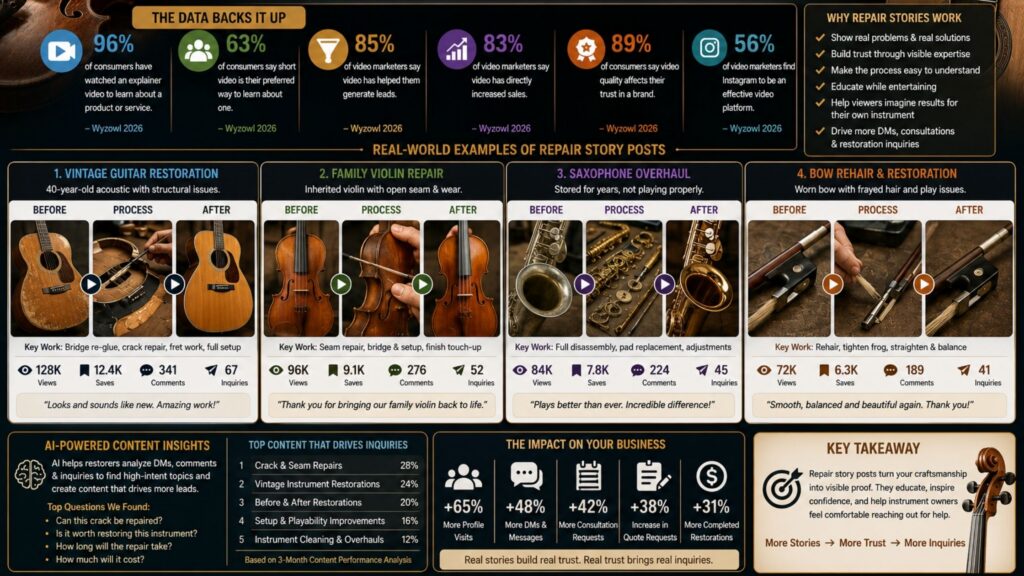
Example 1: Vintage Guitar Restoration
A vintage acoustic guitar arrives with structural problems and years of wear.
The first post introduces the instrument and explains the owner’s goal.
A second video shows selected repair stages.
The final post presents the restored instrument and a short playing demonstration.
Instead of one before-and-after image, the workshop has created a complete restoration narrative.
A potential customer with a similarly damaged guitar can now see relevant evidence before making contact.
Example 2: Family Violin Repair
A violin inherited from a family member has not been played for years.
The restoration story explains what the workshop discovered during assessment and which areas required attention.
The final video shows the completed instrument.
The story combines technical expertise with the reason preservation mattered to the owner.
This can be particularly effective for customers worried about handing sentimental instruments to an unfamiliar business.
Example 3: Correcting Previous Repair Work
An instrument arrives after an earlier repair has created additional problems.
The restorer explains what was discovered without criticizing another business unnecessarily.
The content focuses on:
Problem → assessment → corrective approach → final outcome
This demonstrates diagnostic ability and provides useful education.
Example 4: AI-Assisted Content Selection
Imagine a workshop analyzes three months of social content and discovers:
- Cosmetic restorations generate the most views.
- Vintage guitar repairs generate the most saves.
- Crack-repair posts receive the most direct messages.
- Before-and-after playing clips produce the most assessment inquiries.
The business can now prioritize content according to commercial intent.
This is more useful than assuming the post with the largest view count is automatically the best-performing content.
Wyzowl reports that while 67% of video marketers measure ROI using views, 52% also measure leads or clicks and 32% connect video performance to bottom-line sales.
For specialist restorers, inquiries and completed restoration projects should ultimately matter more than views alone.
Turn Repair Stories Into a Repeatable Content System
One restoration project can create several posts.
A restorer could publish:
- What Arrived at the Workshop
- What We Found During Inspection
- How We Approached the Repair
- One Important Restoration Decision
- Before and After
- The Instrument Plays Again
This reduces the need to constantly invent new content.
The same strategy can become recurring series such as Repair of the Week, Inside the Workshop, Can This Instrument Be Saved?, Restorer Explains, or Before It Plays Again.
Businesses that need a broader strategy for turning specialist work into consistent social content can explore Socinova and internally connect this article to relevant social media management, content creation, or video marketing service pages.
Why Short-Form Repair Stories Are Especially Useful
Musical instrument restoration is highly visual but technically complicated.
Short-form content bridges that gap.
HubSpot reports that short-form video is the top-performing format on Instagram for 61.82% of surveyed marketers in its 2026 social data.
Wyzowl also found that 84% of consumers want to see more video from brands in 2026, while Instagram was considered an effective video platform by 56% of surveyed video marketers.
That makes Instagram Reels particularly useful for discovery.
However, restorers should connect social discovery with deeper proof. A Reel can lead to a detailed project page, gallery, FAQ, assessment form, or relevant blog article.
The journey might look like:
Repair story → profile visit → restoration portfolio → service page → assessment inquiry
Each step reduces uncertainty.
Conclusion: Can Repair Story Posts Really Generate Restoration Inquiries?
Yes. Repair story posts can generate inquiries for musical instrument restorers when they do more than show impressive before-and-after photographs.
The strongest stories reveal the instrument’s initial problem, explain the assessment, document meaningful restoration stages, clarify important decisions, and demonstrate the final outcome.
Video marketing data supports the broader strategy. Consumers actively use video to understand services, marketers report strong lead-generation results from video, and short-form formats continue to deliver high ROI.
AI can make the system more efficient by helping restorers identify recurring customer questions, analyze content performance, repurpose project information, and prioritize topics associated with inquiries. McKinsey’s 2026 research suggests AI-enabled marketing can create substantial productivity improvements when it is integrated into workflows rather than used only for isolated tasks.
But AI should support the story, not become the story.
The most persuasive asset remains genuine restoration expertise.
A customer considering whether to hand over a vintage guitar, inherited violin, or valued saxophone wants evidence that the instrument will be understood and handled carefully.
A repair story provides that evidence before the first conversation begins.
Instead of simply saying “we restore musical instruments,” the restorer shows potential customers exactly what that expertise looks like.
And that visible proof can turn a curious viewer into a qualified restoration inquiry.