
Custom jewelry is a highly visual service, but much of its real value is hidden from customers.
A prospective client may see a finished engagement ring, pendant, bracelet, or heirloom redesign on Instagram without understanding the consultation, sketching, stone selection, metalwork, setting, polishing, and craftsmanship required to create it.
Workshop videos change that.
So, can workshop videos increase bookings for custom jewelry studios?
Yes. Workshop videos can help custom jewelry studios generate consultations by making craftsmanship visible, explaining the bespoke process, reducing uncertainty about commissioning a piece, and giving potential clients evidence that the studio can turn an idea into finished jewelry.
There is even fresh evidence from the jewelry industry itself. Vogue reported in September 2026 that British jeweler Sophie Whitelaw’s behind-the-scenes, educational, and jewelry-making videos helped turn social media into a major client acquisition channel. TikTok now drives 45% of her new inquiries, while social media overall accounts for 75% of her business.
Broader video benchmarks reinforce the opportunity. Wyzowl’s 2026 research found that 85% of video marketers say video generates leads, 83% say it has directly increased sales, and 93% say it improves customer understanding.
For custom jewelers, the workshop itself can therefore become one of the strongest marketing assets available.
Direct Answer: Why Can Workshop Videos Increase Jewelry Bookings?
Workshop videos can increase bookings because they show prospective clients exactly what makes custom jewelry different from buying a ready-made piece.
A finished product photo communicates:
“We make beautiful jewelry.”
A workshop video can communicate:
“Here is how your idea becomes a one-of-a-kind piece.”
That distinction is important when customers are considering expensive, sentimental purchases such as engagement rings, anniversary jewelry, wedding bands, memorial pieces, or heirloom redesigns.
Video is particularly well suited to this journey. Wyzowl reports that 96% of consumers have watched an explainer video to learn about a product or service, 85% have been convinced to purchase after watching video, and 89% say video quality affects their trust in a brand.
The opportunity is not simply to film someone working at a jeweler’s bench.
The video should intentionally answer the questions that stop prospective clients from booking.
Step 1: Start With the Client’s Idea
The strongest workshop videos begin before fabrication.
Show where the piece originated.
For example:
“A client came to us with an inherited diamond and wanted to turn it into an engagement ring.”
Or:
“This pendant started as a simple sketch inspired by a family symbol.”
The opening gives the workshop footage a purpose.
Viewers are no longer watching random metalwork. They are following a transformation.
This is especially effective for custom jewelry because prospective clients often arrive with an idea rather than an exact product.
Showing how other ideas developed gives them confidence to begin their own consultation.
Step 2: Show the Design Process
Potential clients may assume they need to know exactly what they want before approaching a custom jeweler.
Workshop content can remove that misconception.
Show parts of the design process such as:
- Initial consultation notes
- Hand sketches
- Design variations
- Stone selection
- Material discussions
- CAD previews where relevant
- Proportion decisions
- Final design approval
A Reel could open with:
“How does a custom engagement ring go from idea to finished piece?”
Then show the progression.
This turns the video into an explainer as well as a portfolio piece.
That matters because 93% of video marketers surveyed by Wyzowl say video has helped customers better understand their products or services.
For bespoke jewelry, understanding the process can make booking feel less intimidating.
Step 3: Make the Handcraftsmanship Visible
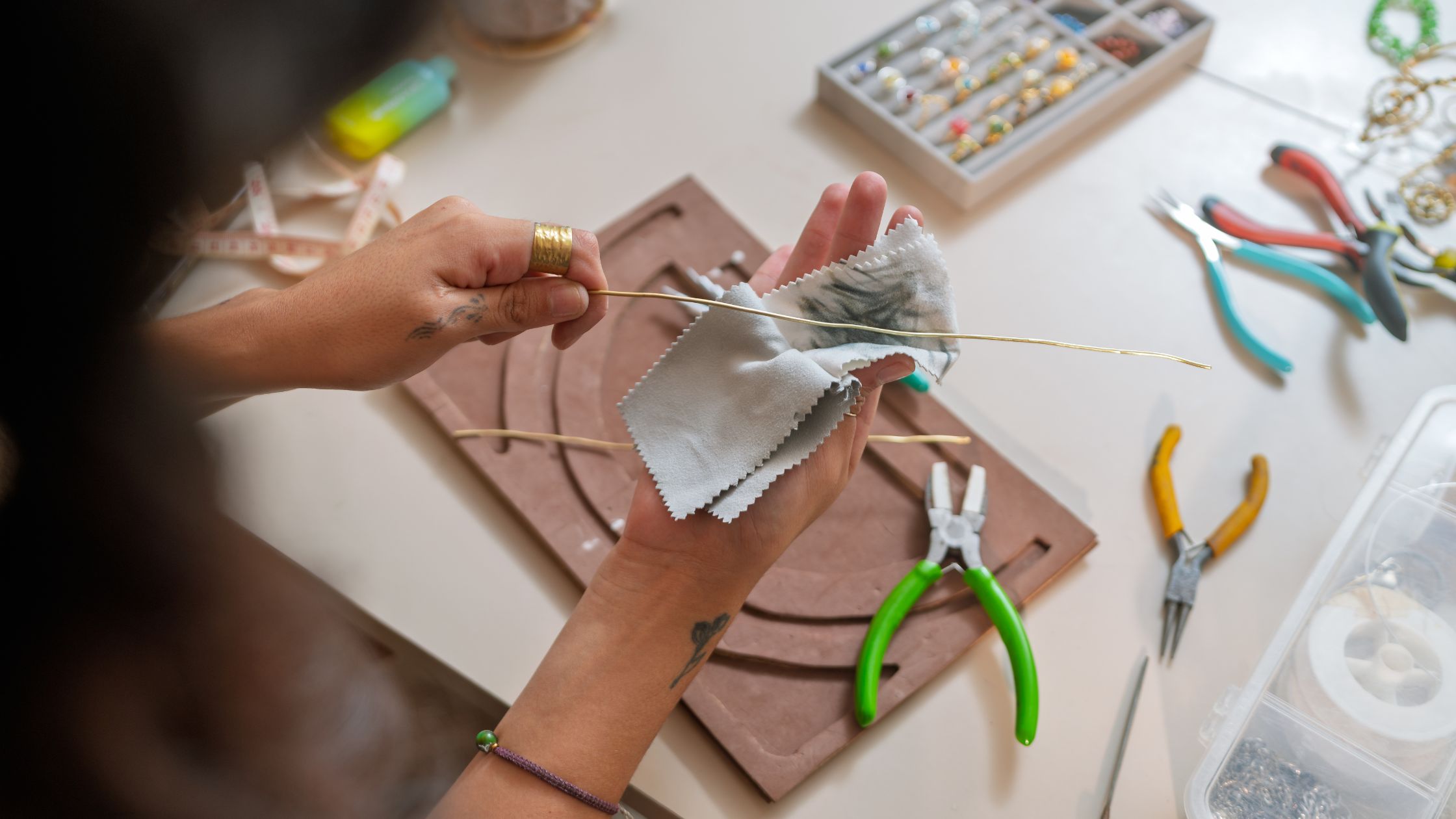
Custom jewelry studios have something particularly valuable in an AI-saturated content environment: real human craftsmanship.
Film genuine workshop moments.
Show:
Sawing metal
Forming components
Soldering
Stone setting
Filing
Engraving
Polishing
Inspection
Final finishing
Macro footage works especially well because jewelry-making involves tiny, precise movements that customers rarely get to see.
The contrast with increasingly automated marketing is useful. HubSpot’s 2026 State of Marketing reports that 80% of marketers now use AI for content creation and 75% use AI for media production, while its research emphasizes that human-led marketing remains important for building trust.
A real jeweler working on a real commission provides exactly that human element.
Step 4: Explain One Technical Decision
Do not make every workshop video purely visual.
Explain one decision that demonstrates expertise.
For example:
Why was this setting selected?
Why did the jeweler recommend one metal over another?
Why was an inherited stone reset instead of replaced?
How was the design adapted for everyday wear?
Why did the proportions change during development?
Keep explanations specific to the actual project.
A Reel might say:
“The client wanted to preserve her grandmother’s diamond, so we designed the new setting around the existing stone rather than sourcing a replacement.”
That sentence communicates personalization, problem-solving, and craftsmanship simultaneously.
It also differentiates custom work from choosing an item from a catalogue.
Step 5: Use Before-and-After Videos for Heirloom Redesigns
Heirloom transformations can be especially effective because the starting point and final result create immediate contrast.
Show:
Original jewelry → assessment → design → workshop → redesigned piece
For example:
“This unworn family ring became a pendant the client could wear every day.”
This type of content speaks directly to people who already own jewelry they do not wear.
Instead of promoting:
“We offer jewelry redesign.”
The video demonstrates what redesign actually means.
That can create inquiries from an entirely different audience than new engagement-ring content.
Step 6: Turn Engagement Ring Commissions Into Mini Case Studies
Custom engagement rings deserve more than a final photograph.
Document the journey.
A practical Reel structure could be:
0–3 seconds: The client’s idea
3–8 seconds: Sketch or design
8–15 seconds: Stone selection
15–25 seconds: Workshop fabrication
25–35 seconds: Stone setting
35–42 seconds: Polishing
42–50 seconds: Final ring reveal
50–55 seconds: Consultation CTA
The final message could say:
“Have an engagement ring idea you can’t find in stores? Book a custom design consultation.”
This converts the Reel from portfolio content into lead-generation content.
Short-form video currently offers strong marketing returns. HubSpot’s 2026 survey found that 48.6% of marketers ranked short-form video among their highest-ROI formats, compared with 28.6% for long-form video and 22.3% for blog posts.
Step 7: Show the Person Behind the Bench
Custom jewelry is personal.
The marketing should be too.
Feature the jeweler occasionally.
Let them explain:
Why they chose jewelry making
How they approach custom commissions
What they look for during stone selection
How they handle sentimental pieces
What makes a particular commission technically interesting
This builds familiarity before the consultation.
The strategy has current real-world support. Vogue’s 2026 profile of Sophie Whitelaw notes that candid, educational, behind-the-scenes jewelry videos helped demystify the industry and build audience trust. Her business now receives roughly 25 inquiries per week and completes as many as 12 bespoke commissions per month.
For an independent studio, that illustrates how process transparency can support high-value client acquisition.
Step 8: Answer Questions That Prevent People From Booking
Prospective custom jewelry clients often hesitate because they do not understand the process.
Create workshop videos answering specific questions:
“Do I need to bring my own stone?”
“Can you redesign inherited jewelry?”
“How does a custom engagement ring consultation work?”
“Can an old diamond be used in a new setting?”
“How long does custom jewelry take?”
“What happens after the design is approved?”
Pair the answer with relevant workshop footage.
For example:
“Can we reuse your existing gemstone? Here’s one commission where we did exactly that.”
Now the video combines an FAQ, case study, workshop demonstration, and portfolio example.
Step 9: Use AI to Identify High-Intent Workshop Topics
AI can help jewelry studios determine which content generates actual consultations rather than simply attractive engagement metrics.
Track categories such as:
Engagement ring making
Stone-setting videos
Heirloom transformations
Jewelry repairs
CAD-to-finished-piece videos
Jeweler explanation videos
Polishing videos
Behind-the-scenes workshop content
Then compare:
- Watch time
- Saves
- Shares
- Profile visits
- Website visits
- Consultation-page visits
- Direct messages
- Appointment requests
- Confirmed consultations
Suppose stone-setting videos generate the most views but heirloom transformations generate twice as many consultation-page visits.
The latter may be commercially more valuable.
AI can help categorize comments, summarize recurring questions, identify performance patterns, draft hooks, repurpose workshop footage, and organize content ideas.
McKinsey’s 2026 research found that nearly 60% of marketers use AI multiple times each week, but fewer than 10% have started capturing value across end-to-end marketing workflows. McKinsey estimates that generative AI could improve marketing-spend productivity by 5% to 15%.
The goal should therefore not be to use AI simply to produce more jewelry posts.
Use it to understand which authentic workshop stories move customers toward booking.
Step 10: Show Quality Control Before the Reveal
Do not jump immediately from production to glamour photography.
Show the final inspection.
Depending on the piece, this could include:
Checking stone security
Inspecting finishing
Examining symmetry
Final polishing
Cleaning
Checking details under magnification
These moments communicate care.
They can be particularly reassuring for customers considering high-value or sentimental commissions.
Then transition into the finished reveal.
Show the jewelry under clear lighting from several angles so viewers can appreciate the details they just watched being created.
Step 11: Use a Consultation-Specific CTA
“Shop now” is often the wrong CTA for custom work.
The next step is usually a conversation.
Use:
“Have a ring idea? Book a custom design consultation.”
“Have inherited jewelry sitting unworn? Ask about an heirloom redesign consultation.”
“Looking for a one-of-a-kind engagement ring? Start your custom design appointment.”
This CTA matches the buying journey.
The customer is not necessarily ready to purchase a finished piece.
They are ready to discuss what could be created.
Supporting Data and Real-World Examples
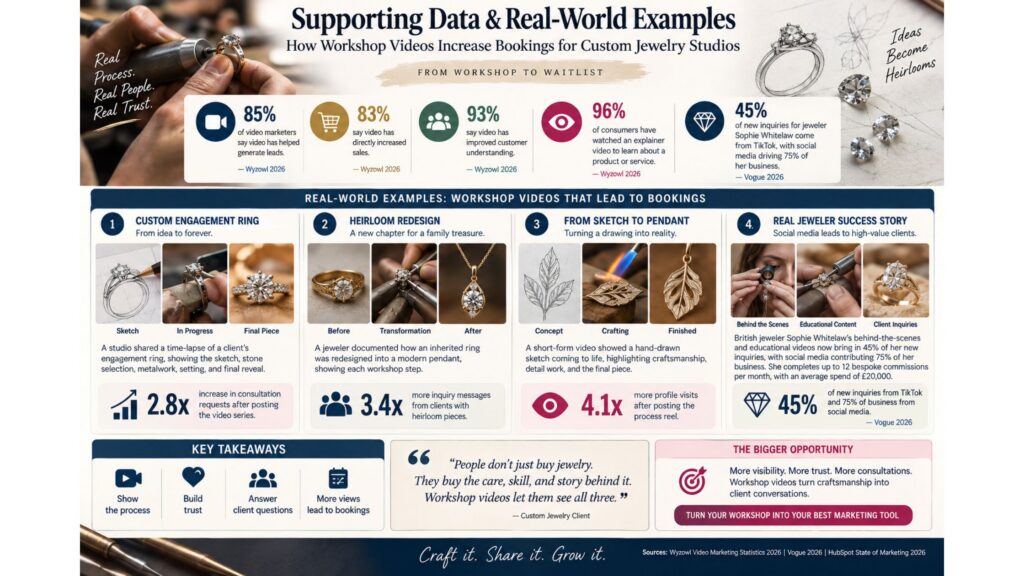
Example 1: Custom Engagement Ring
A studio begins with the client’s inspiration and shows sketching, stone selection, fabrication, setting, polishing, and the completed ring.
The final CTA invites viewers planning an engagement to schedule a design consultation.
The Reel demonstrates both artistic style and the complete service.
Example 2: Heirloom Redesign
A client brings in an older ring containing a sentimental gemstone.
The workshop video shows the original piece, stone removal, new design, fabrication, resetting, and final reveal.
Instead of simply advertising heirloom redesign services, the studio provides visible evidence of what is possible.
Example 3: From Sketch to Pendant
The Reel begins with a hand-drawn idea.
The design progresses through workshop stages until the final pendant is shown beside the original sketch.
This format is particularly effective because it demonstrates the studio’s ability to translate an abstract idea into a physical object.
Example 4: Real Jewelry Industry Evidence
A particularly relevant 2026 example comes from jeweler Sophie Whitelaw. According to Vogue, her behind-the-scenes, educational, and process-oriented social content now generates 45% of new inquiries through TikTok, while social media contributes 75% of her overall business. The average spend on one of her bespoke rings is approximately £20,000.
That does not mean every studio should expect the same results. It does demonstrate that process-led social content can influence real inquiries even for high-value bespoke jewelry.
Turn One Commission Into Multiple Content Assets
A single custom jewelry commission can create an entire content series:
- Client brief
- Initial sketch
- Stone selection
- Design development
- Workshop preparation
- Fabrication
- Stone setting
- Polishing
- Final inspection
- Finished reveal
- Full transformation Reel
- Client story
This makes workshop filming efficient.
Wyzowl reports that 63% of video marketers now use AI video tools to help create or edit marketing videos, up from 51% the previous year.
AI can help turn one authentic commission into different hooks, captions, short edits, FAQs, blog material, and platform-specific content without inventing the underlying story.
Businesses that need a repeatable strategy for transforming behind-the-scenes expertise into social content can explore Socinova and internally connect this article to relevant social media marketing, content creation, Instagram marketing, and video marketing services.
Measure Consultations, Not Just Views
A satisfying stone-setting video could generate thousands of views from jewelry enthusiasts who will never become clients.
That reach can still be useful, but studios should measure deeper actions.
Follow the journey:
Video view → profile visit → website visit → custom jewelry page → consultation request → booked appointment → commission
Wyzowl’s 2026 benchmark shows why this distinction matters. While 67% of video marketers use views to measure ROI and 63% use engagement, 52% measure leads or clicks and 32% measure bottom-line sales.
For custom jewelry studios, the most useful metric may ultimately be:
How many qualified consultation bookings did the content influence?
Track that by content category.
If heirloom videos consistently generate consultations, produce more heirloom stories.
If engagement-ring workshop videos generate higher-value inquiries, build a recurring series around them.
Conclusion: Can Workshop Videos Really Increase Custom Jewelry Bookings?
Yes. Workshop videos can increase bookings for custom jewelry studios because they reveal the expertise customers are actually paying for.
The strongest videos do not merely show beautiful finished jewelry. They document the idea, design decisions, materials, craftsmanship, precision work, quality control, and final transformation.
That process helps potential clients understand what makes a custom commission different from purchasing ready-made jewelry.
The wider marketing evidence is strong. Wyzowl reports that 85% of video marketers say video has generated leads and 83% say it has directly increased sales, while HubSpot ranks short-form video as the highest-ROI content format in 2026.
More importantly, current jewelry-industry evidence shows that the strategy can translate into genuine high-value inquiries. Behind-the-scenes and educational jewelry videos are already helping independent jewelers turn social audiences into bespoke commissions.
AI can make the strategy more efficient by identifying customer questions, analyzing performance, repurposing footage, and improving content workflows.
But the most valuable element cannot be artificially generated.
It is the sight of a real craftsperson turning an idea, stone, sketch, or family heirloom into something a customer may keep for decades.
Instead of simply telling prospective clients:
“We create custom jewelry.”
Show them how it is created.
Then give them a clear invitation to start their own piece.