
A finished mural can demonstrate artistic talent, but it hides much of the work that made the final piece possible.
Potential clients do not see the blank wall, initial layout, scale decisions, colour development, layering, detailed painting, corrections, or hours of work behind the finished mural. A time-lapse video compresses that entire process into a short piece of content.
So, how do time-lapse videos attract clients for mural artists?
They attract clients by turning the creation process into visual proof of expertise. A prospective restaurant owner, school administrator, property developer, retailer, or homeowner can watch an empty wall transform into a finished artwork and understand what the artist can accomplish in a real space.
The wider video marketing data supports this approach. Wyzowl’s 2026 research found that 85% of video marketers say video has helped generate leads, 83% say it has directly increased sales, and 93% say it has increased brand awareness.
It also found that 63% of consumers prefer a short video when learning about a product or service.
For mural artists, time-lapse content can therefore function as more than entertainment. It can become a portfolio, process demonstration, and lead-generation asset in one.
Direct Answer: Why Do Mural Time-Lapse Videos Attract Clients?
Time-lapse videos help mural artists attract clients because they make scale, technique, professionalism, creativity, and final results visible within seconds.
A static photo tells viewers:
“This is what I painted.”
A time-lapse tells them:
“This was the space, this is how I approached it, and this is what I transformed it into.”
That distinction matters when someone is considering spending money on custom artwork.
Video is already one of the strongest-performing marketing formats. HubSpot’s 2026 State of Marketing found that 48.6% of marketers rank short-form video among their highest-ROI media formats, ahead of long-form video, live streaming, user-generated content, and blog posts.
Mural artists have an additional advantage: the service naturally produces highly visual before-and-after content.
The challenge is capturing it strategically.
Step 1: Begin With the Blank Wall
Every strong mural transformation needs a clear starting point.
Film several seconds of the wall before painting begins.
Show enough surrounding context for viewers to understand the space. For commercial projects, that could include part of the restaurant, office, retail store, gym, hotel, school, or exterior building.
The first frame could say:
“Turning this blank restaurant wall into something customers will remember.”
Or:
“Watch this 20-foot wall transform.”
This immediately establishes the scale of the project and creates curiosity.
The blank wall also makes the final reveal more powerful because viewers have a visual reference point for how dramatically the space changed.
Step 2: Show the Planning Stage
Clients are not only buying painting ability.
They are hiring someone to translate an idea into a large-scale physical installation.
Include short clips showing:
Sketching the concept
Measuring the wall
Marking the composition
Preparing the surface
Testing colours
Creating the initial outline
These clips communicate professionalism.
For commercial buyers especially, this can be valuable because they need confidence that the artist has a repeatable process rather than simply improvising on their property.
A simple overlay could read:
Concept → Layout → Paint → Detail → Final Mural
That gives viewers a quick understanding of how a professional mural project develops.
Step 3: Use Time-Lapse to Make Scale Obvious
Scale is one of the biggest differentiators between mural work and smaller artwork.
Make it visible.
Place the camera far enough away that viewers can see the artist working relative to the wall.
Showing ladders, lifts, scaffolding, large brushes, or repeated movement across the surface can help viewers understand the physical size of the project.
This can be particularly useful when attracting commercial clients.
A restaurant owner looking at a 30-foot interior wall needs evidence that an artist can successfully work at that scale.
A close-up photograph of the finished artwork cannot communicate this as effectively as process footage.
Step 4: Compress Hours of Work Into a Strong Short-Form Reel
A mural may require several days to complete.
The audience does not need to watch every minute.
Time-lapse allows artists to compress hours of painting into 20 to 60 seconds.
HubSpot notes that short-form video, generally under 60 seconds and optimized for vertical viewing, remains dominant across platforms such as Instagram Reels, TikTok, and YouTube Shorts.
Wyzowl’s 2026 survey similarly found that 71% of marketers believe videos between 30 seconds and two minutes are the most effective.
A practical mural Reel could follow this structure:
0–3 seconds: Blank wall and hook
3–8 seconds: Sketch or layout
8–20 seconds: Major colours appearing
20–30 seconds: Main painting process
30–40 seconds: Details and finishing
40–50 seconds: Full mural reveal
50–55 seconds: Client-focused CTA
The objective is not to document every action. It is to preserve the moments that make the transformation easy to understand.
Step 5: Include Close-Ups of Technique
A wide time-lapse demonstrates scale.
Close-ups demonstrate craftsmanship.
Mix the time-lapse with normal-speed clips showing details such as:
Brushwork
Line work
Colour blending
Lettering
Texture
Fine details
Edge finishing
This prevents the Reel from becoming a distant recording of someone moving around a wall.
The viewer should be able to evaluate the artist’s work.
Video quality contributes to that perception. Wyzowl found that 89% of consumers say video quality affects their trust in a brand.
Artists do not need expensive cinema equipment, but footage should be stable, well lit, properly framed, and clear enough to showcase the artwork accurately.
Step 6: Explain the Business Goal Behind Commercial Murals
If the goal is attracting paying clients, do not make every Reel solely about artistic technique.
Explain why the client commissioned the mural.
For example:
“This restaurant wanted a mural that reflected the neighbourhood and created a distinctive photo spot for customers.”
Or:
“This office wanted to turn an unused wall into artwork representing its company culture.”
Or:
“This retail mural was designed around the brand’s colours and identity.”
Now the content communicates business value.
Potential commercial clients can begin imagining what a mural might accomplish in their own space.
This is more persuasive than simply describing yourself as a “commercial mural artist.”
Step 7: Create Time-Lapse Videos Around Specific Client Types
Generic mural videos may generate broad attention.
Niche-specific videos can generate more relevant inquiries.
Create separate content for different markets:
Restaurant Mural Transformation
Office Mural Time-Lapse
School Mural Project
Retail Store Mural
Gym Wall Transformation
Hotel Mural Installation
Exterior Building Mural
Residential Feature Wall
This also improves your social portfolio.
A restaurant owner visiting your profile can immediately find examples relevant to restaurants rather than scrolling through unrelated artwork.
The strategy follows a simple principle:
Show prospective clients work that resembles the work you want them to hire you for.
Step 8: Turn the Final Reveal Into the Payoff
The reveal should be treated as a separate moment.
Do not simply let the time-lapse end when the painting stops.
Cut to a clean, normal-speed shot of the completed mural.
Use:
A slow camera pan
A wide shot showing the whole space
A client or customers interacting with the environment
Close-ups of key details
A before-and-after transition
Where possible, use the same camera angle for the blank wall and finished mural.
That makes the transformation immediately understandable.
The finished footage can also be reused on the artist’s website, portfolio pages, Google Business Profile, proposals, and future advertising.
Step 9: Answer Common Client Questions Through the Video
Potential mural clients often have practical questions.
How long does a mural take?
Can you work after business hours?
Do you design the mural?
Can you match brand colours?
Can you paint outdoors?
How large can the project be?
What happens before painting begins?
Use the time-lapse to answer one question at a time.
For example:
“How long does a commercial mural take? Here’s how this project progressed over three painting days.”
Or:
“How does a mural go from concept to finished wall? Watch the entire process in 45 seconds.”
This turns visually satisfying content into useful sales content.
Wyzowl found that 96% of people have watched an explainer video to learn more about a product or service, while 93% of video marketers say video has improved customer understanding.
For mural artists, explaining the process can reduce uncertainty before an inquiry.
Step 10: Use AI to Identify Which Mural Videos Generate Leads
AI can help mural artists determine which videos attract potential customers rather than just other artists.
Track categories such as:
Restaurant murals
Residential murals
Exterior murals
Lettering projects
Brand murals
Before-and-after Reels
Full time-lapses
Technique videos
Then compare:
Views
Average watch time
Saves
Shares
Profile visits
Website clicks
Direct messages
Quote requests
Confirmed projects
AI can help categorize comments, identify repeated questions, summarize performance, create caption variations, and identify patterns across projects.
AI adoption in marketing is already substantial. HubSpot’s 2026 State of Marketing reports that 80% of marketers use AI for content creation and 75% use it for media production.
McKinsey also reports that nearly 60% of marketers use AI multiple times per week, but fewer than 10% have begun capturing value across end-to-end marketing workflows.
For an independent mural artist, the practical lesson is simple.
Do not use AI merely to generate more posts.
Use it to understand which projects and content formats are producing actual inquiries.
Step 11: Add a CTA That Matches the Project
Avoid ending every Reel with:
“DM me.”
Make the CTA relevant to the viewer.
For a restaurant mural:
“Have a blank wall in your restaurant? Send photos and dimensions to discuss a custom mural.”
For a business:
“Want to turn your brand story into a wall customers notice? Request a mural consultation.”
For residential work:
“Thinking about a custom feature wall? Send your space and project idea for availability.”
This filters inquiries.
Someone who responds already understands what information they need to provide.
Supporting Data and Real-World Examples
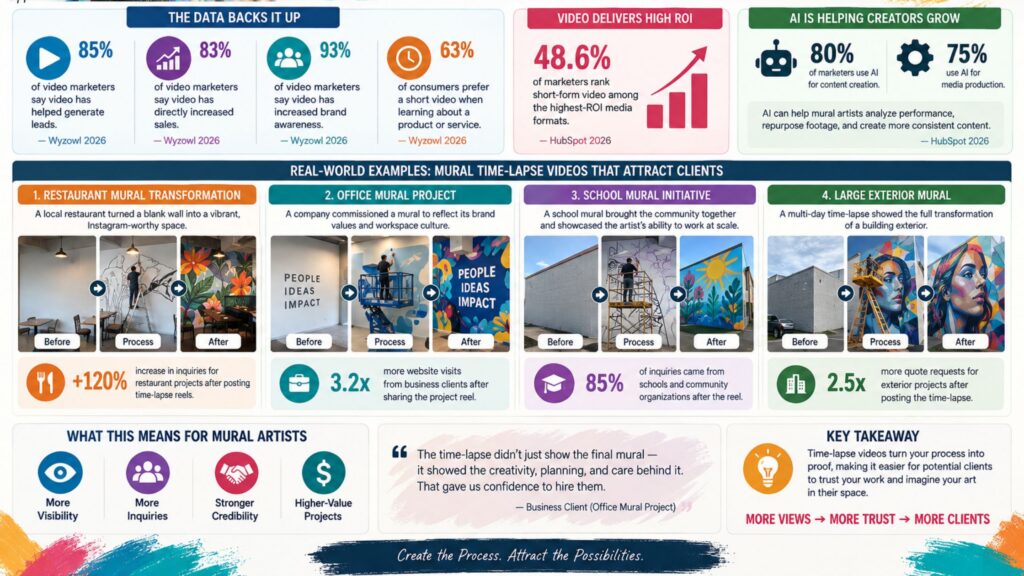
Example 1: Restaurant Wall Transformation
A mural artist films an empty restaurant wall before beginning.
The Reel progresses through the layout, base colours, detailed illustration, and final artwork.
Instead of ending at the reveal, the caption explains that the mural was designed to reflect the restaurant’s concept and create a memorable visual feature.
The CTA targets other restaurant owners.
The result is not merely portfolio content. It is a niche-specific sales asset.
Example 2: Branded Office Mural
A company commissions a mural incorporating its values, visual identity, and local references.
The artist records the process from initial wall markings through final details.
Text overlays explain selected design decisions.
Potential corporate clients can now see both creative ability and the artist’s capacity to interpret a business brief.
Example 3: Large Exterior Mural
An exterior project provides an opportunity to demonstrate scale.
The time-lapse shows equipment, wall preparation, large sections of colour, changing progress over several days, and the completed building.
This can be especially persuasive for property owners evaluating whether an artist has experience handling substantial exterior projects.
Example 4: AI-Assisted Content Analysis
Imagine a mural artist analyzes six months of content and finds:
Technique videos: highest engagement.
Large exterior murals: highest shares.
Before-and-after Reels: highest profile visits.
Restaurant mural time-lapses: highest website clicks.
Commercial mural case studies: highest quote requests.
The artist can now distinguish content that attracts attention from content that attracts clients.
That distinction matters because Wyzowl found that marketers measure video ROI in several ways: 67% use views, 63% use engagement, 52% use leads or clicks, and 32% measure bottom-line sales.
For a mural business, quote requests and booked projects should ultimately matter more than views alone.
Turn One Mural Into Multiple Marketing Assets
A single mural project can create far more than one Reel.
Capture footage throughout the project and repurpose it into:
- Blank-wall before video
- Concept explanation
- Layout time-lapse
- Painting time-lapse
- Technique close-up
- Mid-project progress Reel
- Full transformation
- Before-and-after comparison
- Finished mural showcase
- Client-focused case study
This is where AI can improve efficiency.
It can help organize footage, generate hooks, create caption variations, identify clips for different audiences, transcribe spoken explanations, and repurpose one project across several channels.
Wyzowl reports that 63% of video marketers used AI tools to help create or edit video in 2026, up from 51% the previous year.
However, the artwork itself should remain the star.
AI should make authentic project documentation easier to distribute, not replace the real creative process.
Businesses and artists looking to build a repeatable strategy around visual project content can explore Socinova and internally connect this article to relevant social media marketing, content creation, Instagram marketing, or video marketing services.
Why Time-Lapse Content Fits Mural Marketing So Well
Time-lapse content solves an unusual marketing problem for mural artists.
The most impressive part of the service can take hours or days to happen.
Video compresses that experience into seconds.
Short-form video also remains one of the strongest marketing formats available. HubSpot’s 2026 research found that 48.6% of marketers rank short-form video among their highest-ROI formats, while Wyzowl reports that 69% of video marketers create social media videos.
More importantly, mural time-lapses naturally contain several characteristics effective social content needs:
A clear beginning
Visible progress
Anticipation
Human creativity
A dramatic ending
Artists do not need to manufacture a storyline.
The project already has one.
Conclusion: Can Time-Lapse Videos Really Attract More Mural Clients?
Yes. Time-lapse videos can attract clients for mural artists because they transform the creative process into visible evidence of capability.
A strong mural Reel does not merely show paint appearing on a wall.
It shows the original space, demonstrates planning, communicates scale, reveals artistic technique, explains the client’s objective, and finishes with a transformation that prospective customers can immediately understand.
The broader marketing evidence supports investing in this format. HubSpot ranks short-form video as the highest-ROI media format in its 2026 research, while Wyzowl reports that 85% of video marketers say video has generated leads and 83% say it has directly increased sales.
AI can make the strategy more efficient by helping artists analyze performance, repurpose footage, identify customer questions, and determine which project types generate inquiries. McKinsey’s research suggests the greater opportunity comes from integrating AI into complete workflows rather than using it for isolated tasks.
But the central marketing asset remains the real transformation.
Instead of telling a prospective client:
“I can transform your wall.”
Show them a blank wall.
Show the process.
Show the finished mural.
Then give them a clear way to ask:
“Can you do this for my space?”