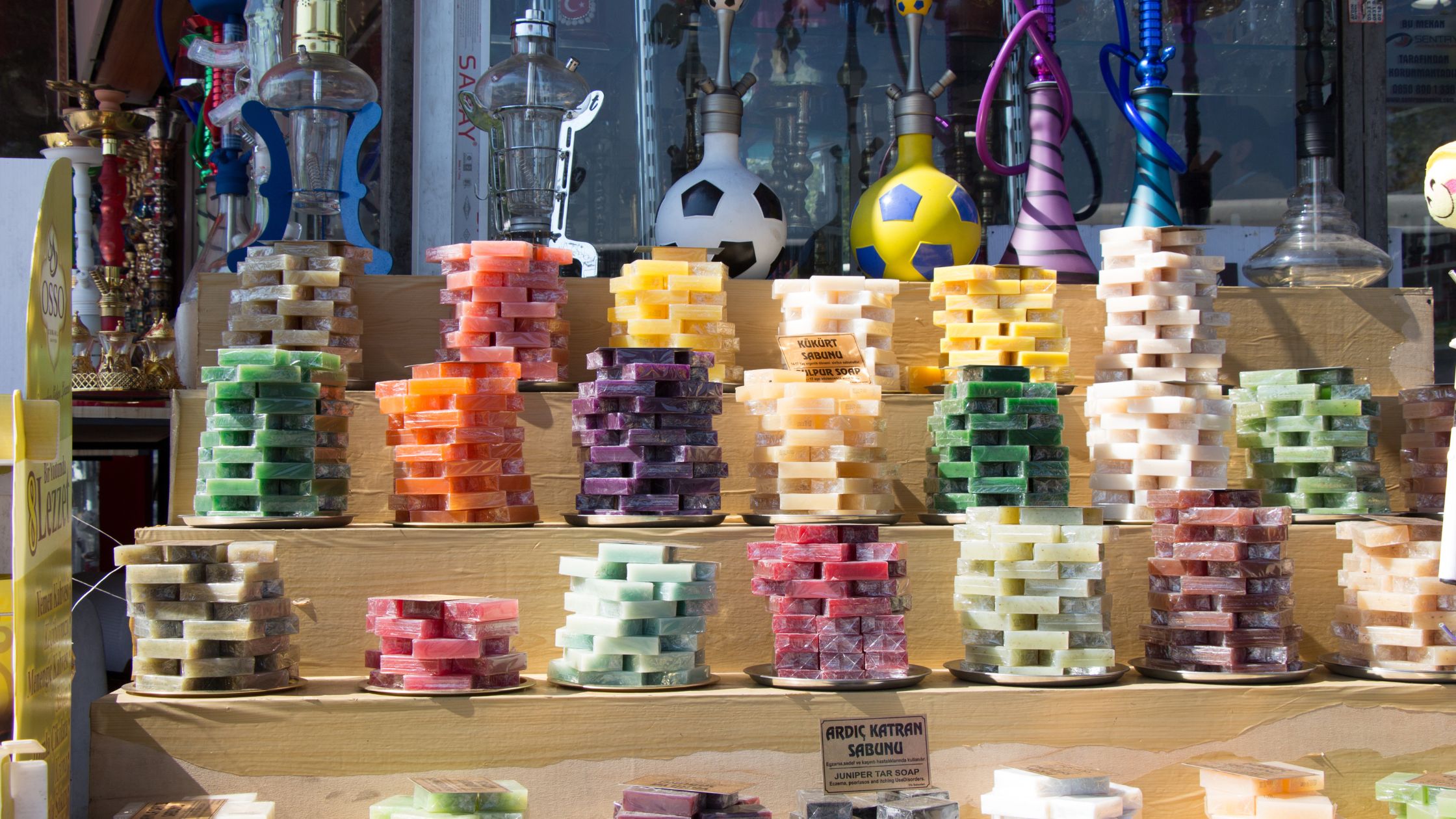

Handmade soap brands face a marketing challenge that mass-market soap companies rarely encounter.
Customers scrolling through Instagram may see dozens of attractive soap bars with botanical ingredients, textured tops, colourful swirls, natural-looking packaging, and fragrance-inspired names. A finished product photo can attract attention, but it does not always explain why one handmade bar deserves to be purchased instead of another.
Making-process videos can change that.
Instead of only presenting the finished soap, brands can show ingredients being prepared, colours being mixed, soap batter being poured, patterns being created, bars being cut, batches being cured, and orders being packed.
So, can making-process videos increase orders for handmade soap brands?
Yes. Making-process videos can increase purchase intent by turning craftsmanship, product differentiation, and small-batch production into visible proof. They help customers understand what goes into the product while creating visually engaging content that can move viewers from curiosity to product-page visits and orders.
Video marketing data supports the broader opportunity. Wyzowl’s 2026 research found that 85% of consumers have been convinced to buy a product or service after watching a video. The same research found that 96% have watched an explainer video to learn about a product or service.
For handmade soap makers, the opportunity is not simply to create satisfying videos.
It is to make the process part of the reason customers buy.
Direct Answer: Why Can Soap-Making Videos Generate Orders?
Making-process videos can help handmade soap brands increase orders by showing the craftsmanship behind each batch, explaining product differences, building confidence in the maker, and creating visually engaging product discovery content.
This is particularly relevant to handmade businesses.
Etsy’s 2025 buyer research found that 85% of buyers said shopping on Etsy means supporting small businesses, 82% said Etsy enables them to support real people, and 81% agreed that the marketplace offers items they cannot find elsewhere.
Those motivations align naturally with process content.
When customers see the person making, cutting, curing, and packing the soap, the product becomes connected to a real maker and process.
Short-form video is also commercially important. HubSpot’s 2026 State of Marketing research found that 48.6% of marketers named short-form video among their highest-ROI media formats, ahead of long-form video, live streaming, user-generated content, and blog posts.
The key is connecting entertaining production footage with information that helps customers choose and purchase a product.
Step-by-Step: How Handmade Soap Brands Can Use Process Videos to Increase Orders
Step 1: Show the Product Being Made Immediately
Do not spend the first few seconds showing a logo.
Start with movement.
For example:
Pouring soap batter into a mould
Creating a swirl pattern
Adding a textured top
Cutting a fresh loaf into bars
Removing soap from a mould
These moments create immediate visual interest.
A simple opening hook could be:
“Watch us make today’s lavender soap batch.”
Or:
“Here’s how this swirl looks inside the loaf.”
The objective is to give viewers an immediate reason to continue watching.
This approach fits current viewing preferences. Wyzowl found that 63% of consumers would most like to learn about a product or service through a short video, compared with 12% who prefer a text-based article.
For handmade products, showing is often more persuasive than describing.
Step 2: Make the Handmade Difference Visible
Simply writing “handmade” in a caption is not as persuasive as demonstrating it.
Show the maker:
- Preparing a batch
- Measuring ingredients
- Mixing colours
- Creating patterns
- Pouring the soap
- Cutting bars
- Inspecting finished pieces
- Packaging orders
The content makes small-batch production tangible.
This matters because handmade buyers may specifically value purchasing from real people and finding distinctive products. Etsy’s buyer research provides strong evidence for both motivations.
The process itself therefore becomes part of the brand positioning.
Instead of:
“Handmade soap available now.”
The video communicates:
“This is how your soap is actually made.”
Step 3: Explain What Makes Each Batch Different
A visually attractive soap-making video may generate views.
An informative video can help generate customers.
Use text overlays or voiceovers to explain relevant product details.
For example:
“This batch features a lavender-inspired scent.”
“We’re creating a limited seasonal colour pattern.”
“Each loaf is cut into individual bars after unmoulding.”
“This design creates slightly different patterns in every bar.”
Keep explanations accurate and avoid unsupported cosmetic or medical claims about ingredients.
The purpose is to help customers understand what they are buying.
Wyzowl reports that 93% of video marketers say video has helped increase customer understanding of their product or service.
For a handmade soap brand, greater product understanding can reduce the gap between seeing an attractive bar and deciding which one to order.
Step 4: Turn Soap Cutting Into Product Discovery
Soap-cutting videos are naturally suited to short-form platforms because they contain anticipation.
The outside of a loaf may reveal only part of the design.
The first cut reveals what is inside.
Use this moment strategically.
For example:
“We weren’t sure how this ocean-inspired swirl would look inside. Let’s cut it.”
The video then reveals each bar.
Finish with:
“This batch is now curing and will be available on [date].”
This creates a connection between content and inventory.
Instead of publishing a satisfying video with no commercial next step, viewers know when and where the product can be purchased.
Step 5: Build Anticipation Before Product Drops
Making-process content does not need to wait until products are ready to sell.
Use production as pre-launch marketing.
A simple sequence could be:
Day 1: Making the batch
Day 2: Cutting reveal
Day 3: Close-up of finished bars
Day 4: Packaging preparation
Launch day: Available now
The customer sees the product repeatedly before being asked to purchase.
This can be particularly useful for:
- Seasonal soaps
- Limited batches
- Gift collections
- Holiday releases
- New scents
- Special designs
The process creates a narrative around the release.
By launch day, followers already recognize the product.
Step 6: Use Process Videos to Answer Purchase Questions
Customers may have questions before ordering handmade soap.
Turn those questions into videos.
Examples include:
“Why does handmade soap need time before it’s ready?”
“Why does every bar look slightly different?”
“How do we package soap for shipping?”
“How big is each bar?”
“How do we create this swirl pattern?”
These videos combine education with product exposure.
Someone watching a question about curing or bar size is already demonstrating greater interest than someone casually watching a generic aesthetic Reel.
That makes FAQ-style process content useful deeper in the purchase journey.
Step 7: Show Packaging and Order Fulfilment
Making does not end when the soap leaves the mould.
Customers may also enjoy seeing:
Wrapping individual bars
Applying labels
Preparing gift boxes
Packing multiple-item orders
Preparing packages for dispatch
Order-packing videos provide a different type of social proof.
They show that real customers are purchasing the products.
For example:
“Pack a five-soap gift order with us.”
The viewer sees several products together while also watching a real order being prepared.
This can naturally encourage bundle purchases.
Step 8: Keep the Video Quality Consistent With the Product
Handmade brands do not need expensive studio production.
They do need clear footage.
Wyzowl’s 2026 survey found that 89% of consumers say video quality affects their trust in a brand.
Prioritize:
- Bright, consistent lighting
- Stable camera positioning
- Clean work surfaces
- Accurate product colours
- Clear close-ups
- Readable text overlays
- Uncluttered backgrounds
Do not over-edit the process.
The attraction of making-process content comes partly from seeing real production.
A polished but authentic workshop video can communicate more about craftsmanship than a heavily edited advertisement.
Step 9: Use AI to Identify Which Making Videos Drive Orders
AI can help handmade soap brands move beyond guessing which content works.
Track different process categories:
Mixing videos
Pouring videos
Swirl-making videos
Soap cutting
Packaging videos
New-batch announcements
Ingredient explanations
Then compare metrics such as:
- Watch time
- Saves
- Shares
- Profile visits
- Product-page clicks
- Add-to-carts
- Orders
Suppose cutting videos generate the most views but ingredient-focused making videos generate more product-page visits.
That distinction matters.
AI can help categorize comments, identify recurring questions, summarize content performance, generate caption variations, and identify which products are attracting the strongest buying signals.
AI adoption in marketing is already substantial. McKinsey’s 2026 research found that nearly 60% of marketers use AI multiple times per week, although fewer than 10% have begun capturing value across complete end-to-end workflows.
McKinsey also estimates that generative AI alone could improve marketing-spend productivity by 5% to 15%.
For a small handmade brand, AI does not need to replace creativity.
It can help determine which creative work deserves to be repeated.
Step 10: Connect Every High-Intent Video to the Product
One of the easiest mistakes is creating beautiful videos without giving viewers a path to purchase.
Use specific CTAs.
After a cutting video:
“The finished bars launch Friday. Join the waitlist through our bio.”
After a making video:
“This batch is available now in our online shop.”
After packing an order:
“Build your own soap bundle through the link in our bio.”
After a seasonal batch:
“Limited batch. Available while stock lasts.”
The CTA should match the content rather than feel like an unrelated advertisement.
Supporting Data and Real-World Examples
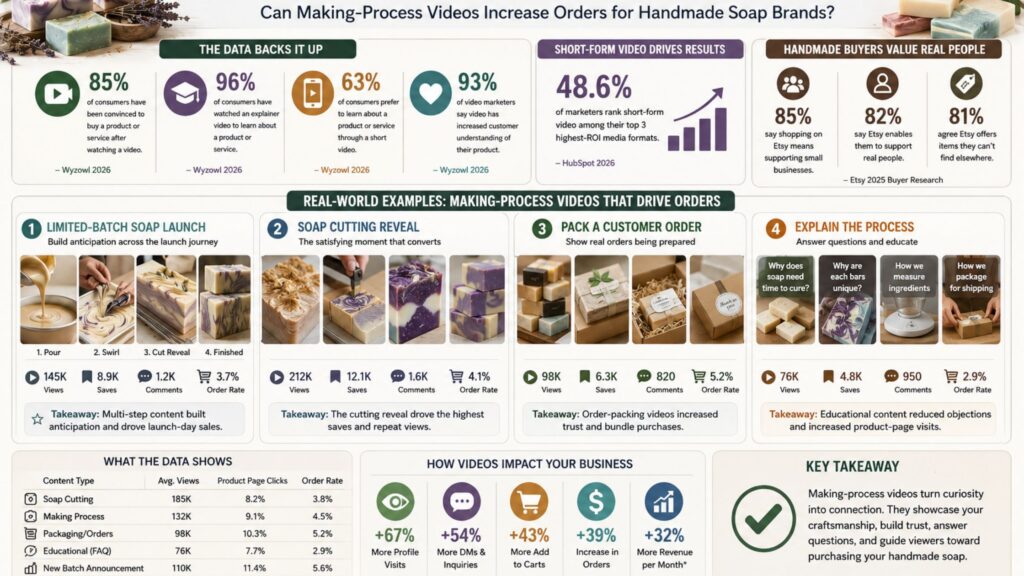
Example 1: Limited-Batch Soap Launch
A brand creates 60 bars of a seasonal soap.
Instead of waiting until launch day, it films the production.
The first Reel shows the pour.
The second reveals the pattern during cutting.
The third introduces the finished bars.
The final Reel announces availability.
The process turns one product batch into an entire mini-campaign.
Example 2: Soap Cutting Reveal
A colourful soap loaf appears on screen with the hook:
“Let’s see how the inside turned out.”
The maker cuts the first bar and reveals the pattern.
Instead of ending there, the final frame displays the product name and release date.
The satisfying moment attracts attention while the commercial information converts that attention into product awareness.
Example 3: Packing a Customer Bundle
The video starts:
“Pack a six-bar order with us.”
The maker selects different soaps, wraps them, adds the packaging, and prepares the parcel.
Each product receives natural exposure without creating a traditional advertisement.
The final CTA invites customers to create their own bundle.
Example 4: AI-Assisted Content Analysis
A soap brand analyzes three months of short-form content.
It discovers:
Cutting videos: highest views.
Making videos: highest saves.
Packaging videos: highest profile visits.
New-batch videos: highest product-page clicks.
Limited-edition videos: highest order conversion.
The brand can now use each format intentionally instead of judging success only through views.
This is important because video marketers use multiple measurements of ROI. Wyzowl reports that 67% measure views, 63% measure engagement, 52% measure leads or clicks, and 32% measure bottom-line sales.
For ecommerce soap brands, orders should ultimately be connected back to the content whenever tracking allows.
Why Short-Form Making Videos Fit Handmade Soap Marketing
Handmade soap has several characteristics that work naturally on video.
It is visual.
It involves movement.
Production creates anticipation.
Cutting reveals unexpected patterns.
Packaging provides satisfying repetition.
And each batch provides fresh content.
HubSpot’s 2026 research found that 60% of marketers use short-form video, while roughly 49% identify it as the top ROI format.
Wyzowl also found that 69% of video marketers create social media videos, making social video the most commonly produced video use case in its 2026 research.
For handmade soap brands, Instagram Reels can therefore serve as both discovery content and product education.
Turn One Soap Batch Into Multiple Content Assets
A small handmade brand does not need to film something new every day.
One production session can produce:
- Ingredient preparation clip
- Mixing Reel
- Colour or swirl Reel
- Pouring video
- Unmoulding clip
- Cutting reveal
- Finished product showcase
- Packaging video
- Launch Reel
- Customer-order packing video
AI can then help turn those assets into captions, hooks, platform variations, product descriptions, and future content ideas.
McKinsey’s latest AI marketing research argues that the largest opportunities come from connecting insights, content creation, personalization, and performance rather than treating AI as an isolated tool.
For small brands, that can start simply:
Film once → repurpose intelligently → measure orders → repeat what works.
Brands that need help building this type of repeatable social content system can explore Socinova and internally link this section to relevant social media marketing, content creation, or video marketing services.
Measure Orders, Not Just Satisfying Views
Making-process videos can easily attract people who enjoy watching soap being made but have no intention of purchasing.
That is not necessarily bad for reach.
But a business should separate entertainment metrics from commercial metrics.
Monitor the journey:
Reel view → profile visit → product-page click → add to cart → purchase
Also compare performance by product.
If one scent receives average views but consistently produces orders after process videos, it may be commercially more valuable than a highly visual soap that generates thousands of views but few purchases.
Wyzowl reports that 85% of video marketers say video has helped generate leads and 83% say it has directly increased sales.
The important question for a handmade soap brand is therefore not:
“Did people enjoy watching this?”
It is:
“Did this video help more people discover, understand, consider, or order the product?”
Conclusion: Can Making-Process Videos Really Increase Handmade Soap Orders?
Yes. Making-process videos can increase orders for handmade soap brands when they connect craftsmanship with product discovery and a clear buying opportunity.
The strongest videos do more than show attractive soap.
They reveal how a batch is created, explain meaningful product details, introduce the maker, build anticipation around releases, answer purchase questions, show real orders being packed, and direct interested viewers toward the product.
The broader data supports this approach. Short-form video remains a leading ROI format for marketers, 85% of consumers surveyed by Wyzowl say video has convinced them to purchase, and handmade marketplace research shows strong consumer interest in supporting real people and small businesses.
AI can strengthen the strategy by helping brands identify high-performing process moments, analyze customer questions, repurpose footage, and connect content performance with buying behaviour.
But the central advantage remains distinctly human.
Customers get to see that someone actually mixed, poured, cut, inspected, wrapped, and packed the product they are considering buying.
For a handmade soap brand, that process is not something to hide behind the finished product.
It is part of what makes the finished product worth ordering.