

December is a strange month for many day spas. Regular clients are busy with travel, parties, and family plans, so appointment books can thin out just as costs rise. Yet December is also when people are actively searching for something thoughtful to give.
A spa gift card fits that search well. It feels personal, it suits almost anyone, and it can be bought and delivered in minutes, even on Christmas Eve.
Demand is already there. According to the National Retail Federation, 43% of holiday shoppers planned to buy at least one gift card last season, with gift card spending expected to reach $29 billion. Gift cards ranked as the second-most popular holiday gift.
So, how can holiday gift card posts boost December revenue for day spas?
They turn existing gift-buying intent into sales by making your spa the obvious, easy choice. Well-timed posts remind followers that a gift card exists, show what it buys, remove friction from the purchase, and create a reason to act now.
The opportunity is not to post “Gift cards available!” once in mid-December. It is to run a planned sequence of posts that guides shoppers from inspiration to checkout.
Direct Answer: Why Do Gift Card Posts Lift December Revenue?
Gift card posts lift December revenue because they capture money from people who are not booking treatments for themselves that month.
A regular client might skip a December facial. Their partner, sister, or colleague may still buy them a $150 spa voucher. Gift cards let a spa sell to the gift-giver rather than waiting for the client to book.
There are three revenue effects:
- Immediate cash in December. Gift card sales arrive upfront, often during the spa’s quietest booking weeks.
- New clients in the new year. Many recipients have never visited before. Zenoti’s 2024 Beauty and Wellness Benchmark Report found that 1 in 4 spa gift cards is redeemed by a new customer.
- Additional spend at redemption. Recipients often add an upgrade, a retail product, or a second treatment when they visit.
Online sales make the difference. The same Zenoti report found online gift card sales grew 17% at non-membership spas and 33% at membership-focused spas. Social posts that link straight to an online purchase page let shoppers buy at the moment they feel inspired.
Gift card posts will not fix a weak offer or a clumsy checkout. But with a clear offer and an easy purchase path, they are one of the most direct ways a spa can turn social media attention into December revenue.
Step 1: Fix the Purchase Path Before You Post
Every gift card post depends on one thing: how easily someone can buy.
Before planning content, check the full journey on a phone:
- Can someone buy a gift card online in under two minutes?
- Is there a direct link, not just a homepage?
- Can buyers choose a delivery date, so the card arrives on Christmas morning?
- Is there a printable or emailed version for last-minute shoppers?
- Does the card show clearly what it can be used for, and any expiry terms?
If the answer to any of these is no, fix it first. A brilliant Reel that sends people to a phone number or an outdated booking widget will lose most of its potential sales.
Also check your local gift card rules. In the US, federal law generally requires gift cards to remain valid for at least five years, and some states go further. Make sure your terms are compliant and stated plainly.
Step 2: Plan a Sequence, Not a Single Post
Holiday gift buying happens in waves. Plan posts for each one rather than relying on one announcement.
A simple December sequence:
- Late November: Early-bird gift card offer, timed around Black Friday and Small Business Saturday
- Early December: Gift guides by recipient and budget
- Mid-December: Bundles and packages, plus office and corporate gifting
- Final week: Last-minute digital gift cards with instant delivery
- After Christmas: “Treat yourself” posts for people who received cash or want a reset
Each phase speaks to a different shopper mindset. Early buyers want value. Mid-month buyers want ideas. Last-minute buyers want speed.
Step 3: Sell the Experience, Not the Card
A plain image of a gift card gives shoppers little reason to choose it. The experience the card unlocks is what sells it.
Use photos and short videos of:
- Treatment rooms prepared and ready
- Relaxation lounges, robes, and tea service
- Close-ups of massage oils, facial products, and warm towels
- Short, permission-based clips of the spa atmosphere
A strong caption hook could be: “The gift that actually gets used: 90 minutes of quiet.”
Write captions around how the recipient will feel, not just the treatment name. “A morning to themselves after a hectic year” means more to a buyer than “60-minute Swedish massage.”
Step 4: Build Gift Guides by Person and Budget
Many shoppers know who they are buying for but not what to choose. Gift guides make the decision for them.
Create carousel posts such as:
- “Spa gifts for Mom”
- “Gifts for the friend who never stops”
- “Spa gifts for couples”
- “Stocking fillers under $50”
- “The ultimate pamper day”
Give each recommendation a clear price and a direct link. Budget-led guides work particularly well, because buyers often set a spending limit before choosing a gift.
This also lets you guide shoppers toward the treatments and packages you most want to fill in January.
Step 5: Create Bundles and Holiday Packages
Bundles raise the average gift card value and make the gift feel more special.
Ideas include:
- A treatment plus a retail product, such as a facial with take-home skincare
- A “winter reset” package combining two treatments
- A couples’ experience
- A gift card with a small bonus, such as a complimentary upgrade
Some spas offer a bonus card with larger purchases, for example “Buy $200, get a $25 bonus card.” If you do this, set clear terms on when the bonus can be used. Many spas restrict bonus cards to January and February, which helps fill quieter post-holiday weeks.
Make sure any promotion is profitable after redemption costs. A discount that sells well but loses money on every treatment is not a December win.
Step 6: Use Urgency Honestly
Deadlines move holiday shoppers, but only when they are real.
Helpful, honest urgency includes:
- Real shipping cut-off dates for physical cards
- “Last day for in-store pickup” reminders
- Instant digital delivery for last-minute buyers
- A genuine end date for a bonus offer
Avoid fake countdowns, invented scarcity, or “only 3 left” claims on digital gift cards. These damage trust and may breach advertising rules in some markets.
A strong last-minute post might read: “Still need a gift? Our digital gift cards arrive by email in minutes.”
Step 7: Target Corporate and Group Buyers
Businesses buy gifts for employees and clients every December, and spa gift cards are an easy fit.
Create posts and LinkedIn content aimed at:
- Office managers buying staff gifts
- Local businesses rewarding top clients
- Teams pooling money for a manager’s gift
Offer a simple bulk-purchase process, such as a form or a dedicated email address, and consider tiered pricing for larger orders.
One corporate order for 20 gift cards can match a week of individual sales.
Step 8: Plan for Redemption in January and February
December sales are only half the opportunity. The other half is turning recipients into regular clients.
Prepare for the redemption wave by:
- Making it easy to book online with a gift card
- Training staff to welcome first-time visitors warmly
- Offering a rebooking incentive at checkout
- Recommending suitable retail products without pressure
- Adding new clients to your email list, with consent
Post content in January aimed at recipients: “Got a spa gift card? Here’s how to book.” This reduces unused cards and brings people through the door during a slower period.
Step 9: Use AI to Plan Content and Track Results
AI can help a spa produce holiday content faster and see which posts actually sell.
Tag every gift card link by post or campaign, then compare:
- Link clicks
- Gift card sales and average order value
- Bundle versus single-card sales
- Corporate enquiries
- Redemption rates in January and February
- First-time clients who rebook
AI tools can draft caption variations, suggest gift guide angles, summarise last year’s sales data, and repurpose one photoshoot into many posts.
Use AI to organise genuine information and offers. Never use it to fabricate reviews, invent client stories, or create misleading promotions.
A gift card post that drives $3,000 in sales matters more than one that gets 3,000 likes.
Supporting Data and Real-World Examples
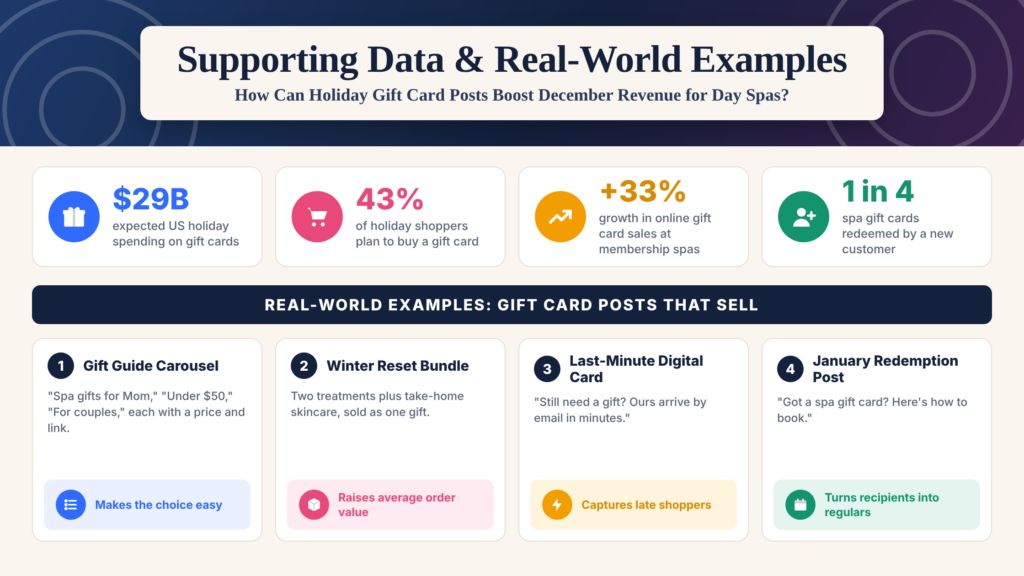
Gift cards are already one of the most popular holiday purchases, and spa gift cards fit the occasion especially well.
Key figures:
- $29 billion is the expected US holiday spending on gift cards (NRF).
- 43% of holiday shoppers planned to buy at least one gift card, making gift cards the second-most popular holiday gift (NRF).
- 17% and 33% growth in online gift card sales at non-membership and membership-focused spas respectively (Zenoti).
- 1 in 4 spa gift cards is redeemed by a new customer (Zenoti).
The new-customer figure is the most important for long-term revenue. Each holiday gift card is a chance to introduce someone to your spa who might never have booked on their own.
These figures describe the market broadly. Each spa should track its own gift card sales, redemptions, and rebookings to see what works. The examples below are illustrative scenarios.
Example 1: The Gift Guide Carousel
A spa publishes a series of carousels in early December: “Spa gifts for Mom,” “Gifts under $50,” and “For couples.” Each slide shows a treatment, a price, and a direct purchase link.
Shoppers who were unsure what to buy get a ready-made answer, and the spa steers buyers toward the treatments it wants to fill in January.
Example 2: The Winter Reset Bundle
The spa packages two treatments with take-home skincare and sells it as a single holiday gift.
The bundle raises the average gift card value, and the retail product introduces recipients to the spa’s product range.
Example 3: The Last-Minute Digital Card
In the final days before Christmas, the spa posts short Reels and Stories: “Still need a gift? Our digital gift cards arrive by email in minutes.”
These posts capture shoppers who have missed shipping deadlines and need something they can give immediately.
Example 4: The January Redemption Post
In early January, the spa posts: “Got a spa gift card? Here’s how to book.” The post explains online booking and highlights quieter appointment times.
Recipients book sooner, fewer cards go unused, and the spa can offer a rebooking incentive to turn first-time visitors into regular clients.
How to Turn One Gift Card Offer Into a Month of Posts
A single holiday photoshoot and one clear gift card offer can supply most of your December content:
- An early-bird gift card announcement
- A gift guide for each recipient type
- A budget-based gift guide
- A holiday bundle showcase
- A treatment room or relaxation lounge Reel
- A corporate gifting post for LinkedIn
- A shipping or pickup deadline reminder
- A last-minute digital gift card post
- A “treat yourself” post after Christmas
- A January “how to redeem” post
This keeps the message consistent while giving shoppers a reason to see your gift cards again at every stage of the season.
If you want a planned December campaign without adding work for your front desk, Socinova’s social media management services cover content planning, design, captions, and scheduling at a flat monthly rate.
Conclusion: Can Holiday Gift Card Posts Really Boost December Revenue for Day Spas?
Yes. Holiday gift card posts can boost December revenue by capturing gift-buying intent, raising order values through bundles, and bringing new clients through the door in the new year.
The spas that do this well do not post once and hope. They fix the purchase path first, plan a sequence across the season, sell the experience, and make the last-minute purchase effortless.
Use real photos of your spa. Keep offers clear and profitable. Use urgency only when it is genuine. Then track sales, redemptions, and rebookings, not just likes.
Make it easy to buy. Make it feel special. Make it timely. Then make every recipient want to come back.
That is how a gift card post turns December shoppers into January clients.