

A new roof is one of the biggest purchases a homeowner makes. It is expensive, it happens rarely, and a bad choice can mean leaks, insurance headaches, and thousands of dollars in repairs.
That makes homeowners cautious. Most have heard stories about contractors who took a deposit and disappeared, or crews who left nails in the driveway. Before they let anyone onto their roof, they want proof from people like them.
Customer reviews provide that proof. According to BrightLocal’s Local Consumer Review Survey 2026, 97% of consumers read reviews for local businesses, and 68% will only use a business with a rating of four stars or higher.
So, how can customer review posts win more jobs for roofing contractors?
They take the trust buried in your Google profile and put it in front of homeowners on social media, at the moment they are deciding who to call. Review posts show real results, real customers, and real reliability, which is exactly what a cautious homeowner needs to see.
The goal is not to screenshot five-star ratings and post them on repeat. It is to turn genuine customer experiences into content that answers the questions homeowners worry about most.
Direct Answer: Why Do Review Posts Win Roofing Jobs?
Review posts win roofing jobs because homeowners trust other homeowners far more than they trust a contractor’s own claims.
“Quality workmanship” and “honest pricing” appear on almost every roofing website. A customer saying “they found storm damage my insurance adjuster missed and cleaned up every nail” carries much more weight.
BrightLocal’s 2026 survey found that 49% of consumers trust online reviews about as much as personal recommendations. Review posts extend that trust beyond Google, into the social feeds where homeowners spend their time.
They also solve three specific problems roofers face:
- High-stakes decisions. Homeowners need reassurance before signing a large contract.
- Infrequent purchases. Most people have never hired a roofer before, so they rely heavily on others’ experiences.
- Trust gaps after storms. Storm-chasing contractors make homeowners wary of unfamiliar names. Reviews from local neighbours show you are established and accountable.
Review posts will not replace good workmanship or fast quotes. But when the work is good, they make sure more homeowners see it.
Step 1: Build a System for Collecting Reviews
You cannot post reviews you do not have. Make asking for them part of every job.
A simple process:
- Ask in person at the final walkthrough, when the customer is happiest
- Send a text the same day with a direct link to your Google review page
- Follow up once after a few days if they have not left one
- Ask every customer, not only the ones you expect to be positive
Recency matters. BrightLocal found that 74% of consumers only consider reviews written in the last three months. A steady flow of new reviews is worth more than a large pile of old ones.
Never offer a discount or gift in exchange for a positive review. Under the FTC’s final rule on fake reviews and testimonials, incentives tied to positive sentiment are prohibited, and the FTC can seek civil penalties from knowing violators.
Step 2: Ask Permission Before You Post
A review on Google is public, but featuring a customer by name on your social media is a different step.
Before posting:
- Ask the customer if you can share their review on your social channels
- Confirm whether they are happy to show their first name, full name, or initials
- Never show a house number or full address
- Ask separately before using photos of their home, especially if the property is identifiable
Most happy customers say yes. Asking also makes them feel valued, which often leads to referrals.
Step 3: Pair Every Review With Real Job Photos
A review on its own is good. A review alongside before-and-after photos of the actual job is far better.
Strong pairings include:
- Storm damage before, new roof after, with the customer’s quote
- Close-ups of flashing, ridge caps, or ventilation work the customer praised
- Drone shots of the finished roof
- A clean driveway and yard after cleanup, if the review mentions it
The combination shows homeowners both what the work looked like and how the customer felt about it.
Use only photos from the job the review describes. Pairing a review with a different project, or with stock images, is misleading.
Step 4: Focus on the Details Homeowners Worry About
The most persuasive reviews are specific. Look for reviews that mention the concerns homeowners raise before hiring.
Common worries include:
- Showing up on time and finishing on schedule
- Clear quotes with no surprise costs
- Help with insurance claims
- Protecting landscaping and cleaning up nails
- Communication during the job
- Fixing problems quickly if something went wrong
Pull a short quote that addresses one concern and use it as the headline of the post. For example: “They handled everything with our insurance company. We didn’t have to chase a single call.”
Organise posts so each one answers a different worry. Over time, your feed becomes a library of proof.
Step 5: Use Video Testimonials When You Can
A short video of a real homeowner standing in front of their new roof is one of the most convincing posts a roofer can share.
Keep it simple:
- 20 to 45 seconds is enough
- Film in natural light, with the roof visible behind the customer
- Ask one or two easy questions, such as “Why did you choose us?” or “How was the process?”
- Add captions, since many people watch without sound
Do not script what the customer says. Natural, slightly imperfect answers are more believable than polished lines.
Step 6: Respond Publicly, Including to Negative Reviews
How you respond to reviews is itself a trust signal.
BrightLocal’s 2026 survey found that 80% of consumers are likely to use a business that responds to all of its reviews, while 50% are put off by generic or templated replies.
For positive reviews, thank the customer and mention something specific about their job.
For negative reviews, respond calmly, acknowledge the concern, and explain how you will fix it. Then fix it.
A well-handled complaint can become a powerful post with the customer’s permission: “We had a leak after install. They were back the next morning and sorted it.” It shows homeowners what happens if something goes wrong, which is often their biggest fear.
Never try to remove or suppress honest negative reviews through threats or pressure. That is also prohibited under the FTC rule.
Step 7: Target Posts to Your Service Area
Roofing is local. A review from a homeowner in the same town carries extra weight.
Mention neighbourhoods or towns in captions where the customer is comfortable with it: “Another full replacement in Oak Ridge.” Tag the location on Instagram and Facebook.
After storms, share recent reviews from affected areas. Homeowners searching for help want to know you have already worked successfully on homes like theirs.
You can also boost your strongest review posts with a small local ad budget, targeted to homeowners in your service area.
Step 8: Use AI to Organise Reviews and Measure Results
AI can help a roofing contractor turn a growing collection of reviews into a steady content plan.
Use it to:
- Sort reviews by theme, such as insurance help, cleanup, or communication
- Pull out short, quotable lines
- Draft caption variations
- Spot recurring complaints you need to fix
Then track:
- Profile visits and website clicks from review posts
- Calls and quote requests
- Which themes generate the most enquiries
- Close rate on leads that mention seeing reviews
Use AI to organise real reviews only. Never use it to write reviews, invent testimonials, or alter what a customer said. The FTC rule explicitly covers AI-generated fake reviews.
A review post that brings three quote requests in your service area is worth more than one that gets hundreds of likes from people who will never hire you.
Supporting Data and Real-World Examples
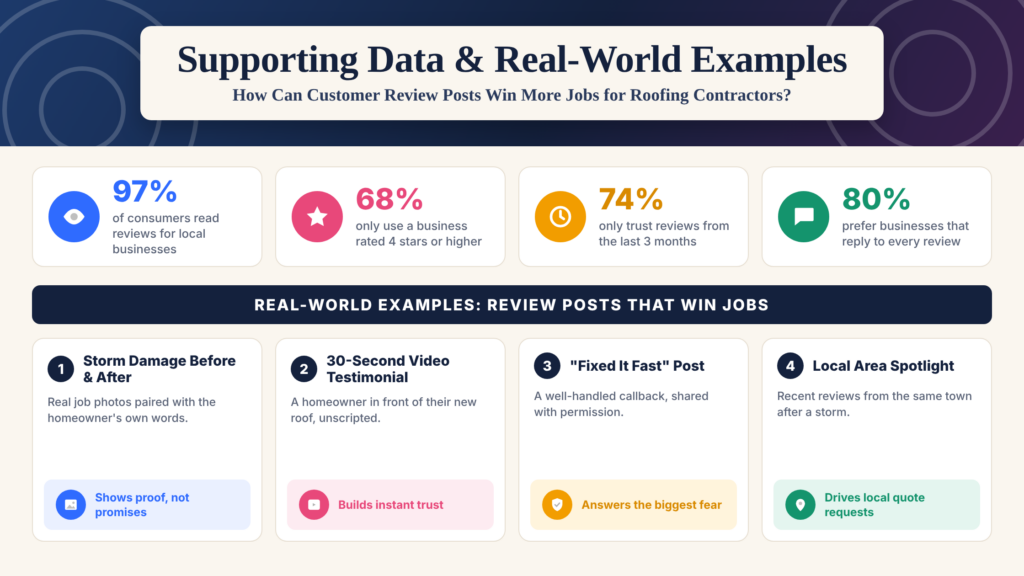
Reviews shape almost every local hiring decision, and homeowners are becoming stricter about what they will accept.
Key figures from BrightLocal’s Local Consumer Review Survey 2026:
- 97% of consumers read reviews for local businesses.
- 68% will only use a business rated four stars or higher, up from 55% the previous year.
- 74% only consider reviews written in the last three months.
- 80% are likely to use a business that responds to all of its reviews.
- 47% will not use a business with fewer than 20 reviews.
For roofers, the message is clear. Homeowners want plenty of reviews, recent reviews, and visible responses. Review posts on social media keep that proof in front of them.
These figures cover local businesses broadly, not roofing specifically. Each contractor should track their own calls, quote requests, and close rates to see what works. The examples below are illustrative scenarios.
Example 1: Storm Damage Before and After
A roofer posts a carousel showing hail damage on a customer’s roof, the tear-off, and the finished replacement. The final slide quotes the homeowner: “They documented everything for our insurance claim.”
The post shows proof of the work and addresses a common worry at the same time.
Example 2: The 30-Second Video Testimonial
A homeowner stands in front of their new roof and explains, in their own words, why they chose the contractor and how the job went.
The video feels personal and believable in a way a written review often cannot.
Example 3: The “Fixed It Fast” Post
After a minor leak appeared following an install, the roofer returned the next morning to fix it. With the customer’s permission, the roofer shares the review describing how quickly the problem was resolved.
The post answers one of homeowners’ biggest fears: what happens if something goes wrong?
Example 4: The Local Area Spotlight
After a storm, the roofer shares a series of recent reviews from homeowners in the affected town, with neighbourhood names in the captions.
Homeowners in that area see a contractor with proven, recent local work, and quote requests follow.
How to Turn One Review Into Multiple Posts
A single strong review, paired with job photos and a short video, can produce several pieces of content:
- A quote graphic with the customer’s best line
- A before-and-after carousel of the job
- A short video testimonial
- A Story with a link to your Google reviews page
- A “common question” post built around the concern the review addresses
- A local area post mentioning the town or neighbourhood
- A thank-you reply shared as a screenshot, with permission
- A monthly roundup of recent five-star reviews
This keeps your feed full of proof without asking customers for more than one review.
If you want a consistent stream of review-led content without taking time away from the job site, Socinova’s social media management services cover planning, design, captions, and scheduling at a flat monthly rate.
Conclusion: Can Customer Review Posts Really Win More Jobs for Roofing Contractors?
Yes. Customer review posts can win more roofing jobs by giving cautious homeowners the proof they need before they pick up the phone.
The most effective review content is genuine, specific, and recent. It pairs real customer words with real job photos, addresses the worries homeowners have, and shows how the contractor responds when something goes wrong.
Ask every customer for a review. Get permission before posting. Respond to every review. Keep everything honest and compliant. Then track calls and quote requests, not just likes.
Do the work well. Ask for the review. Share the proof. Answer the worries.
That is how customer review posts turn a satisfied homeowner into your next three jobs.