
Most couples planning a wedding have the same first question for every photographer they find: how much?
When the answer is “Contact us for a quote,” many of them simply move on to the next profile. They are not being difficult. They are working to a budget, comparing dozens of options, and trying to avoid an awkward conversation with someone they cannot afford.
Pricing is not a minor detail in this decision. According to The Knot Real Weddings Study, the average US couple spent $3,000 on their wedding photographer, with spending ranging from around $1,500 at the lower end to $4,700 at the upper end. That is a significant purchase, and couples want to know where a photographer sits before they reach out.
So, can price transparency posts increase bookings for wedding photographers?
Yes, when they are done well. Price transparency posts build trust, attract couples whose budgets fit, and give enquiries a head start because the money question has already been answered.
The goal is not to turn an Instagram feed into a price list. It is to explain what couples are paying for, why it costs what it does, and what they can expect, so the right couples feel confident enough to get in touch.
Direct Answer: Why Does Price Transparency Increase Bookings?
Price transparency increases bookings because it removes the biggest point of friction between a couple liking your work and actually contacting you.
Couples tend to treat hidden pricing in one of two ways. Some assume the photographer is out of their budget and never enquire. Others enquire, receive a quote far above what they expected, and go quiet. Either way, the photographer loses time and the couple loses trust.
Couples say this themselves. In a WeddingPro poll, 77% of couples said pricing was the most important thing they looked at before contacting a vendor.
Price transparency posts change the dynamic in three ways:
- They pre-qualify enquiries. Couples who reach out already know your range and are more likely to book.
- They build trust. Openness about money signals confidence and honesty, which matters for a once-in-a-lifetime purchase.
- They frame value before price. Posts can explain what is included, so couples compare your full offer rather than a single number.
Transparency will not suit every business model, and it does not guarantee bookings. But for most wedding photographers, a clear starting price paired with a strong explanation of value converts better than silence.
Step 1: Decide How Much Pricing to Share
Price transparency does not have to mean publishing every package in full. Choose the level that fits your business.
Common approaches include:
- Starting price: “Wedding collections start at $2,800.”
- Price range: “Most couples invest between $3,200 and $4,500.”
- Full packages: Each collection listed with hours, deliverables, and price.
- Average investment: “Our couples typically spend around $3,600.”
A starting price or range is often the best balance. It filters out couples who cannot afford you while leaving room for custom quotes.
Whatever you choose, keep it consistent across your website, social profiles, and directory listings. A couple who sees one number on Instagram and another on your website will start to question both.
Step 2: Explain What Is Included Before the Price
A number on its own invites comparison with the cheapest option. A number with context invites comparison on value.
Before stating a price, show what the couple receives:
- Hours of coverage
- Second shooter
- Engagement session
- Number of edited images
- Online gallery and delivery time
- Albums or prints
- Travel within a set area
A useful carousel structure is:
- Slide 1: “What’s included in our wedding photography collections?”
- Slides 2 to 5: One inclusion per slide, with an image from a real wedding
- Final slide: Starting price and a simple next step
This way, the price arrives after the couple already understands what they would be getting.
Step 3: Show Where the Money Goes
Many couples do not realise how much work happens outside the wedding day. They see eight hours of shooting and assume that is the whole job.
Create posts or Reels that walk through the full process:
- Consultation and planning calls
- Timeline and location planning
- The wedding day itself
- Image culling and editing
- Gallery delivery and album design
- Equipment, backups, and insurance
A hook such as “What actually goes into a $3,000 wedding photography package?” turns pricing into education rather than a sales pitch.
Keep the breakdown honest. Do not inflate editing hours or invent costs to justify a price. Couples respond better to a clear, accurate picture than an exaggerated one.
Step 4: Answer Common Money Questions Directly
Couples have recurring questions about budget, and each one can become its own post.
Popular topics include:
- “How much should we budget for wedding photography?”
- “Why do wedding photographers charge so much?”
- “Do you offer payment plans?”
- “How much is the deposit, and when is the balance due?”
- “What’s the difference between a 6-hour and 10-hour package?”
- “Do you charge travel fees?”
Pull these from your enquiry emails, consultation calls, and DMs. If a question comes up repeatedly, it is probably stopping other couples from reaching out.
Answering these openly also shortens your sales process. Couples who arrive already informed spend less time on logistics and more time deciding whether you are the right fit.
Step 5: Use Real Weddings to Show Value at Each Price Point
Couples want to see what their budget can realistically get them.
With permission, feature real weddings and connect them to the collection the couple booked:
- “This 6-hour intimate wedding was part of our Essentials collection.”
- “Full-day coverage with a second shooter: here’s what our Signature collection looks like.”
This helps couples picture their own wedding at each level. It also shows that a smaller package still delivers a complete, beautiful story.
Only share a couple’s package details if they are comfortable with it. Some couples consider their wedding spending private.
Step 6: Address Price Objections Without Being Defensive
Some couples will think you are too expensive. Posts can address this without sounding defensive or dismissive.
Useful angles include:
- Why photography is one of the few things that lasts after the day
- What to look for when comparing photographers beyond price
- The risks of choosing purely on cost, such as missing backups or poor delivery times
- How to prioritise photography within the wider wedding budget
Avoid criticising cheaper photographers. It reads as insecure and can damage your reputation in a local wedding community where vendors often refer to each other.
The aim is to help couples make an informed choice, not to shame them for having a budget.
Step 7: Make the Next Step Simple
A pricing post should end with a clear, low-pressure action.
Instead of “DM to book,” try:
- “Send us your date to check availability.”
- “Download our full pricing guide.”
- “Book a free 20-minute call to talk through your plans.”
A downloadable pricing guide works particularly well. It gives couples the detail they want while capturing their contact information for follow-up.
Make sure the link in your bio or post leads directly to the right page. Sending couples to a generic homepage adds friction at the exact moment they are ready to act.
Step 8: Use AI to Plan Content and Track What Converts
AI can help a wedding photographer produce pricing content faster and understand which posts actually lead to bookings.
Group posts into categories such as package breakdowns, behind-the-scenes value, FAQs, real weddings, and objection handling. Then compare them using:
- Saves and shares
- Profile and website visits
- Pricing guide downloads
- Enquiries and DMs
- Consultation calls booked
- Contracts signed
AI tools can summarise common questions from enquiry emails, draft caption variations, and help repurpose one pricing guide into multiple posts.
Use AI to organise and communicate genuine information. Never use it to invent client testimonials, fake reviews, or misleading “limited time” pricing.
A pricing post with modest reach but a high enquiry-to-booking rate is worth more than a viral post that attracts couples who were never going to book.
Supporting Data and Real-World Examples
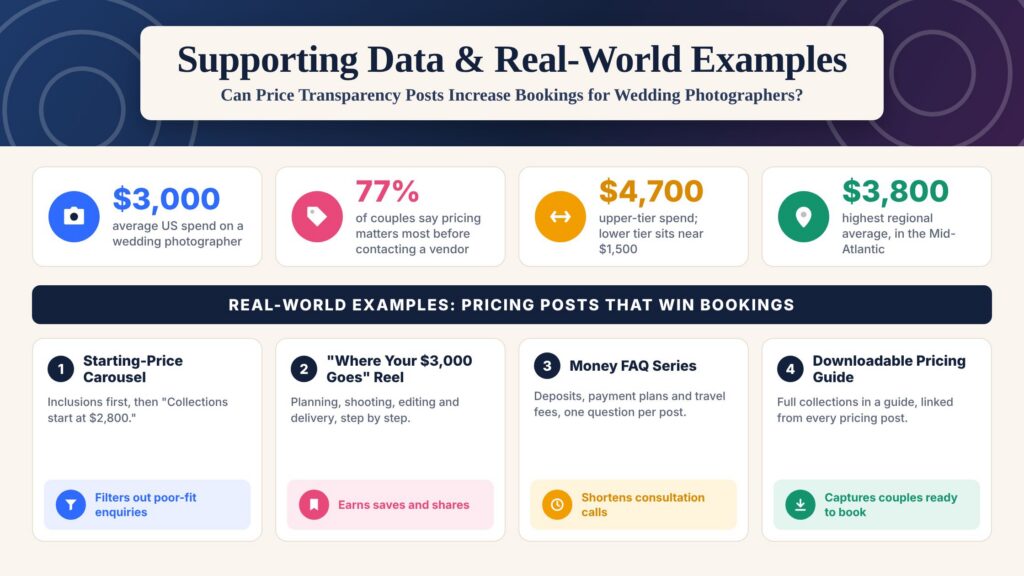
Wedding photography is a considered purchase, and couples weigh price heavily before they make contact.
Key figures:
- $3,000 is the average amount US couples spent on a wedding photographer (The Knot Real Weddings Study).
- $1,500 to $4,700 is the spread between lower-tier and upper-tier spending.
- $3,800 is the highest regional average, in the Mid-Atlantic, compared with $2,600 in the Southwest.
- 77% of couples said pricing was the most important thing they looked at before contacting a vendor (WeddingPro).
The wide spending range is exactly why transparency matters. A couple with a $1,800 budget and a couple with a $5,000 budget are looking for different photographers, and both want to know quickly whether you fit.
These figures describe the market broadly. Each photographer should track their own enquiry and booking data to see which pricing content works. The examples below are illustrative scenarios.
Example 1: The Starting-Price Carousel
A photographer posts a five-slide carousel. The first four slides show what each collection includes, using images from real weddings. The final slide states: “Collections start at $2,800.”
Couples who enquire after seeing it already know the starting point, so fewer conversations end at the quote stage.
Example 2: The “Where Your $3,000 Goes” Reel
A 45-second Reel walks through the full process: planning calls, the wedding day, culling, editing, and gallery delivery.
Viewers save it and share it with partners, because it helps explain the cost to the person they are planning with.
Example 3: The Money FAQ Series
The photographer turns recurring enquiry questions into a weekly post series covering deposits, payment plans, travel fees, and overtime.
Consultation calls become shorter and more focused, because couples arrive with the basics already answered.
Example 4: The Downloadable Pricing Guide
Every pricing post links to a full pricing guide that couples can download in exchange for their email address and wedding date.
The photographer can follow up with couples who are actively researching, and track which posts drive the most downloads.
How to Turn One Pricing Guide Into Multiple Posts
A single, well-built pricing guide can supply a month or more of social content:
- A starting-price announcement
- A carousel for each collection
- A “what’s included” breakdown
- A “where your money goes” Reel
- A deposit and payment plan FAQ
- A real wedding linked to its collection
- A post on how to budget for photography
- A reminder to download the full guide
This keeps your messaging consistent and saves time, because every post draws from the same accurate source.
If you want a consistent stream of pricing, portfolio, and educational posts without losing your editing days, see Socinova’s flat-rate social media management pricing.
Conclusion: Can Price Transparency Posts Really Increase Bookings for Wedding Photographers?
Yes. Price transparency posts can increase bookings by answering the question every couple has first, filtering out mismatched enquiries, and building trust before the first conversation.
The most effective pricing content does not simply post a number. It explains what is included, shows where the money goes, answers common budget questions, and makes the next step easy.
Share a starting price or range. Lead with value. Use real weddings, with permission. Keep your pricing consistent everywhere. Then track which posts lead to enquiries and signed contracts, not just likes.
Show the value. State the price. Answer the questions. Make it easy to book.
That is how price transparency turns a couple who is browsing into a couple who is ready to sign.