

When people experience back pain, neck discomfort, poor posture, headaches, or mobility issues, their first step is often not booking an appointment.
Instead, they search for answers.
They look for information about symptoms, treatment options, recovery expectations, and whether chiropractic care may help their condition.
This behavior has changed how chiropractic practices market their services.
Rather than relying solely on referrals and advertisements, many chiropractors now use educational content to build trust before a patient ever contacts the clinic.
This raises an important question:
How do educational posts help chiropractors attract new patients?
The answer is simple.
Educational posts position chiropractors as trusted healthcare resources. By answering common questions, explaining treatment approaches, and helping people understand their symptoms, chiropractors can build credibility, increase visibility, and encourage prospective patients to schedule appointments.
This guide explains exactly how educational content attracts patients and how chiropractic practices can create content that generates consistent growth.
Direct Answer
Educational posts help chiropractors attract new patients by increasing trust, improving online visibility, addressing common concerns, demonstrating expertise, and encouraging people to seek professional care when they recognize symptoms or problems discussed in the content.
Instead of immediately promoting services, educational content provides value first.
This approach helps chiropractors:
- Build credibility
- Increase engagement
- Improve local visibility
- Reduce patient uncertainty
- Generate appointment inquiries
- Strengthen long-term patient relationships
According to HubSpot Research, educational content consistently performs among the most effective content types for building trust and supporting purchase decisions.
For healthcare providers, trust is often the deciding factor.
Why Education Matters in Chiropractic Marketing
Many Patients Do Not Fully Understand Chiropractic Care
Potential patients frequently have questions such as:
- Can chiropractic care help my condition?
- What happens during an adjustment?
- Is chiropractic treatment safe?
- How many sessions will I need?
- Will treatment hurt?
Unanswered questions often prevent people from booking appointments.
Educational content removes uncertainty.
Healthcare Decisions Depend on Trust
Patients want confidence before choosing a provider.
According to Edelman Trust Barometer, expertise and transparency remain major factors influencing trust.
Educational posts demonstrate both.
Search Behavior Creates Opportunities
People search online for topics such as:
- Lower back pain relief
- Neck pain causes
- Sciatica symptoms
- Poor posture solutions
- Headache treatment options
Educational content allows chiropractors to appear during these research stages.
Visibility during the research phase increases patient acquisition opportunities.
Step-by-Step Breakdown: How Educational Posts Attract New Patients
Step 1: Answer Common Patient Questions
The most effective chiropractic content often starts with frequently asked questions.
Examples include:
- What causes lower back pain?
- Can poor posture cause headaches?
- What is sciatica?
- How does chiropractic care work?
- When should you see a chiropractor?
Answering these questions helps patients feel informed.
Informed prospects are more likely to schedule consultations.
Step 2: Explain Symptoms and Conditions
Many people experience symptoms without understanding the underlying causes.
Educational posts can address:
- Neck pain
- Back pain
- Sciatica
- Joint discomfort
- Sports injuries
- Workplace strain
When readers recognize their symptoms, they become more likely to seek professional evaluation.
Step 3: Demonstrate Expertise Through Practical Education
Educational content should provide useful information while remaining easy to understand.
Topics may include:
- Posture improvement tips
- Stretching routines
- Ergonomic advice
- Injury prevention
- Mobility exercises
Providing practical value strengthens credibility.
Step 4: Address Misconceptions About Chiropractic Care
Many prospective patients have misconceptions.
Examples include:
- Chiropractic care is only for back pain.
- Adjustments are painful.
- Treatment requires endless appointments.
- Chiropractic care lacks scientific support.
Educational posts can address these concerns directly.
Reducing misconceptions increases confidence.
Step 5: Use AI Insights to Identify High-Interest Topics
Modern healthcare marketing increasingly uses AI-driven analytics.
AI tools can identify:
- Frequently searched conditions
- Common patient questions
- Website engagement trends
- Social media interests
- Local search behavior
According to McKinsey & Company, AI-powered customer insights frequently improve content relevance and marketing effectiveness.
These insights help chiropractors focus on topics prospective patients actively care about.
Step 6: Include Clear Next Steps
Educational content should guide readers toward action.
Examples include:
- Schedule a consultation
- Request a posture assessment
- Book an evaluation
- Download a wellness guide
- Contact the clinic
Education creates trust.
Clear calls-to-action create appointments.
Instagram Video Embed Opportunity
Embed a reel demonstrating posture correction techniques or explaining common causes of back pain.
Supporting Data and Real-World Examples
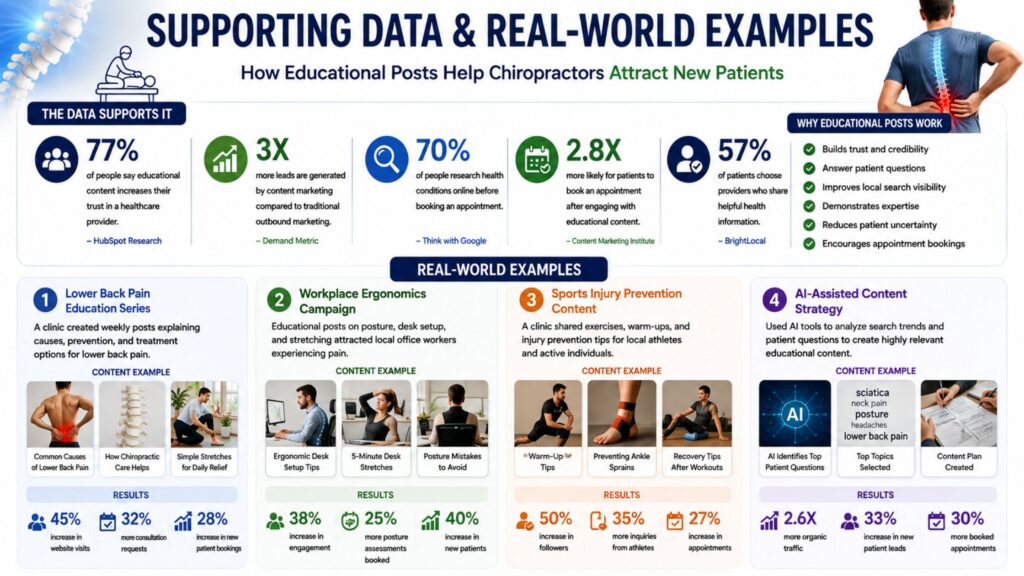
Example 1: Lower Back Pain Education Series
A chiropractic clinic creates weekly educational posts explaining:
- Common causes of back pain
- Lifestyle contributors
- Prevention strategies
- Treatment options
Patients searching for solutions discover the content and begin viewing the clinic as a trusted resource.
Appointment inquiries increase over time.
Example 2: Workplace Ergonomics Campaign
A chiropractor develops educational posts focused on:
- Desk posture
- Screen positioning
- Sitting habits
- Workplace stretches
Office workers frequently engage with the content because it addresses everyday challenges.
The clinic attracts new patients experiencing work-related discomfort.
Example 3: Sports Injury Prevention Content
A chiropractic practice serving athletes publishes educational content covering:
- Warm-up routines
- Mobility exercises
- Recovery strategies
- Injury prevention tips
The content attracts active individuals who later seek professional treatment and performance support.
Example 4: AI-Assisted Content Strategy
A chiropractic clinic uses AI tools to analyze patient questions and online search behavior.
The analysis reveals strong interest in:
- Sciatica
- Neck pain
- Posture correction
- Headache relief
Future content focuses on these topics, resulting in higher engagement and more patient inquiries.
Common Educational Content Mistakes Chiropractors Should Avoid
Using Excessive Medical Terminology
Patients want clear explanations.
Complex language can reduce understanding and engagement.
Focusing Only on Promotions
Constant advertising rarely builds trust.
Educational content should provide value first.
Ignoring Patient Concerns
Frequently asked questions often generate the best content opportunities.
Listen to patients and create content accordingly.
Publishing Inconsistently
Trust develops over time.
Consistent education strengthens visibility and authority.
Conclusion
Educational posts can significantly help chiropractors attract new patients because they answer questions, reduce uncertainty, build trust, and position the practice as a reliable healthcare resource.
The most effective educational content strategies focus on:
- Frequently asked questions
- Symptom education
- Practical health advice
- Myth correction
- AI-driven topic selection
- Clear calls-to-action
Many prospective patients spend weeks researching symptoms before seeking professional help.
Educational content allows chiropractors to become part of that research journey.
The goal is not simply to publish information.
The goal is to build enough trust and credibility that when someone decides they need professional care, your practice is the first one they contact.