
January is the busiest month in most Pilates studios. New members arrive with fresh goals, intro packs sell out, and the reformer schedule fills up fast.
Then, a few weeks later, attendance starts to slip. A member who came four times in the first week comes twice the next, then once, then stops booking. By March, many January sign-ups have quietly disappeared.
This pattern is well known across fitness. Strava has identified a “Quitter’s Day” in mid-January when motivation drops, and its 2025 analysis found that January and February are the months when people are least likely to be hitting their fitness goals.
So, can progress check-in posts stop January members from quitting Pilates studios?
They can help a great deal. Progress check-in posts remind new members how far they have come, make small wins visible, and create a sense of shared commitment at exactly the point when motivation fades.
They will not fix a poor class experience or a confusing booking system. But for a studio that already delivers good classes, regular check-in posts can be the nudge that turns a January sign-up into a long-term member.
Direct Answer: Why Do Progress Check-In Posts Keep January Members?
Progress check-in posts keep January members because they make progress visible at the moment members are most likely to feel stuck.
Pilates progress is often subtle in the first few weeks. Members do not see dramatic changes in the mirror, so they assume nothing is happening and lose interest. A check-in post helps them notice what has changed: better balance, a stronger core, less back stiffness, or simply showing up three weeks in a row.
Research on goal-setting supports this. A meta-analysis of 138 studies involving nearly 20,000 participants, published by the American Psychological Association, found that monitoring progress increases the chances of reaching a goal. The effect was even stronger when progress was physically recorded or shared publicly.
Check-in posts work on three levels:
- Reflection. Members are prompted to notice their own progress.
- Accountability. A public or community check-in creates a gentle commitment to keep going.
- Belonging. Seeing other new members at the same stage makes the studio feel like a group, not a solo struggle.
The study did not look at Pilates or social media specifically. But its core finding applies directly: when people track and share progress, they are more likely to stick with a goal.
Step 1: Plan Check-Ins Around the Danger Weeks
Most January drop-off happens in a predictable window. Plan check-in posts for the moments members are most likely to stall.
A simple schedule:
- Week 1: Welcome post for new members, with what to expect in the first month
- Week 2: “Two weeks in” check-in, timed around mid-January when motivation dips
- Week 4: One-month milestone post
- Week 6: “What’s changed?” reflection, before intro packs run out
- Week 8 to 12: Progress stories and next-goal posts
Line these up with your intro offer. If most January members buy a four-week or six-week pack, the check-in before it expires matters most.
Step 2: Celebrate Effort, Not Just Results
New members rarely see big physical changes in the first month. If your posts only celebrate visible transformation, most beginners will feel they are falling behind.
Celebrate the things they can achieve quickly:
- Attending eight classes in a month
- Holding a plank or teaser longer than in week one
- Moving from a beginner class to a mixed-level class
- Feeling less stiff at work
- Finally understanding how to set up the reformer
A strong hook is: “Three weeks in? Here’s what’s already changing, even if you can’t see it yet.”
This keeps expectations realistic and gives members a reason to stay through the slow early phase.
Step 3: Use Simple, Repeatable Formats
Check-in posts work best when they feel familiar. Members should recognise them and look forward to them.
Formats that work well:
- Instagram Story polls: “How many classes did you make this week?”
- Question stickers: “What’s one thing that feels easier than it did in January?”
- Carousel posts: “Your first month of Pilates, week by week”
- Short Reels: An instructor explaining what usually changes by week four
- Milestone graphics: “Class 10 club” or “30 days strong”
Use the same name and visual style each time, such as a weekly “Wednesday Check-In,” so it becomes part of the studio’s routine.
Step 4: Put Instructors in Front of the Camera
Members trust their instructors. A short video from a familiar teacher feels personal and motivating.
Ideas for instructor-led check-ins:
- “What I notice in new members around week three”
- “If you’ve missed a week, here’s how to get back in”
- “The one cue that will make your next class easier”
- “Why progress in Pilates feels slow at first”
Keep videos under 45 seconds and add captions. Many people watch with the sound off.
Avoid promising specific physical results. Pilates benefits vary from person to person, and studios should not make health claims they cannot support.
Step 5: Feature Real Members, With Permission
Seeing someone similar succeed is one of the strongest motivators for a new member.
With written permission, share:
- A short quote from a member about their first month
- A milestone celebration, such as their 25th class
- A before-and-after of a movement, such as a roll-up or side plank, rather than body photos
- A member explaining what helped them keep coming
Focus on strength, mobility, confidence, and consistency rather than weight or appearance. Never pressure anyone to share personal health information or body images.
Step 6: Invite Members to Check In Publicly
The APA research found that progress monitoring works better when it is shared publicly. Give members easy, low-pressure ways to do that.
Ideas include:
- A monthly check-in post where members comment their class count
- A studio hashtag for members to share milestones
- A “January Challenge” board in the studio that members tick off after each class
- Story prompts members can reshare with their own answer
Keep participation optional and positive. Some members prefer to stay private, and that should feel completely fine.
Step 7: Connect Posts to a Clear Next Step
A check-in post should remind members of their progress and make it easy to keep going.
End posts with practical actions:
- “Book next week’s classes now”
- “Try a new class time if mornings aren’t working”
- “Ask us about moving from intro pack to membership”
- “Message us if you need help getting back into a routine”
If you offer a membership or class pack upgrade, introduce it around weeks four to six, when members have built some momentum but before their intro offer runs out.
Step 8: Use AI to Plan Check-Ins and Track Retention
AI can help a Pilates studio plan check-in content and see which posts help members stay.
Use it to:
- Draft caption variations for each check-in week
- Summarise common questions and concerns from DMs and comments
- Plan a 12-week content calendar for new members
- Turn instructor tips into short scripts
Then track:
- Booking rates of January members in weeks two to eight
- Intro pack to membership conversion
- Story poll responses and replies
- Members who return after a missed week
- Retention at 30, 60, and 90 days
Use AI to organise and communicate genuine progress. Never use it to fabricate member stories, invent testimonials, or make health claims.
A check-in post that helps 10 January members book their next month is worth far more than one that gets hundreds of likes.
Supporting Data and Real-World Examples
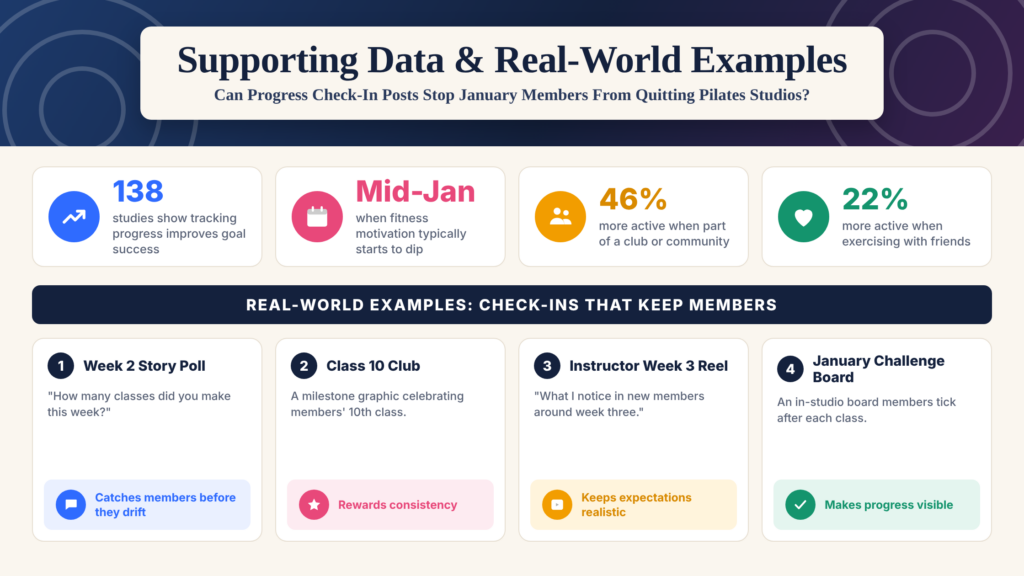
The evidence points the same way: tracking progress helps people stick with goals, and community makes them more consistent.
Key figures:
- 138 studies with nearly 20,000 participants found that monitoring progress improves goal attainment, with stronger effects when progress is recorded or shared publicly (APA).
- Mid-January is when Strava’s data shows fitness motivation typically dips, and January and February are when people are least likely to be on track with their goals.
- 46% more active: Strava’s earlier analysis found people who joined a club were 46% more active.
- 22% more active: The same analysis found people exercising with friends were 22% more active.
The Strava club and friends figures come from its 2017 to 2018 data on running and cycling, not Pilates. But the principle carries over: people stay more consistent when they feel part of a group.
Each studio should track its own January cohort, including bookings in weeks two to eight and conversion from intro packs to memberships. The examples below are illustrative scenarios.
Example 1: The Week 2 Story Poll
In the second week of January, the studio posts a Story poll: “How many classes did you make this week?” Members who answer “zero” or “one” get a friendly follow-up message.
The poll catches members before they drift away, and the follow-up feels personal rather than salesy.
Example 2: The Class 10 Club
Every member who reaches their 10th class is celebrated in a monthly “Class 10 Club” graphic, with permission.
New members see a realistic early milestone they can reach, and those featured feel recognised.
Example 3: The Instructor Week 3 Reel
A familiar instructor records a 30-second Reel: “What I notice in new members around week three.”
The video reassures members that progress is happening, even when they cannot see it yet.
Example 4: The January Challenge Board
The studio sets up an in-person board where members tick off each class they attend in January, then shares a photo of the board’s progress on social media each week.
Progress becomes visible for everyone, combining personal tracking with gentle public accountability.
How to Turn One Check-In Into Multiple Posts
A single weekly check-in theme can support several pieces of content:
- A Story poll or question sticker
- A follow-up Story sharing anonymous answers
- A short instructor Reel on that week’s theme
- A carousel of tips for the next week
- A milestone graphic for members who hit a target
- A member quote, shared with permission
- An email to January members with the same message
- A reminder to book next week’s classes
This keeps new members hearing the same encouraging message across every channel during their most vulnerable weeks.
If you want a ready-made January retention calendar without adding work for your instructors, Socinova’s flat-rate social media management pricing covers planning, design, captions, and scheduling.
Conclusion: Can Progress Check-In Posts Really Stop January Members From Quitting Pilates Studios?
They can make a real difference. Progress check-in posts help January members notice their progress, feel part of a community, and keep booking through the weeks when motivation usually fades.
The most effective check-ins are timed around the danger weeks, celebrate effort as much as results, and always point to a clear next step. They feature real members only with permission and avoid health claims.
Plan check-ins for weeks two, four, and six. Celebrate small wins. Put instructors on camera. Invite members to share. Then track bookings, conversions, and 90-day retention, not just likes.
Show the progress. Celebrate the effort. Build the habit. Keep them coming back.
That is how a January sign-up becomes a member who is still on the reformer in June.