
Watch repair is a service customers rarely understand until they need it.
A mechanical watch can contain hundreds of small components working together with extreme precision. When a watch stops running, loses accuracy, suffers water damage, develops scratches, or needs a complete service, customers cannot easily judge what is happening inside it.
This creates a trust problem for independent watchmakers.
Customers may wonder whether their watch really needs the recommended repair, whether original components will be handled carefully, or whether the watchmaker has enough experience to work on a valuable or sentimental timepiece.
Repair transformation reels can address that uncertainty visually.
How do repair transformation reels attract customers for watchmakers?
They work by turning an invisible technical service into visible proof of expertise. Customers can watch a damaged or malfunctioning watch being inspected, disassembled, cleaned, repaired, tested, refinished, and returned to working condition.
Video is particularly useful for this purpose. Wyzowl’s 2026 research found that 96% of consumers have watched an explainer video to learn about a product or service, while 85% said a video had convinced them to purchase a product or service.
For watchmakers, the opportunity is not simply creating satisfying repair content.
It is showing potential customers exactly why they should trust the workshop with their watch.
Direct Answer: How Do Watch Repair Reels Generate Customers?
Repair transformation reels attract customers for watchmakers by demonstrating technical expertise, making complicated repairs understandable, providing visible proof of results, and reducing the perceived risk of handing over a valuable timepiece.
A strong repair reel can demonstrate:
- Movement servicing
- Component cleaning
- Crystal replacement
- Case refinishing
- Bracelet restoration
- Water-resistance testing
- Accuracy testing
- Vintage watch repair
- Mechanical troubleshooting
This type of content aligns particularly well with current social media behavior.
HubSpot’s 2026 marketing data identifies short-form video as the highest-ROI content format, with 49% of marketers naming it among the top ROI-driving formats. Sixty percent of marketers now use short-form video in their strategies.
For a watchmaker, however, the commercial advantage goes beyond reach.
Every reel can function as a miniature case study.
Step-by-Step Breakdown: How Repair Transformation Reels Attract Watch Customers
Step 1: Start With the Problem
Do not begin every reel with a logo or a shot of the workshop.
Show the problem immediately.
For example:
“This mechanical watch hadn’t run in seven years.”
Then show the watch.
Other hooks might include:
“This watch was gaining 15 minutes every day.”
“Can this scratched crystal be saved?”
“Here’s what we found inside this vintage movement.”
“This watch came in after being exposed to water.”
The problem creates curiosity.
Viewers immediately want to know whether the watch can be repaired.
That naturally encourages them to continue watching.
Step 2: Show the Initial Inspection
Before showing tools or polishing equipment, explain what is wrong.
The watchmaker might demonstrate:
- Poor timekeeping
- Movement contamination
- Worn components
- Damaged seals
- Scratched surfaces
- Broken crowns
- Damaged crystals
- Bracelet wear
This stage is particularly important because professional watch servicing begins with assessment.
For example, Rolex’s documented servicing procedure starts with a watchmaker carefully examining the watch and preparing an estimate before work begins.
Independent watchmakers can use the same principle in their content.
Showing diagnosis communicates that repairs are based on inspection rather than guesswork.
Step 3: Reveal What Happens Inside the Watch
This is where watchmakers have an extraordinary content advantage.
Most customers have never seen the inside of a mechanical watch.
Macro footage can show:
- Movement removal
- Tiny screws
- Gears
- Bridges
- Springs
- Jewels
- Balance components
That creates both educational and visual interest.
The footage should emphasize precision rather than speed.
Viewers should see that components are handled methodically and carefully.
For comparison, Rolex describes its official service process as completely dismantling the movement, inspecting individual parts, cleaning components, reassembling and lubricating the movement, and testing precision afterward.
Showing similar stages, where appropriate to the specific repair, helps customers understand why professional watch servicing requires expertise.
Step 4: Explain One Technical Detail Per Reel
Trying to explain an entire watch movement in 30 seconds can overwhelm viewers.
Instead, build individual videos around one question.
For example:
Why does a mechanical watch need lubrication?
What happens when moisture enters a watch?
Why can an automatic watch start losing time?
What does pressure testing actually check?
Why do watchmakers inspect seals during servicing?
This turns repair footage into educational content.
The strategy is valuable because consumers actively use video to learn. Wyzowl reports that 63% of consumers would most like to learn about a product or service through a short video, compared with 12% who prefer text-based articles.
A watchmaker who consistently explains repairs becomes more than a repair provider.
They become a trusted source of watch knowledge.
Step 5: Show the Transformation Clearly
Every repair reel should eventually answer:
Did it work?
Depending on the project, the final result could demonstrate:
- The movement running
- Improved timekeeping
- Restored crystal clarity
- Cleaned dial appearance
- Refinished case surfaces
- Restored bracelet
- Successful water-resistance testing
For aesthetic repairs, use comparable before-and-after camera angles.
For mechanical work, show measurable evidence where possible.
For example:
Before service: significant timing deviation.
After service: improved performance within the appropriate specification for that watch and service.
Avoid making universal accuracy claims because different watches have different specifications.
The transformation should document the actual result.
Step 6: Use Visual Quality to Reinforce Trust
Watchmaking is precision work.
Poorly filmed content can undermine that positioning.
Wyzowl’s 2026 research found that 89% of consumers say video quality affects their trust in a brand.
That does not mean every reel needs expensive production.
Prioritize:
- Clean lighting
- Stable macro footage
- Sharp focus
- Uncluttered work surfaces
- Legible text
- Clear audio
A smartphone combined with a macro lens, tripod, and proper lighting can be sufficient.
The workshop should look organized and professional because customers may interpret the environment as evidence of how their watches will be treated.
Step 7: Turn Satisfying Repair Footage Into Proof of Expertise
Watch repair naturally contains visually satisfying moments.
Examples include:
- Ultrasonic cleaning
- Crystal polishing
- Case refinishing
- Bracelet cleaning
- Movement reassembly
- Precision testing
These moments can generate attention, but they should not become meaningless “satisfying videos.”
Add context.
Instead of only showing a polishing wheel, explain:
“We’re carefully restoring the original finish while preserving the case geometry.”
That communicates skill.
Rolex’s servicing documentation similarly emphasizes that case and bracelet refinishing requires careful operations to reproduce original polished or satin finishes.
The educational explanation distinguishes professional craftsmanship from generic restoration content.
Step 8: Use AI to Identify Repair Topics Customers Care About
AI can help watchmakers decide which content to create next.
A workshop can analyze:
- Reel comments
- Direct messages
- Website searches
- Frequently asked questions
- Video watch time
- Saves
- Shares
- Repair inquiries
For example, suppose videos about water damage consistently generate more inquiries than polishing videos.
That suggests potential customers are using those videos to solve an immediate problem.
The watchmaker could develop additional reels such as:
“What should you do if water gets inside your watch?”
“Why condensation under the crystal needs attention.”
“How watchmakers inspect water-damaged movements.”
AI adoption is already widespread in marketing. McKinsey reported in 2025 that 71% of surveyed organizations regularly used generative AI in at least one business function, with marketing and sales among the most common areas of use.
AI can help categorize questions, generate content outlines, analyze performance, and produce caption variations.
The actual repair footage should remain authentic.
Customers need to see real watches and real craftsmanship.
Step 9: Answer High-Intent Customer Questions
Some questions indicate much stronger purchase intent than others.
Examples include:
“Can my vintage watch still be repaired?”
“How long does a mechanical watch service take?”
“Can scratched cases be restored?”
“What happens during a full watch service?”
These questions should become dedicated reels.
For example, Rolex states that a complete overhaul can require at least four to six weeks depending on a watch’s condition, demonstrating how detailed professional servicing can be.
An independent workshop should explain its own timelines rather than copying another company’s estimate.
Transparency about process, expected turnaround, and assessment can reduce hesitation before customers request a quote.
Supporting Data and Real-World Examples
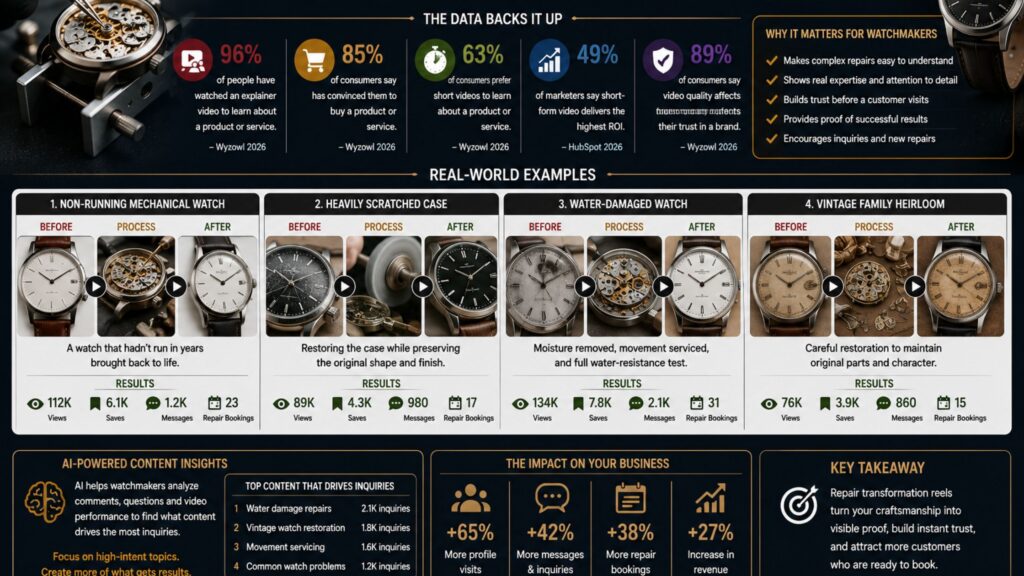
Example 1: Non-Running Mechanical Watch
A watch arrives after sitting unused for several years.
The reel begins:
“This watch hasn’t run in seven years. Let’s find out why.”
Viewers see the inspection, movement removal, selected servicing stages, reassembly, and final test.
The reel ends with the watch running again.
The transformation demonstrates both diagnostic and repair expertise.
Example 2: Heavily Scratched Watch Case
A customer brings in a watch with extensive cosmetic wear.
The video compares the condition before and after refinishing.
Instead of presenting the work as simple polishing, the watchmaker explains how the original finishing style and case shape must be considered.
This education reinforces the difference between specialist restoration and aggressive polishing.
Example 3: Vintage Family Watch
A customer brings in a watch inherited from a family member.
The workshop documents selected stages of the restoration while explaining which original components can be retained.
The emotional context adds meaning without overshadowing the technical process.
The final reel becomes both a repair case study and a demonstration of careful stewardship.
Example 4: AI-Assisted Content Strategy
A watchmaker analyzes six months of Reels and discovers:
- Movement videos generate the highest watch time.
- Before-and-after refinishing receives the most shares.
- Water-damage videos generate the most direct messages.
- Educational servicing videos generate the most quote requests.
The workshop can then align its content with business goals.
If the goal is generating repair inquiries, it should prioritize the topics producing qualified questions rather than simply chasing the videos generating the most views.
Turn Repair Reels Into a Repeatable Series
A single transformation may attract attention.
A recognizable series can build authority.
Potential recurring concepts include:
- Watch Repair of the Week
- Inside the Movement
- Can This Watch Be Saved?
- Before and After Service
- Watchmaker Explains
- What’s Wrong With This Watch?
- Inside the Workshop
Each format creates a reason for enthusiasts and potential customers to return.
For a broader content strategy, watchmakers can also connect repair Reels with relevant social media marketing services, video production pages, local marketing resources, and educational blog content.
Businesses looking to build consistent short-form content can also explore Socinova and internally link this section to a relevant video marketing or social media service page.
Measure Customer Intent, Not Just Views
Watchmakers should not evaluate Reels solely through reach.
Track:
- Average watch time
- Saves
- Shares
- Profile visits
- Direct messages
- Website clicks
- Repair quote requests
- Service appointments
- Completed repairs
A video with 500,000 satisfying views may generate little local business.
A technical video with 8,000 views might generate ten genuine repair inquiries.
HubSpot’s 2026 data shows that marketers increasingly view short-form video as a high-ROI format, but ROI depends on connecting content performance with business outcomes.
For a watchmaker, the most valuable comment may not be:
“So satisfying!”
It may be:
“My watch is doing exactly this. Can I bring it in?”
Conclusion
Repair transformation reels attract customers for watchmakers because they transform an unfamiliar technical service into visible evidence of expertise.
The strongest videos start with a clear problem, document the assessment, reveal important stages of the repair, explain technical decisions, and show the final result.
Transformation creates attention.
Education builds authority.
Process footage reduces uncertainty.
Authentic results create trust.
AI can make the strategy more efficient by identifying high-intent questions, analyzing content performance, and helping plan future videos. But the central marketing asset remains the watchmaker’s real craftsmanship.
When customers own watches that are valuable, sentimental, vintage, or simply important to them, they need confidence before handing them over.
Repair transformation reels provide that confidence before the customer ever enters the workshop.
Instead of telling viewers “we are expert watchmakers,” the content gives them something far more persuasive:
the opportunity to watch that expertise in action.