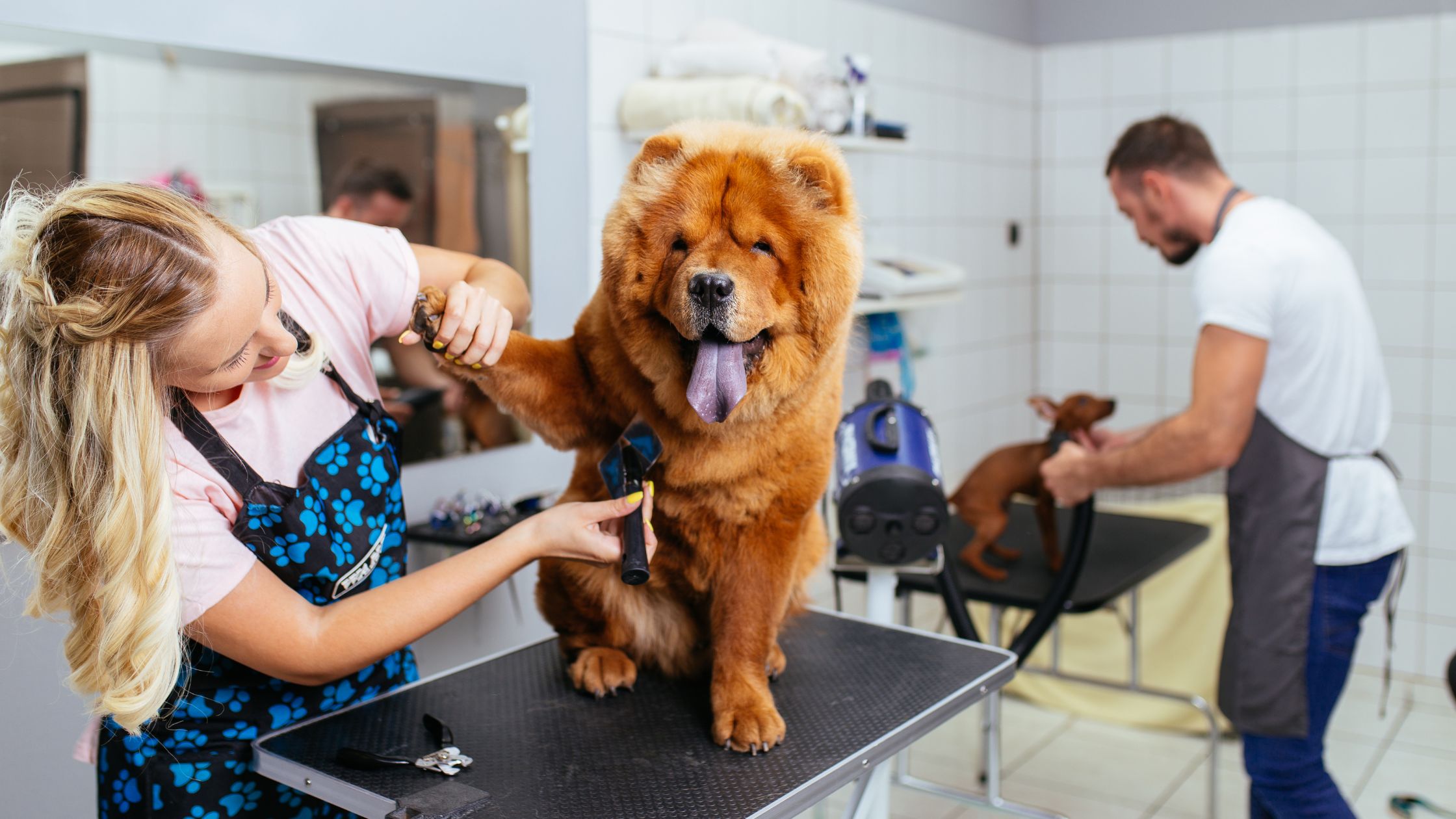

Dog grooming is one of the most visually demonstrable pet services.
A potential customer can read that a groomer offers deshedding, trimming, bathing, coat care, or breed-specific grooming, but those descriptions do not immediately demonstrate the quality of the work. A transformation Reel can.
A shaggy coat becomes neat and manageable. An overgrown face becomes clearly shaped. A dog arrives looking untidy and leaves looking refreshed. Within a few seconds, viewers can see evidence of what the groomer can deliver.
So, how do grooming transformation reels attract clients for dog groomers?
They attract clients by turning grooming results into visual proof, demonstrating the groomer’s technique, helping owners imagine similar results for their own dogs, and reducing uncertainty before someone books an appointment.
The market opportunity is significant. The American Pet Products Association reported that 71 million U.S. households owned dogs in 2025, up from 68 million the previous year. Total U.S. pet industry spending reached $158 billion in 2025 and is projected to reach $165 billion in 2026.
However, professional groomers also face stronger value scrutiny. APPA’s 2026 Dog Report found that spending on salon and mobile grooming declined in 2025, while 51% of dog owners groomed their dogs at home.
That makes demonstrating the value of professional grooming more important, not less.
Direct Answer: Why Do Grooming Transformation Reels Generate Bookings?
Grooming transformation Reels can generate clients because they combine an attention-grabbing visual change with proof of skill, education, personality, and a clear reason to book professional grooming.
Short-form video is particularly suited to this strategy.
HubSpot’s 2026 State of Marketing research found that 48.6% of marketers ranked short-form video among their highest-ROI formats, making it the strongest-performing format in the study. Sixty percent of marketers actively use short-form video.
Wyzowl’s 2026 research provides additional evidence. It found that 85% of video marketers say video has helped generate leads, 83% say it has directly increased sales, and 82% report increased website traffic.
For a local dog groomer, the objective is straightforward:
Before → grooming process → transformation → booking opportunity.
The following steps make that journey more effective.
Step 1: Open With the Dog’s Before-Grooming Condition
The first seconds determine whether someone continues watching.
Start with the dog before the groom.
Show relevant visible issues such as:
- Overgrown facial hair
- Excess coat
- Untidy paws
- Coat needing shaping
- Heavy shedding
- A generally overdue groom
Add a simple hook:
“Wait until you see his transformation.”
Or:
“Someone was definitely ready for grooming day.”
The before footage establishes contrast.
Without it, viewers only see a nicely groomed dog. With it, they understand what changed.
Avoid exaggerating problems or presenting normal coat conditions as neglect. The goal is to demonstrate the service without embarrassing the owner.
Step 2: Show Enough of the Process to Prove the Work
Do not jump directly from before to after every time.
Include short clips of the process.
Depending on the service, these might show:
Bath → drying → brushing → trimming → styling → final reveal
These clips make the transformation credible.
They also demonstrate what customers are paying for.
That is especially relevant when owners are becoming more value-conscious about grooming services. APPA found that 51% of owners groom their dogs at home, while spending on professional salon and mobile grooming declined during 2025.
A professional groomer therefore needs to show more than a cute finished dog.
The Reel should communicate:
“Here is the skill and work involved in achieving this result.”
Step 3: Highlight One Grooming Skill
A transformation Reel becomes more persuasive when it demonstrates a specific capability.
For example:
Deshedding Transformation
Show excess coat removal and the finished appearance.
Face Trim
Show careful shaping around the face.
Paw Cleanup
Demonstrate trimming and tidying.
Curly-Coat Groom
Show the stages required to create an even finish.
Breed-Specific Style
Explain one important feature of the requested cut.
This turns the Reel from generic entertainment into proof of expertise.
Someone looking for a groomer for a similar dog can immediately see relevant work.
That is much more valuable than simply posting random pet videos.
Step 4: Use the Reveal as the Emotional Payoff
The final transformation should be obvious.
Whenever possible, film the before and after from similar angles.
For example:
Before: dog standing on the grooming table.
After: same dog, similar framing, finished groom.
This creates an easy visual comparison.
Then add personality.
Show the dog wagging its tail, walking toward the camera, sitting for a treat, or posing after the groom where appropriate.
The reveal provides the satisfying conclusion viewers expect from transformation content.
Video quality also matters. Wyzowl found that 89% of consumers say video quality affects their trust in a brand.
That does not mean groomers need expensive production equipment.
Clear lighting, stable footage, sharp focus, and a clean grooming environment can make the business appear significantly more professional.
Step 5: Explain the Groom Instead of Only Showing It
Some transformation videos should educate viewers.
For example:
“For today’s groom, we’re shortening the body while keeping a softer, rounded face.”
Or:
“This dog needed a thorough deshed before we could finish the coat.”
This helps owners understand what they are seeing.
Educational content can also answer common questions:
How often should this type of coat be professionally groomed?
What should owners ask for when booking this style?
Why does coat condition affect the final groom?
What information should an owner give a groomer before an appointment?
Wyzowl’s research found that 93% of video marketers say video has improved customer understanding of their products or services, while 96% of consumers have watched an explainer video to learn about a product or service.
A grooming transformation can therefore attract attention while simultaneously educating a potential customer.
Step 6: Feature Different Dogs and Services
A feed filled with one type of dog may unintentionally suggest that the groomer specializes only in that breed or coat.
Show variety where it reflects the services actually offered.
Content could include:
Small Dog Transformation
Large Dog Deshed
Curly-Coat Groom
Puppy’s Grooming Visit
Senior Dog Groom
Seasonal Coat Cleanup
Breed-Specific Transformation
Bath and Tidy
This gives potential clients more opportunities to recognize a dog similar to their own.
It also makes the portfolio stronger.
Someone searching for a groomer for a Golden Retriever may respond more strongly to a Golden Retriever deshedding transformation than to a Reel featuring an unrelated breed and service.
Step 7: Make the Groomer’s Handling Visible
Owners are not only evaluating the haircut.
They are deciding whether they trust someone to handle their dog.
Show appropriate moments of calm interaction between groomer and dog.
This might include:
- Introducing the dog to the grooming area
- Calm brushing
- Gentle positioning
- Short breaks when appropriate
- Rewarding cooperative behaviour
- Positive interaction after the groom
Do not manufacture “happy dog” moments or make claims about a dog’s emotional state that the footage cannot establish.
Simply allow potential clients to observe the working environment.
For pet businesses, this can be particularly valuable because the customer is purchasing both a result and a care experience.
Step 8: Turn Common Customer Concerns Into Transformation Content
Instead of brainstorming random Reel ideas every week, use questions customers already ask.
For example:
“Can you groom my dog if the coat is heavily tangled?”
“What does a deshedding appointment actually involve?”
“How short should I ask for my dog’s coat?”
“What happens during a puppy’s first grooming appointment?”
“How long does a full groom usually take?”
Build a transformation around the question.
The result becomes searchable educational content and a portfolio example at the same time.
This strategy can also improve lead quality because customers contact the business with a clearer understanding of the service.
Step 9: Use AI to Identify Which Grooming Reels Generate Clients
AI can help groomers understand which transformations create business results rather than simply views.
Track Reel categories such as:
Before-and-after transformations
Deshedding videos
Breed-specific grooms
Puppy grooming
Educational videos
Funny grooming moments
Behind-the-scenes clips
Then compare:
- Average watch time
- Saves
- Shares
- Profile visits
- Direct messages
- Booking-page visits
- Appointment inquiries
- Confirmed appointments
For example, funny dog videos may generate the highest reach while breed-specific transformations generate more bookings.
That distinction matters.
Wyzowl found that while 67% of video marketers measure ROI through views and 63% through engagement, 52% measure leads or clicks and 32% measure bottom-line sales.
AI can help categorize these results and identify patterns.
It is already becoming common in video workflows. Wyzowl reports that 63% of video marketers used AI video tools to help create or edit videos in 2026, up from 51% the previous year.
Groomers can use AI for:
- Hook variations
- Caption drafts
- FAQ analysis
- Content categorization
- Performance summaries
- Editing assistance
- Repurposing longer footage
But the dogs, grooming process, results, and client experience should remain authentic.
Step 10: Add a Local Booking CTA
A Reel may generate thousands of views without producing a single appointment if viewers do not know where the groomer operates or what to do next.
Include the service area naturally.
For example:
“Dog grooming appointments available in [City]. Book through our profile.”
Or make the CTA specific to the transformation:
“Does your Golden need a serious deshed? Request a grooming appointment in [City].”
For a puppy Reel:
“Getting ready for your puppy’s first grooming appointment? Message us about availability.”
Specific CTAs connect the transformation viewers just watched with their own dog’s needs.
Supporting Data and Real-World Examples
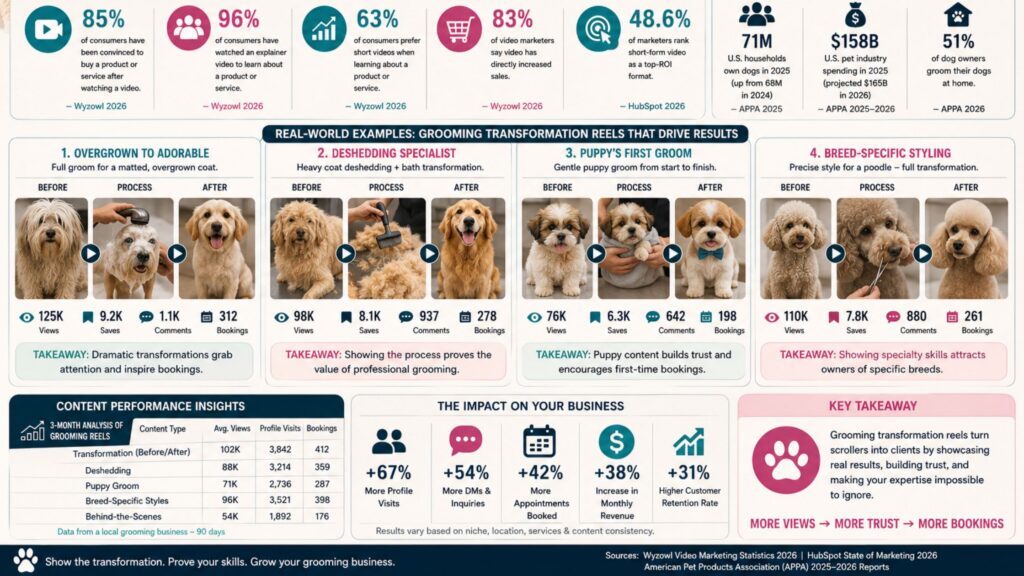
Example 1: Overgrown-to-Styled Transformation
A groomer starts with a dog ready for a full groom.
The opening frame says:
“Wait for the final transformation.”
The Reel shows bathing, drying, selected trimming stages, and the finished result.
The final frame identifies the service and invites local owners to book.
This format combines curiosity, process, proof, and action.
Example 2: Heavy Deshedding Session
The Reel opens with:
“How much loose coat will come out?”
Viewers watch selected stages of brushing and deshedding before seeing the finished dog.
The groomer briefly explains what the service involved.
This is commercially useful because an owner dealing with excessive shedding can immediately recognize the problem.
Example 3: Puppy Grooming Story
Instead of focusing only on dramatic visual change, the video documents selected parts of a puppy grooming visit.
It can show the grooming environment, basic service stages, and final result.
The CTA could invite owners to ask about puppy grooming appointments.
This type of content addresses a different customer need from a dramatic coat transformation.
Example 4: AI-Assisted Performance Analysis
Imagine a groomer reviews three months of Reels and discovers:
Funny dog videos: highest reach.
Transformation Reels: highest profile visits.
Deshedding videos: highest saves.
Breed-specific transformations: highest booking-page clicks.
Puppy grooming content: highest direct-message inquiries.
The business can now create content based on commercial goals.
If appointment growth is the objective, the videos generating booking behaviour deserve more attention than those generating views alone.
Why Transformation Reels Are Especially Important in 2026
Professional grooming businesses are operating in a large but increasingly value-conscious pet market.
APPA reported that dog ownership reached 71 million U.S. households in 2025, while the overall pet market is projected to reach $165 billion in 2026. At the same time, owners are becoming more strategic about spending, and home grooming remains common.
That means groomers need to communicate why professional service is worth paying for.
Transformation content can help by making the difference visible.
The format also aligns with broader marketing behaviour. HubSpot found that short-form video delivers the highest ROI of any media format surveyed in 2026, with 48.6% of marketers ranking it among their top-performing formats.
Businesses that need a broader strategy for turning service results into consistent social content can explore Socinova and internally connect this article to relevant social media management, video marketing, or content creation services.
Measure Bookings, Not Just Views
A dog transformation can easily attract viewers who live hundreds of miles away.
For a local grooming business, those views may have limited commercial value.
Measure the customer journey:
Reel → profile visit → booking page → inquiry → confirmed appointment
Also track which services generate inquiries.
If deshedding transformations repeatedly produce appointments, create more of them.
If puppy content generates questions but few bookings, review the CTA or booking information.
Wyzowl’s 2026 data shows that 85% of video marketers report generating leads through video and 83% report directly increasing sales.
For dog groomers, the equivalent business outcome is not merely a viral Reel.
It is a fuller appointment calendar with relevant local clients.
Conclusion: How Do Grooming Transformation Reels Attract More Clients?
Grooming transformation Reels attract clients because they allow potential customers to evaluate a groomer’s work before making an appointment.
The strongest Reels establish the dog’s starting point, show selected grooming stages, highlight professional technique, reveal the finished result, educate owners about the service, and provide a clear local booking opportunity.
Current market conditions make that proof particularly useful. Dog ownership remains widespread, but APPA’s research indicates owners are becoming more deliberate about spending and many continue grooming at home.
Professional groomers therefore need to demonstrate their value rather than simply advertise availability.
AI can help analyze performance, identify customer questions, improve content planning, and speed up editing. But authentic footage remains the most important ingredient.
A potential client does not simply want to hear:
“We provide professional dog grooming.”
A transformation Reel allows them to see the result, observe the process, and imagine their own dog receiving similar care.
That visible proof can turn a casual viewer into a local grooming inquiry.