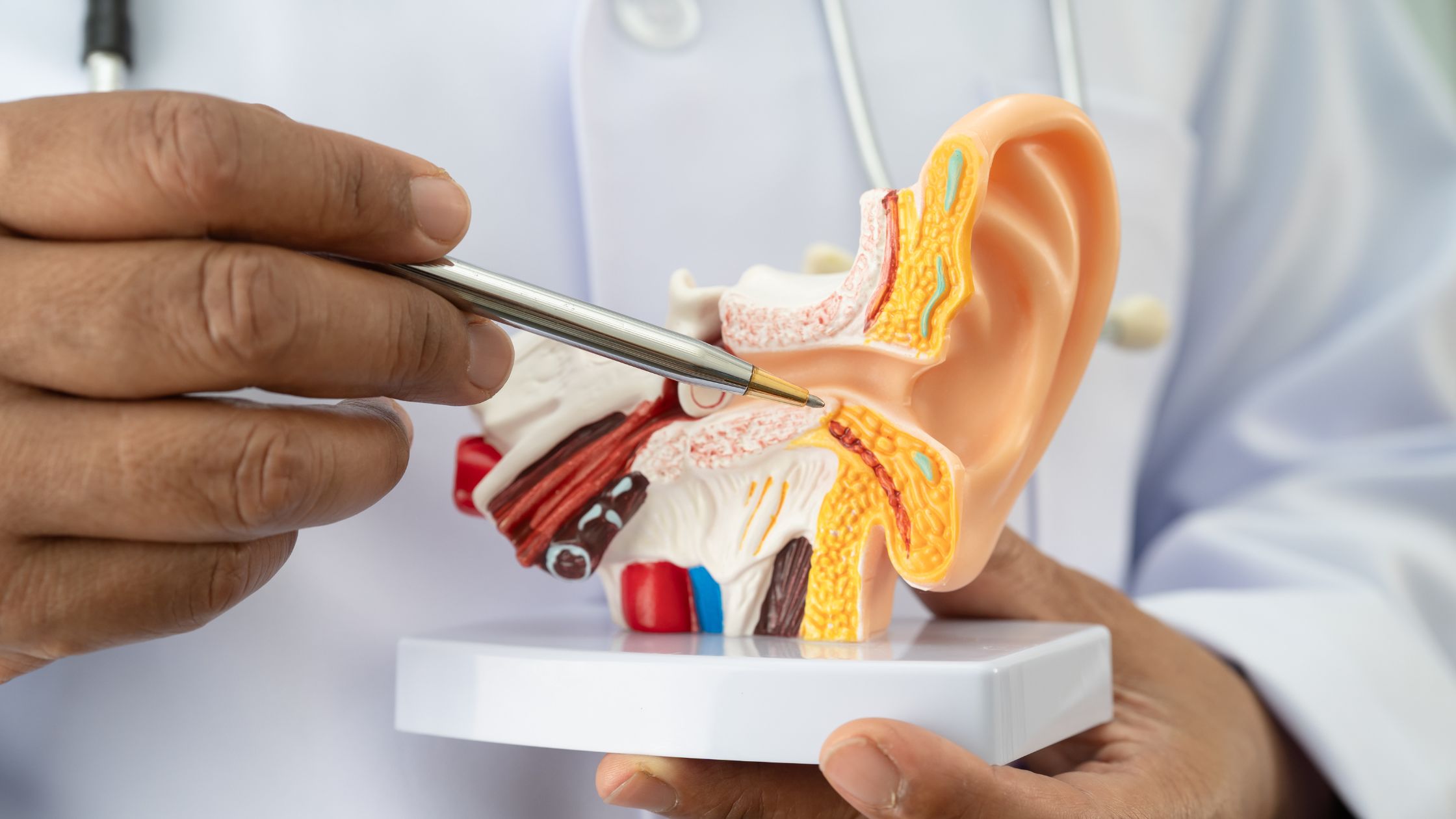

Most people with hearing loss do not ignore it because they do not care. They delay because they believe something that makes waiting feel reasonable. Hearing aids are for old people. They are bulky and obvious. A hearing test will end in a hard sell. My hearing is not bad enough yet.
The numbers show how costly that hesitation is. According to the NIDCD, 28.8 million US adults could benefit from hearing aids, yet only about 1 in 4 adults who could benefit has ever used them. Among adults aged 20 to 69, the figure drops to about 16%.
So, how can myth-busting posts help hearing clinics attract hesitant patients?
They work by naming the exact belief that keeps someone from booking, correcting it with clear evidence, and making the next step feel small and low-pressure. A hesitant patient rarely needs more persuasion. They need a reason to stop believing the thing that makes waiting feel safe.
For hearing clinics, the opportunity is not to lecture or scare people. It is to answer the doubts patients already have, in plain language, before they ever walk through the door.
Direct Answer: Why Do Myth-Busting Posts Work for Hesitant Patients?
Myth-busting posts work because hesitation around hearing care is driven more by belief than by access.
People wait a long time. Industry research published in Canadian Audiologist reports an average gap of 8.9 years between a hearing aid recommendation and actually getting one. MarkeTrak 10 data shows hearing aid owners waited about 4.2 years before even booking their first hearing test. In the UK, an Anglia Ruskin University survey of 512 private audiology patients found that 92% had delayed seeking help, and the researchers named stigma as a key reason.
A standard promotional post (“Book your free hearing test today!”) assumes the person is ready. Most are not. A myth-busting post meets them earlier, at the point where a specific misconception is doing the work of keeping them away.
The format also suits social media. A myth stated in the first line creates instant recognition (“I’ve thought that”), and the correction gives a reason to keep reading or watching. Short educational video is especially effective: Wyzowl’s 2026 video marketing survey found that 93% of video marketers say video has improved customer understanding of their product or service.
These are general benchmarks, not a guarantee of appointments. The practical goal is to remove the reasons people give themselves for waiting, so the right patients feel ready to book.
Step 1: Find the Myths That Actually Stop Bookings
The best myth-busting content does not come from a generic list. It comes from the clinic’s own front desk.
Ask audiologists and reception staff what patients say before they book, during consultations, and when they decline a fitting. Review phone call notes, website chat logs, Google reviews, social comments, and direct messages. The same handful of objections will appear again and again.
Common examples include:
- “Hearing aids are only for old people.”
- “Everyone will notice I’m wearing them.”
- “My hearing isn’t bad enough yet.”
- “I’ll just buy cheap ones online.”
- “A hearing test is just a sales pitch.”
- “Hearing aids whistle and feel uncomfortable.”
- “If I had hearing loss, I’d know.”
Rank them by how often they come up and how directly they block an appointment. Start with the myths that sit closest to the booking decision.
Step 2: Lead With the Myth, Then Correct It Clearly
The structure matters. A myth-busting post should name the belief in the first line, so the right person recognises themselves instantly.
A simple format:
- Hook: “Myth: You’d know if you had hearing loss.”
- Correction: “Hearing loss usually develops gradually, so many people adapt without realising it.”
- Proof or explanation: One sentence from an audiologist, or a credible statistic.
- Low-pressure next step: “A baseline hearing test takes about an hour and tells you where you stand.”
Avoid mocking the myth or the people who believe it. Someone who has avoided a hearing test for five years should feel understood, not corrected in public. Phrases like “It’s a common belief” or “We hear this every week” keep the tone respectful.
Confirm timings, prices, and processes with the clinic before publishing. Every clinic’s appointment length and approach differs.
Step 3: Tackle Stigma Head-On
Stigma is the hardest myth to shift because it is emotional, not factual. People worry that hearing aids will make them look older or less capable.
Use visual content to address this directly:
- A Reel showing modern devices up close, including small in-ear and rechargeable styles
- A side-by-side carousel: “What people imagine hearing aids look like” versus current models
- An audiologist explaining that hearing loss affects working-age adults too
- Short clips of real patients (with written consent) going about normal routines
The statistics support this angle. NIDCD data shows that adults aged 20 to 69 who could benefit from hearing aids are even less likely to have used them than adults over 70. Hesitation is not just a retirement-age issue.
Do not oversell invisibility. Some styles are discreet; others are not. Accuracy builds more trust than a promise the patient will later find untrue.
Step 4: Clear Up Confusion About Cost and Over-the-Counter Devices
Cost is often the real objection hiding behind other excuses. Since the FDA’s over-the-counter (OTC) hearing aid rule took effect in October 2022, patients also face a new question: why see a clinic at all?
Address this honestly. Under the FDA rule, OTC devices are intended for adults 18 and over with perceived mild to moderate hearing loss. Prescription devices remain the route for more severe loss and for children.
Useful posts include:
- “OTC or prescription hearing aids: which is right for you?”
- “Why a hearing test is still worth it, even if you buy OTC”
- “What’s included in the price of hearing aids at our clinic”
- “Questions to ask about payment plans and insurance coverage”
Do not attack OTC products. Many hesitant patients see them as a sensible first step, and criticism will read as self-interest. The stronger position is to explain that many people cannot tell whether their loss is mild, moderate, or caused by something else, such as earwax. A professional assessment answers that question first.
If the clinic does not publish prices, explain what affects cost and invite questions. Vague answers about money fuel the very hesitation the post is trying to remove.
Step 5: Show What a Hearing Test Actually Involves
Many people avoid hearing tests because they do not know what happens in one. Fear of the unknown, fear of bad news, and fear of a sales pitch combine into inaction.
Film or photograph the full appointment journey:
- Arriving at reception and the welcome process
- The sound booth and what the patient hears
- The audiologist explaining the audiogram in plain language
- What happens if no treatment is needed
- What happens if treatment is recommended, including time to think it over
A strong hook is “Myth: A hearing test is just a sales pitch.” Follow it by showing that the result is information, and that the patient decides what to do next.
Only make this promise if the clinic genuinely works this way. If staff are under sales targets that push same-day purchases, the content will create a gap between expectation and experience, and that gap will show up in reviews.
Step 6: Put Audiologists on Camera
Patients trust people, not logos. A 30-second clip of an audiologist calmly explaining a myth does more than a polished graphic.
Ideas for audiologist-led content:
- “Three things I wish patients knew before their first appointment”
- “The most common myth I hear every week”
- “What I look for on an audiogram”
- “Why I recommend a baseline test after 50”
Let them speak naturally. A slightly unpolished explanation feels more credible than a memorised script. Add captions to every video. A large share of the target audience has hearing loss, and many people watch with sound off.
Verify every credential mentioned. Use correct titles (audiologist, hearing instrument specialist, doctor of audiology) according to each person’s actual qualifications and local licensing rules.
Step 7: Handle Health Claims With Care
The link between hearing loss and cognitive decline is one of the most powerful topics a clinic can cover. It is also the easiest to overstate.
The 2024 Lancet Commission on dementia lists hearing loss among 14 potentially modifiable risk factors, accounting for about 7% of dementia cases in its analysis. The Commission also states that the evidence for treating hearing loss to reduce dementia risk has strengthened.
That is meaningful, but it is evidence of association and risk reduction, not a guarantee. Do not write “Hearing aids prevent dementia.” Write something closer to “Research identifies untreated hearing loss as a risk factor for dementia, and treating it is one step you can take.”
Fear-based content may get attention, but it can also push anxious people further away. Pair health information with reassurance and a clear, manageable next step.
Step 8: Use Real Patient Experiences, With Proper Consent
Patient stories are the most persuasive proof that a myth is wrong. A retired teacher explaining that her hearing aids are barely noticeable will outperform any statistic.
Useful formats:
- “I waited eight years. Here’s what I wish I’d known.”
- A patient describing their first test and how it felt
- A spouse or adult child describing the difference at family dinners
- A short clip of a patient demonstrating their device
Hearing clinics handle protected health information. In the US, featuring a patient on social media requires written HIPAA authorisation, and the clinic should never confirm someone is a patient in a comment reply without permission. Testimonials must reflect genuine experiences and comply with FTC endorsement rules. In the UK, equivalent GDPR and advertising standards apply.
Never script testimonials to sound more positive than the patient’s real experience. Never use AI-generated or stock “patients” presented as real.
Step 9: Speak to the Family, Not Just the Patient
This is the step most clinics miss. The person with hearing loss is often the last to accept it. Their partner, adult children, and colleagues usually notice first.
Create content addressed to them:
- “Think your parent might have hearing loss? Signs to look for”
- “How to talk to a loved one about a hearing test without starting an argument”
- “Myth: Turning the TV up is just a habit”
These posts are highly shareable because they give family members something to send. A hesitant patient may ignore a clinic advert but read a post their daughter forwarded.
Target platforms accordingly. Facebook remains strong for older patients. Instagram and short-form video often reach the adult children who influence the decision.
Step 10: Use AI to Plan Content and Measure What Builds Bookings
AI can help a clinic produce myth-busting content more efficiently and see which myths actually move patients.
Group posts by myth category, then compare each using:
- Average watch time and completion rate
- Saves and shares
- Comments that ask follow-up questions
- Profile and website visits
- Online hearing check completions
- Calls and appointment requests
- Attended hearing tests
AI tools can summarise recurring questions from comments and call notes, draft caption variations, transcribe audiologist explanations, and cut one long recording into several short clips.
Use AI to organise and repurpose genuine material, never to invent patient stories, fabricate statistics, or generate medical claims without review. Every health-related post should be checked by a qualified clinician before it is published.
A myth-busting post with modest reach but a high rate of appointment requests is worth more than a viral post that brings no bookings.
Supporting Data and Real-World Examples
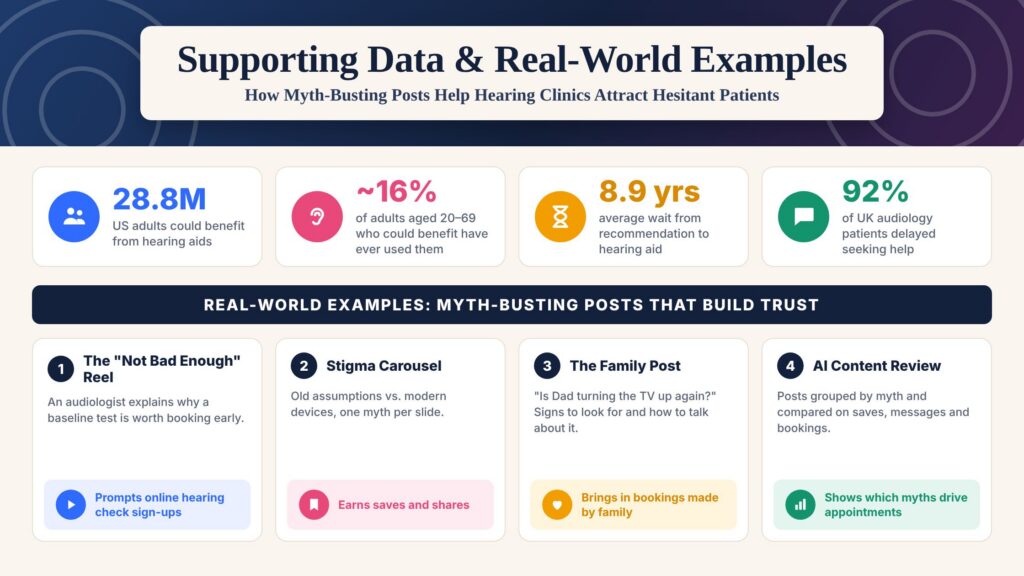
The case for myth-busting content rests on one gap: the distance between how many people need hearing care and how many actually seek it.
Key figures:
- 28.8 million US adults could benefit from hearing aids (NIDCD).
- About 16% of adults aged 20 to 69 who could benefit have ever used them, compared with about 30% of adults aged 70 and over (NIDCD).
- 8.9 years is the average reported gap between a hearing aid recommendation and adoption (Canadian Audiologist).
- 92% of UK private audiology patients surveyed had delayed seeking help (Anglia Ruskin University).
- 7% of dementia cases are linked to hearing loss in the 2024 Lancet Commission analysis.
These figures describe the market broadly, not any single clinic. Each clinic should track its own enquiry and appointment data to see which content works for its patients. The examples below are illustrative scenarios showing how the approach can play out.
Example 1: The “Not Bad Enough Yet” Reel
An audiologist records a 40-second Reel opening with: “Myth: You should wait until your hearing is really bad.” She explains that a baseline test gives a reference point and that early conversations are usually simpler.
The caption invites viewers to take the clinic’s online hearing check. The post targets people who already suspect something is wrong but have been putting it off.
Example 2: The Stigma Carousel
A clinic publishes a five-slide carousel comparing outdated assumptions with modern devices. Each slide pairs a myth (“They’re bulky”, “They whistle”, “Everyone will notice”) with a short correction and a real close-up photo.
The carousel gets saved and shared, which signals that people want to return to it or send it to someone.
Example 3: The Family Post
A Facebook post titled “Is Dad turning the TV up again?” lists five everyday signs of hearing loss and suggests a calm way to raise the subject.
Adult children share it with siblings, and the clinic starts receiving calls from family members asking how to book a test on a parent’s behalf.
Example 4: AI-Assisted Content Review
After eight weeks, the clinic reviews its myth-busting posts by category. Stigma content earns the most shares. Cost and OTC content generates the most direct messages. Hearing test walkthroughs produce the most appointment requests.
The team plans the next quarter around all three: stigma for reach, cost for conversation, and test walkthroughs for bookings.
How to Turn One Clinic Session Into Multiple Myth-Busting Posts
A single half-day recording session with one or two audiologists can produce a month of content:
- “You’d know if you had hearing loss” (audiologist Reel)
- “Hearing aids are only for old people” (carousel with device close-ups)
- “A hearing test is a sales pitch” (appointment walkthrough)
- “I’ll just buy OTC” (honest comparison post)
- “My hearing isn’t bad enough yet” (baseline test explainer)
- “Hearing aids whistle and feel uncomfortable” (fitting and adjustment clip)
- Signs a loved one may have hearing loss (family-focused post)
- A consented patient story about why they waited
This keeps production manageable and ensures every post is grounded in the clinic’s real staff, process, and equipment.
If your clinic wants a steady, compliant stream of myth-busting posts without adding work to your audiologists’ week, Socinova’s social media management services cover content planning, design, captions, and publishing at a flat monthly rate.
Conclusion: Can Myth-Busting Posts Really Help Hearing Clinics Attract Hesitant Patients?
Yes. Myth-busting posts help hearing clinics by naming the beliefs that keep people waiting, correcting them with credible information, and making the first appointment feel low-risk.
The strongest content is not the most dramatic. It is the post that makes someone who has delayed for years think, “That’s exactly what I believed, and it isn’t true.”
Use your own patients’ objections as the content plan. Put audiologists on camera. Show the hearing test honestly. Speak to families as well as patients. Handle health claims with care, obtain written consent for every patient story, and have a clinician review every medical statement before it goes live.
Then measure which myths lead to attended appointments, not just views.
Name the myth. Correct it kindly. Show the process. Make the next step small.
That is how myth-busting content turns a hesitant patient into one who finally books the test.