
Handing over a modern table for repair is one thing. Handing over a 100-year-old family heirloom is completely different.
Customers approaching an antique furniture restoration studio may own pieces with significant financial, historical, or emotional value. A cabinet may have belonged to a grandparent. A chair may be a rare period piece. A dining table may have been passed through several generations.
Before allowing someone to strip, repair, refinish, or reconstruct that furniture, customers need evidence that the studio knows what it is doing.
That creates a specific marketing challenge:
How do restoration videos build trust for antique furniture studios?
Restoration videos work because they make expertise visible. Instead of asking customers to believe claims such as “expert craftsmanship” or “decades of experience,” studios can show how damaged pieces are assessed, repaired, refinished, and preserved.
Video is particularly useful for demonstrating complex services. Wyzowl’s 2026 video marketing research found that 96% of people have watched an explainer video to learn more about a product or service, while 85% said video had convinced them to buy a product or service.
For antique furniture studios, the opportunity is not simply to create satisfying before-and-after content. It is to use video to answer the customer’s underlying question:
Can I trust you with something I cannot replace?
Direct Answer: How Do Restoration Videos Create Customer Trust?
Restoration videos build trust for antique furniture studios by showing craftsmanship, documenting careful processes, explaining restoration decisions, demonstrating respect for original materials, and providing visible proof of successful outcomes.
A prospective customer can watch how the studio handles:
- Damaged veneers
- Loose joints
- Broken components
- Scratched finishes
- Missing hardware
- Water damage
- Surface deterioration
- Previous poor repairs
This visibility reduces uncertainty.
Video also allows customers to become familiar with the craftsperson before making contact. They can hear how restorers explain problems, observe their attention to detail, and see whether preservation appears to be prioritized over shortcuts.
This matters because trust remains a major purchasing factor. Edelman’s 2025 Trust Barometer found that concerns about whether institutions and businesses act competently and ethically continue to shape public trust.
For a specialist service dealing with irreplaceable possessions, competence must be demonstrated rather than merely claimed.
Step-by-Step Breakdown: How Restoration Videos Turn Expertise Into Trust
Step 1: Start With the Furniture’s Existing Condition
A restoration video should not begin with the finished piece.
Show what arrived at the workshop.
Capture:
- Cracks
- Scratches
- Loose joints
- Missing pieces
- Damaged finishes
- Water marks
- Broken hardware
- Previous repairs
This establishes the difficulty of the project.
For example, instead of opening with a beautifully restored Victorian chest, begin with close-up footage of damaged veneer and unstable drawers.
The transformation becomes meaningful because viewers understand the starting point.
This also prevents the content from looking like a simple furniture makeover. Antique restoration is specialized work, and the video should communicate that difference.
Step 2: Explain the Assessment Before Showing the Repair
One of the strongest trust-building moments happens before restoration begins.
Show the craftsperson inspecting the furniture and briefly explaining what they find.
For example:
“This joint has already been repaired once, so before we touch the finish, we need to stabilize the structure.”
That sentence demonstrates expertise more effectively than a generic claim about quality.
Studios can explain:
- Approximate construction techniques
- Materials present
- Structural problems
- Previous alterations
- Finish condition
- Proposed restoration approach
Educational explanation turns the video from entertainment into evidence of professional judgment.
Step 3: Show the Process, Not Just the Transformation
Before-and-after footage is engaging, but customers considering an expensive restoration need more information.
Show what happens between those two moments.
Depending on the project, footage could include:
- Careful disassembly
- Joint repair
- Veneer replacement
- Cleaning
- Surface preparation
- Wood matching
- Hardware restoration
- Finish application
- Hand polishing
- Reassembly
Close-up footage works especially well because viewers can observe precision.
Wyzowl reports that 89% of consumers say video quality affects their trust in a brand.
The footage does not need cinematic production, but customers should clearly see the details being discussed.
Step 4: Explain Why Certain Decisions Were Made
Trust increases when customers understand that restoration is not simply about making old furniture look new.
Sometimes preservation is more important than perfection.
A restorer might explain:
“We could replace this entire section, but the original veneer is still recoverable, so we’re preserving as much of it as possible.”
That communicates judgment.
Videos can explain decisions such as:
- Repair versus replacement
- Cleaning versus stripping
- Preserving patina
- Matching replacement wood
- Retaining original hardware
- Reversing previous repairs
- Selecting an appropriate finish
This type of content can separate a specialist restoration studio from general furniture repair services.
Step 5: Use Before-and-After Reveals as Proof
Once viewers understand the work involved, show the finished result.
Use comparable camera angles whenever possible.
If the “before” footage shows the front-left corner of a damaged cabinet, capture the restored version from approximately the same position.
This makes improvements easier to evaluate.
Highlight details such as:
- Repaired joints
- Restored veneer
- Improved finish
- Repaired drawers
- Reinstalled hardware
- Preserved original features
The final reveal creates emotional impact, but it also functions as a portfolio.
Over time, dozens of restoration videos create a searchable body of evidence demonstrating what the studio can handle.
Step 6: Feature the Craftsperson Behind the Work
Customers are not trusting a logo with their furniture.
They are trusting people.
Videos should occasionally show the restorer explaining the project directly.
Potential topics include:
“Why we don’t automatically strip every antique.”
“How we decide whether old hardware should be replaced.”
“What happens during an antique furniture assessment?”
“Can damaged veneer actually be restored?”
This type of educational content demonstrates expertise while making the business more approachable.
Short-form video remains particularly valuable here. HubSpot’s 2026 State of Marketing research identifies short-form video as the media format marketers most commonly report as producing their highest ROI.
For restoration studios, even a 30-second explanation can answer a concern that might otherwise prevent an inquiry.
Step 7: Use AI to Improve Video Planning Without Replacing Craftsmanship
AI can make restoration marketing more efficient without becoming the focus of the content.
A studio could use AI to analyze:
- Frequently asked customer questions
- Search queries
- Reel comments
- Website inquiries
- Video retention
- High-performing restoration categories
- Customer objections
Suppose videos about veneer repair consistently receive more saves than general refinishing videos.
That is useful information.
The studio could produce more content such as:
- Can antique veneer be repaired?
- When should damaged veneer be replaced?
- How do restorers match missing veneer?
- Why is antique veneer different from modern laminate?
McKinsey’s 2025 State of AI report found that 71% of surveyed organizations regularly used generative AI in at least one business function, with marketing and sales among the most common areas of use.
AI can also help generate video outlines, organize content calendars, summarize performance data, and create multiple caption options.
It should not be used to fabricate restorations, customer results, or historical facts about furniture.
For trust-based businesses, authenticity remains essential.
Step 8: Address Common Customer Fears Directly
Some of the best restoration videos can be built around objections.
Potential customers may worry:
“Will restoration reduce the value?”
“Will you remove the original finish?”
“Can the original parts be preserved?”
“What if replacement wood doesn’t match?”
“How long will restoration take?”
Create individual videos addressing these questions.
Do not make universal promises. Antique furniture varies considerably, and the appropriate treatment depends on the piece.
Instead, explain how the studio evaluates each situation.
That transparency can make potential customers more comfortable requesting an assessment.
Supporting Data and Real-World Examples
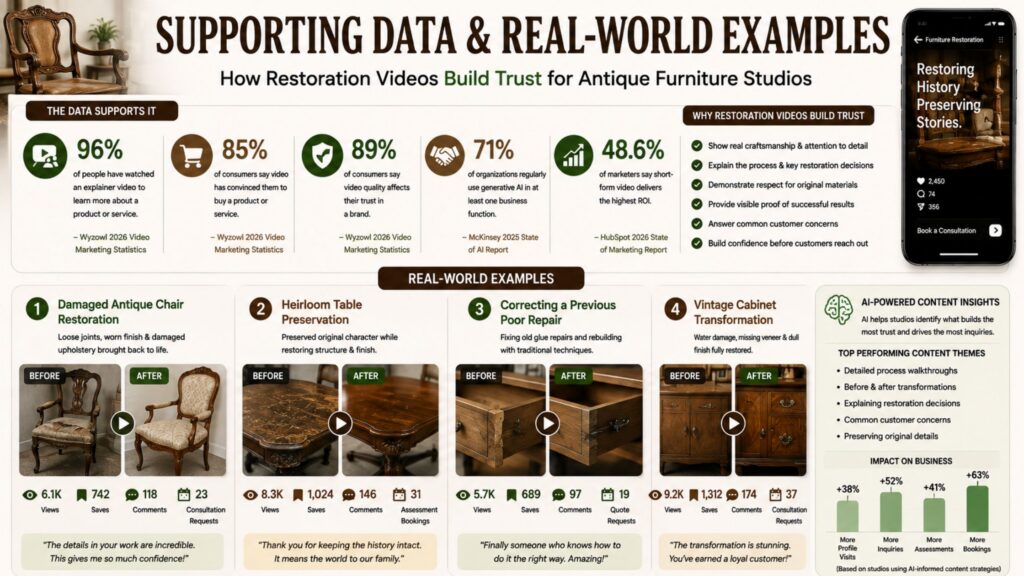
Example 1: Damaged Antique Chair Restoration
A studio receives an antique chair with loose joints, worn upholstery, and surface damage.
Instead of posting only the completed chair, it creates a video sequence:
Part 1: Condition assessment
Part 2: Structural repair
Part 3: Surface restoration
Part 4: Final reveal
Each video explains one part of the process.
By the final video, viewers understand how much expertise went into the restoration.
The series builds more credibility than a single finished photograph.
Example 2: Preserving a Family Heirloom
A customer brings in a dining table inherited from a grandparent.
The restoration studio documents the process while explaining which original features can be preserved.
The finished video focuses not simply on making the table attractive, but on retaining its character.
This approach addresses an important emotional factor: customers with heirlooms are often purchasing preservation, not merely repair.
Example 3: Correcting a Previous Repair
A cabinet arrives after an unsuccessful previous repair.
The studio shows the existing issue, explains why the earlier solution failed, and demonstrates how the repair is carefully corrected.
This is powerful educational content because it demonstrates diagnostic expertise.
The viewer learns why specialist restoration matters.
Example 4: AI-Assisted Content Planning
A restoration studio reviews six months of social media performance.
It discovers that:
- Structural repair videos generate the longest watch time.
- Before-and-after reveals receive the most shares.
- Videos explaining restoration decisions receive the most inquiries.
- Quick polishing videos receive views but fewer qualified leads.
AI can help organize these signals and identify patterns.
The studio can then prioritize content that generates customer confidence rather than chasing views alone.
Turn Restoration Videos Into a Trust-Building Content Series
A single transformation video can attract attention.
A consistent restoration library builds authority.
Studios can create recurring series such as:
- Restoration of the Week
- Inside the Workshop
- Before We Restore
- What Would You Repair?
- Saving Original Details
- Restoration Mistakes
- From Workshop to Home
Each series should reinforce a specific part of the studio’s expertise.
Longer articles can also link viewers to relevant furniture restoration service pages, project galleries, consultation pages, or detailed guides explaining restoration techniques.
For businesses developing a broader visual content strategy, Socinova can be internally linked alongside relevant social media marketing or video content services.
Measure Trust Signals, Not Just Views
A viral restoration video is not necessarily the most valuable video.
Studios should monitor:
- Saves
- Shares
- Profile visits
- Website clicks
- Direct messages
- Assessment requests
- Quote inquiries
- Consultation bookings
A video with 5,000 highly relevant views and five restoration inquiries may be commercially more valuable than a satisfying transformation video with 500,000 international views and no qualified leads.
Comments can also reveal trust.
Questions such as “Can you restore something like mine?” or “Do you work on 19th-century cabinets?” indicate stronger commercial intent than generic reactions.
Track which videos create those conversations.
Conclusion
Restoration videos build trust for antique furniture studios because they allow customers to see the expertise that would otherwise remain hidden inside the workshop.
The most effective videos show the original condition, explain the assessment, document important restoration stages, justify key decisions, and reveal the final result.
Before-and-after footage creates attention.
The process creates credibility.
Education creates confidence.
AI can support this strategy by identifying customer questions, analyzing content performance, and helping studios plan more relevant videos. But it should remain behind the scenes.
The most persuasive content is still authentic footage of skilled craftspeople carefully working on real furniture.
For someone deciding whether to hand over a valuable antique or irreplaceable family heirloom, that visibility matters.
The customer does not simply need to know that a studio can restore furniture.
They need enough evidence to believe:
“I can trust these people with mine.”