
A damaged dresser, faded dining table, scratched cabinet, or worn antique may not look valuable to the average customer.
A furniture restorer sees something different.
They see the original timber beneath an old finish, joints that can be repaired, details worth preserving, and a piece that could look completely different after skilled restoration.
The challenge is showing prospective clients that transformation before they decide to discard, replace, or sell the furniture.
So, can transformation Reels attract clients for furniture restoration studios?
Yes. Transformation Reels can attract clients by showing visible proof of restoration skill, demonstrating what can be saved, explaining the work behind the result, and helping customers imagine similar possibilities for furniture they already own.
The wider video data supports using this format. Wyzowl’s 2026 research found that 85% of video marketers say video has helped generate leads, 83% say it has directly increased sales, and 93% say it has increased customer understanding of products or services.
Furniture restoration is particularly suited to video because every project already contains a natural story:
Damaged piece → assessment → restoration → reveal.
Direct Answer: Why Do Furniture Transformation Reels Attract Clients?
Transformation Reels work because they replace claims with evidence.
A studio can say:
“We restore antique furniture.”
Or it can show a scratched, faded cabinet becoming a polished statement piece in 40 seconds.
The second approach demonstrates capability immediately.
This matters because customers considering restoration may not know whether their furniture can be repaired, whether restoration is worth pursuing, or what the finished result might look like.
Video helps close that information gap. Wyzowl reports that 96% of consumers have watched an explainer video to learn about a product or service, 85% have been convinced to purchase after watching video, and 89% say video quality affects their trust in a brand.
For a restoration studio, the Reel becomes a portfolio, process explanation, and trust-building asset at the same time.
Step 1: Make the Original Condition Impossible to Miss
Do not rush through the “before.”
It establishes the value of everything that follows.
Film:
- Scratches
- Faded finishes
- Water marks
- Loose joints
- Damaged veneer
- Broken components
- Paint buildup
- Worn surfaces
- Missing hardware
Start with a hook such as:
“Would you restore this or replace it?”
Or:
“This 60-year-old dresser was almost thrown away.”
Or:
“Can this damaged table be saved?”
These openings create curiosity because viewers want to see whether the piece is recoverable.
Capture a wide shot as well as close-ups. The wide shot establishes the furniture’s overall condition, while close-ups prove the damage is genuine.
Step 2: Explain What Is Actually Wrong
A transformation becomes more credible when viewers understand the problem.
Instead of jumping immediately from damaged furniture to sanding footage, explain the assessment.
For example:
“The finish was badly worn, but the timber underneath was still in good condition.”
Or:
“The biggest problem wasn’t cosmetic. Two joints had become loose and needed structural repair.”
This demonstrates expertise.
Potential clients begin learning that professional furniture restoration involves diagnosis and decision-making, not simply repainting old furniture.
That education can reduce uncertainty before someone requests a quote.
Step 3: Show Enough Process to Prove the Work
The middle of the Reel is where craftsmanship becomes visible.
Depending on the project, show:
Cleaning
Disassembly
Finish removal
Sanding
Veneer repair
Joint repair
Wood filling
Staining
Painting
Hardware restoration
Polishing
Reassembly
Avoid showing every step at equal length.
Select the moments that demonstrate skill or produce visible progress.
A practical 45-second Reel might use:
0–5 seconds: damaged furniture
5–10 seconds: assessment
10–25 seconds: restoration stages
25–35 seconds: finishing details
35–42 seconds: completed reveal
42–45 seconds: inquiry CTA
This fits broader short-form trends. HubSpot’s 2026 marketing data ranks short-form video as the highest-ROI content format, cited by approximately 49% of marketers, ahead of long-form video and live streaming.
Step 4: Highlight One Restoration Skill Per Reel
Do not make every video a generic before-and-after.
Use individual projects to demonstrate specific capabilities.
For example:
Removing Decades of Old Finish
Repairing Damaged Veneer
Restoring Original Hardware
Fixing Loose Furniture Joints
Bringing Faded Timber Back to Life
Restoring an Antique Dining Table
Repairing a Damaged Drawer
This helps potential clients understand the range of problems your studio can solve.
It also makes your content more searchable and relevant.
Someone with damaged veneer may not be searching broadly for “furniture inspiration.” They may be trying to determine whether damaged veneer can be repaired.
A Reel demonstrating exactly that problem can attract a much higher-intent viewer.
Step 5: Build the Reel Around the Reveal
The final transformation is the payoff.
Do not let it appear for half a second at the end.
Give viewers time to see:
The full piece
Restored details
Wood grain
Hardware
Finish quality
Repaired areas
Where possible, shoot the final furniture from the same position as the original “before” footage.
This makes the transformation instantly understandable.
You can also use a split-screen:
Before | After
Or a fast transition:
Damaged → Restored
The objective is not simply to create a satisfying edit. It is to make the improvement clear enough that a prospective customer can imagine what restoration could do for their own furniture.
Step 6: Tell the Story Behind Sentimental Furniture
Not every restoration decision is purely financial.
Some furniture has emotional value.
A customer may own:
A grandparent’s dresser
A family dining table
An inherited cabinet
A childhood rocking chair
A vintage piece from a family home
With permission, tell that story.
For example:
“This dining table has been in our client’s family for three generations. They wanted to keep its character while making it usable again.”
Now the Reel is not merely about refinishing timber.
It becomes a story about preservation.
This human context can differentiate restoration studios from generic furniture makeover accounts.
It is particularly valuable as marketing becomes increasingly automated. HubSpot reports that 80% of marketers use AI for content creation and 75% use it for media production, while its 2026 research emphasizes the value of human-led marketing for trust and connection.
Real objects with real histories give restoration studios material that AI cannot authentically recreate.
Step 7: Explain Restoration Decisions
Transformation videos become more persuasive when viewers understand why certain decisions were made.
For example:
Why preserve the original hardware?
Why repair rather than replace the veneer?
Why use a particular finish?
Why was one damaged area reconstructed?
Why wasn’t the entire piece stripped?
This positions the studio as a specialist rather than simply someone performing cosmetic makeovers.
A useful format is:
“Three decisions we made while restoring this cabinet.”
Show each decision alongside footage of the work.
This combines education with proof of expertise.
Step 8: Create Reels Around High-Intent Client Questions
Look at questions customers ask before requesting a quote.
These may include:
Can water-damaged furniture be restored?
Can scratched wood furniture be repaired?
Is antique furniture worth restoring?
Can painted furniture be returned to natural wood?
Can damaged veneer be repaired?
How long does furniture restoration take?
Can you restore sentimental furniture without removing its character?
Turn each question into a transformation Reel.
For example:
“Can damaged veneer actually be repaired? Watch what we did with this cabinet.”
The transformation provides the answer.
This is stronger than a generic FAQ because viewers see evidence alongside the explanation.
Step 9: Show the Craftsperson Occasionally
Furniture restoration is skilled human work.
Let potential clients see who will handle their furniture.
The restorer can briefly explain:
What they discovered during assessment
Which repair was most difficult
Why they chose a particular approach
What original detail they wanted to preserve
What changed during the restoration
This builds familiarity before an inquiry.
It also gives the studio a recognizable identity instead of making the account feel like an anonymous collection of furniture photos.
Video remains particularly useful for this type of communication. In Wyzowl’s 2026 survey, 84% of consumers said they want to see more videos from brands, while 63% preferred short video when learning about a product or service.
Step 10: Use AI to Identify Which Transformations Generate Inquiries
AI can help restoration studios distinguish between content that earns views and content that attracts potential customers.
Categorize Reels by project type:
Antique restoration
Dining tables
Dressers
Cabinets
Veneer repairs
Paint removal
Structural repairs
Sentimental furniture
Then compare:
Views
Watch time
Saves
Shares
Profile visits
Website clicks
Direct messages
Quote requests
Booked projects
Suppose paint-removal videos generate the most views, but antique cabinet transformations generate the most quote requests.
That distinction should influence future content.
AI can help summarize these patterns, categorize comments, identify recurring questions, transcribe videos, create caption variations, and repurpose long restoration footage.
AI is already deeply integrated into marketing. HubSpot’s 2026 research found that 86.4% of marketing teams use AI in at least some marketing areas, with content creation and media creation among the most common applications.
Wyzowl also found that 63% of video marketers use AI tools to help create or edit videos, up from 51% the previous year.
The important distinction is this:
Use AI to improve how real restoration work is marketed. Do not use AI to fabricate transformations.
Step 11: Use a Quote-Focused CTA
A transformation Reel should make the next action obvious.
Avoid ending every post with:
“Follow for more.”
That may grow an audience but does little to capture high-intent prospects.
Try:
“Have a piece you think is beyond repair? Send us photos for an assessment.”
“Have an inherited piece you’d like restored? Request a restoration quote.”
“Thinking about restoring an old dining table? Send photos and dimensions to discuss the project.”
The CTA should match the transformation viewers just watched.
Someone with similar furniture can immediately understand what to do next.
Supporting Data and Real-World Examples
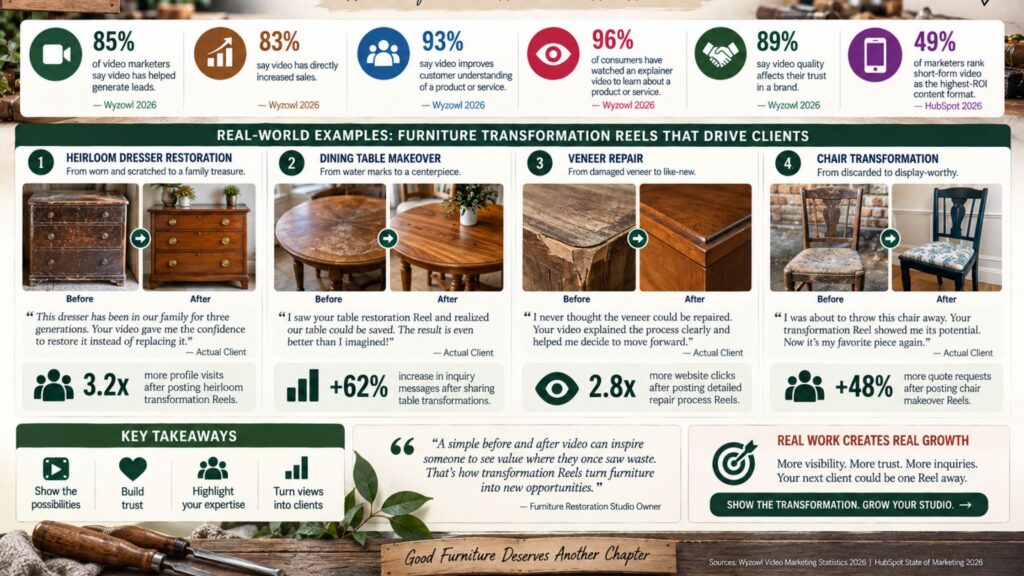
Example 1: Heirloom Dresser Transformation
A client brings in a dresser inherited from a grandparent.
The Reel starts with scratches, faded finish, and damaged hardware.
Viewers then see assessment, repairs, surface preparation, refinishing, hardware restoration, and the final piece.
The caption explains which original details were preserved.
The result demonstrates technical skill while addressing customers who own sentimental furniture.
Example 2: Painted Table Back to Natural Wood
The opening hook asks:
“What’s underneath decades of paint?”
The Reel shows careful removal, surface preparation, repairs, finishing, and the restored timber.
This works because the transformation contains genuine visual suspense.
It can also attract people wondering whether their own painted furniture has restoration potential.
Example 3: Damaged Veneer Repair
Instead of hiding the damaged section, the studio begins with a close-up.
The restorer explains what can be repaired and shows key stages.
The finished shot returns to the same area.
The Reel does more than display a beautiful result. It answers a specific service question through visual proof.
Example 4: AI-Assisted Content Analysis
Imagine a restoration studio reviews six months of Reels and discovers:
Fast before-and-after videos: highest reach.
Sanding videos: highest watch time.
Educational repair videos: highest saves.
Heirloom transformations: highest profile visits.
Detailed antique restorations: highest quote requests.
The studio now knows which videos should be optimized for awareness and which should be optimized for inquiries.
Wyzowl’s 2026 data supports measuring video beyond surface-level engagement. 67% of video marketers measure ROI through views and 63% through engagement, but 52% track leads or clicks and 32% measure bottom-line sales.
For restoration businesses, quote requests and completed projects are ultimately more valuable than views alone.
Turn One Restoration Into Multiple Content Assets
One restoration project can create an entire content series:
- Initial condition walkthrough
- Can This Be Saved? Reel
- Assessment video
- Repair close-up
- Stripping or preparation time-lapse
- Technique explanation
- Mid-project update
- Finishing process
- Before-and-after Reel
- Full restoration story
- FAQ Reel
- Finished furniture showcase
This allows studios to create more content without manufacturing new projects solely for social media.
Wistia’s 2026 video research found that businesses are being asked to produce more video across more channels while getting greater mileage from existing assets, based on analysis of more than 13 million videos and 79 million viewing hours.
AI can further assist by transcribing workshop explanations, identifying strong clips, generating hook variations, organizing footage, and repurposing one project across Instagram Reels, TikTok, YouTube Shorts, websites, and email.
Businesses looking to build a structured content strategy around transformation-based services can explore Socinova and connect this article internally with relevant social media marketing, content creation, Instagram marketing, and video marketing services.
Why Transformation Reels Fit Furniture Restoration So Well
Furniture restoration has almost every ingredient needed for compelling short-form video.
There is:
A visible problem
A skilled process
Gradual progress
Human craftsmanship
Visual suspense
A dramatic result
The studio does not need to invent a storyline.
The project already provides one.
Short-form video also remains commercially relevant. HubSpot reports that it is the most-used media format among marketers and the leading format for ROI in 2026.
Meanwhile, Wyzowl reports that 82% of marketers say video delivers good ROI, 85% say it generates leads, 83% say it directly increases sales, and 82% say it increases website traffic.
These are general video-marketing benchmarks rather than furniture-restoration-specific conversion guarantees, but they demonstrate why studios should test transformation video as part of their client acquisition strategy.
Conclusion: Can Transformation Reels Really Attract Furniture Restoration Clients?
Yes. Transformation Reels can attract clients for furniture restoration studios because they show prospective customers something difficult to communicate through text alone:
what is possible.
A scratched table can become a centerpiece.
A damaged dresser can become usable again.
An inherited cabinet can retain its history while being restored for another generation.
The strongest Reels make that transformation believable by showing the original condition, assessment, repair process, craftsmanship, restoration decisions, and final reveal.
The wider video benchmarks reinforce the opportunity. Short-form video leads HubSpot’s 2026 ROI rankings, while Wyzowl reports that 85% of video marketers say video helps generate leads and 83% say it directly increases sales.
AI can make the strategy more efficient by analyzing performance, categorizing inquiries, repurposing footage, identifying customer questions, and assisting with editing.
But the core marketing asset should remain completely real:
A real damaged piece.
A real restoration process.
A real craftsperson.
A real transformation.
Instead of telling prospective customers that their furniture might be worth saving, show them what happened when another customer decided to restore theirs.