

Planning a trip involves more than selecting flights, hotels, and activities.
For many travelers, the hardest part is imagining what the experience will actually feel like.
Will the itinerary flow smoothly? Is the destination suitable for their travel style? Will the accommodation match expectations? Will the experiences feel worth the investment?
Travel planners solve these uncertainties, but communicating that value online can be challenging.
A simple destination photo may show where someone can go. A customer journey post shows how the entire experience unfolds.
So, can customer journey posts attract clients for travel planners?
Yes. Customer journey posts can attract clients by demonstrating the complete travel experience from planning to return, showing real outcomes, reducing booking uncertainty, and helping potential customers visualize themselves taking a similar trip.
This approach aligns with how travelers increasingly discover and evaluate destinations. Social platforms such as Instagram, TikTok, YouTube, and Pinterest have become major sources of travel inspiration and planning information, with travelers often using visual content before making decisions.
Short-form video and visual storytelling also continue to perform strongly. HubSpot’s marketing research identifies short-form video as one of the highest-return content formats, with many marketers using it to increase engagement and conversions.
For travel planners, the opportunity is clear:
Do not only show destinations. Show the journey customers experience when they trust you to plan it.
Direct Answer: Why Do Customer Journey Posts Work for Travel Planners?
Customer journey posts work because they transform a service that is often invisible into a visible experience.
A travel planner does not simply sell:
- Flights
- Hotels
- Tours
- Activities
They sell:
- Confidence
- Convenience
- Personalization
- Time savings
- Expert recommendations
- A smoother travel experience
A destination image can create interest.
A journey story creates trust.
For example:
A post saying:
“Explore Japan this spring.”
creates awareness.
A journey post saying:
“How we planned a 10-day Japan trip for a couple who wanted food experiences, cultural activities, and a relaxed itinerary.”
Shows expertise.
Travel planning often involves a high-consideration purchase. Customers want evidence that someone understands their preferences before committing money.
Research into social media and travel behaviour has found that social media feedback and travel-related content can influence future trip planning decisions. One 2025 study examining Indian travelers found that social media engagement signals were linked with future travel-planning behaviour.
Customer journey posts provide exactly that type of decision-supporting content.
Step 1: Start With the Traveler’s Goal
The strongest customer journey posts begin with the reason behind the trip.
Do not start with:
“Our client visited Italy.”
Start with:
“This couple wanted their first Italy trip to include local food, historic cities, and enough downtime to relax.”
The goal creates context.
Every traveler has a different motivation:
- Honeymoon
- Family vacation
- Luxury escape
- Adventure trip
- Cultural experience
- Business travel
- Solo exploration
- Multi-generational holiday
When potential clients see a journey similar to their own situation, they are more likely to imagine working with the travel planner.
A customer journey post should answer:
Who was this trip designed for?
What problem did the planner solve?
What experience was created?
Step 2: Show the Planning Process Behind the Trip
Many customers underestimate how much work goes into creating a successful itinerary.
Use content to reveal the process.
Show:
- Destination research
- Hotel comparisons
- Activity selection
- Route planning
- Local recommendations
- Travel documents
- Personalized itinerary creation
For example:
“How we planned a 12-day European itinerary without unnecessary backtracking.”
This demonstrates expertise.
It also explains why hiring a travel planner can be valuable compared with spending hours researching independently.
The content should not reveal private client information. Avoid showing personal documents, booking details, passport information, or confidential data.
Instead, focus on the expertise involved.
Step 3: Tell the Trip Story in Stages
Customer journey posts work best when they follow a timeline.
A simple structure:
Before Travel
Show:
- Client goals
- Destination planning
- Itinerary creation
During Travel
Show:
- Experiences
- Locations
- Food
- Activities
- Highlights
After Travel
Show:
- Client feedback
- Favourite moments
- Lessons learned
This structure creates a complete narrative.
The audience understands that the travel planner was involved before, during, and after the trip.
That is important because many travelers are not only paying for recommendations. They are paying for confidence throughout the journey.
Step 4: Use Before-and-After Planning Stories
Travel planners can create powerful transformation content.
Examples:
Before:
“Client wanted a European vacation but had no idea where to start.”
After:
“A customized 14-day itinerary covering three countries with balanced travel days.”
Or:
Before:
“Family wanted a stress-free Disney vacation.”
After:
“A complete plan including hotels, dining, park schedules, and activities.”
This format communicates problem-solving.
The customer is not only seeing a destination.
They are seeing a challenge being solved.
Step 5: Highlight Personalized Recommendations
Generic travel advice is everywhere.
Personalized recommendations demonstrate expertise.
Instead of posting:
“Best restaurants in Paris.”
Create:
“Three Paris experiences we recommended for a couple who wanted local food away from tourist-heavy areas.”
Instead of:
“Best beaches in Greece.”
Create:
“Why we selected this Greek island for a family looking for quieter beaches.”
Personalization is one of the strongest advantages travel planners have over generic online searches.
Customer journey content makes that advantage visible.
Step 6: Use Client Stories as Social Proof
Travel purchases involve trust.
People want evidence that someone else had a positive experience.
Customer journey posts can include:
- Client testimonials
- Travel photos
- Favorite moments
- Short interviews
- Reviews
- Reactions after returning home
For example:
“What our client loved most about their Iceland adventure.”
Or:
“The three moments this family said made the trip unforgettable.”
Social proof helps reduce uncertainty.
Travel decisions are emotional. Seeing real people enjoying a planned experience can make the service feel more trustworthy.
Step 7: Show the Details Travelers Often Worry About
Many travel decisions are delayed because customers have unanswered questions.
Create journey posts addressing concerns:
How much planning is involved?
What happens if plans change?
How do you choose accommodations?
How do you create realistic itineraries?
How do you plan travel days?
What support is available during the trip?
These posts position the travel planner as a problem solver.
They also attract customers who are actively looking for help.
Step 8: Create Journey Posts for Specific Audiences
Avoid creating only broad travel content.
Different travelers have different priorities.
Create journey stories for:
Families
Example:
“Planning a stress-free family vacation to Italy.”
Couples
Example:
“Creating a romantic anniversary getaway.”
Luxury Travelers
Example:
“Designing a private luxury experience.”
Adventure Travelers
Example:
“Planning a hiking-focused Iceland itinerary.”
Seniors
Example:
“Creating a comfortable European journey with slower travel days.”
Specific content attracts specific customers.
A person searching for a family vacation planner is more likely to engage with family-focused journey content than a general destination post.
Step 9: Use AI to Identify High-Performing Travel Stories
AI can help travel planners understand which customer journeys attract the most qualified inquiries.
Analyze:
- Destination content
- Trip types
- Client demographics
- Engagement rates
- Saves
- Shares
- Website visits
- Consultation requests
For example:
A travel planner may discover:
Luxury travel posts: highest saves.
Family trip stories: highest inquiries.
Adventure content: highest engagement.
Client testimonials: highest conversion rate.
This helps create content based on business goals.
AI can assist with:
- Content categorization
- Caption ideas
- Customer question analysis
- Video editing
- Performance summaries
- Repurposing testimonials
However, customer stories should remain authentic.
AI should organize and improve storytelling, not create fake travel experiences.
Step 10: Connect Content to a Consultation
The goal of customer journey posts is not only engagement.
It is attracting travelers who need planning assistance.
Use specific CTAs:
“Planning a similar trip? Book a travel consultation.”
“Need help creating your perfect itinerary? Let’s start planning.”
“Tell us your dream destination and we’ll help build the journey.”
The CTA should match the content.
Someone watching a honeymoon journey should not receive a generic sales message.
They should receive an invitation relevant to their travel goal.
Supporting Data and Real-World Examples
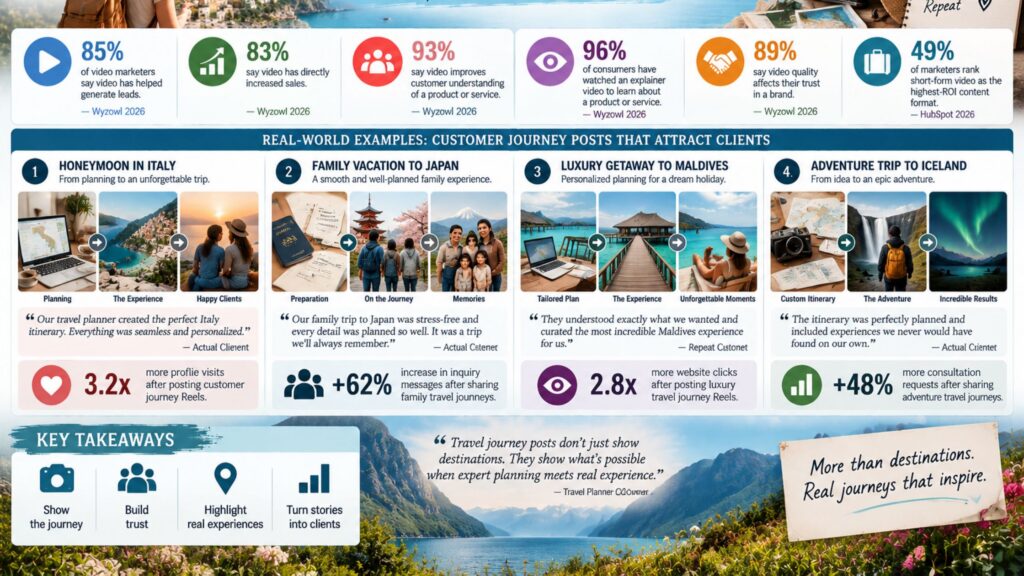
Example 1: Honeymoon Journey
A travel planner shares:
- Couple’s goals
- Destination selection
- Hotel recommendations
- Romantic experiences
- Final memories
The content demonstrates emotional understanding, not just booking ability.
Example 2: Family Vacation Planning
A Reel shows how a family trip was created.
It highlights:
- Child-friendly activities
- Convenient hotels
- Balanced schedules
- Transportation planning
Parents watching can immediately see the value of professional planning.
Example 3: Luxury Travel Experience
A journey post explains how a luxury itinerary was customized.
It shows:
- Private experiences
- Premium accommodations
- Personalized recommendations
This attracts customers looking for expertise rather than basic booking assistance.
Example 4: AI-Assisted Content Analysis
A travel planner reviews content performance and discovers:
Destination photos: high reach.
Customer journeys: highest saves.
Testimonials: highest inquiries.
Planning process videos: highest consultation conversions.
The planner can then invest more effort into content formats that support business growth.
Turn One Client Trip Into Multiple Content Assets
One customer journey can create:
- Trip announcement
- Planning process Reel
- Destination highlights
- Hotel selection explanation
- Activity recommendations
- Client testimonial
- Final trip recap
- Lessons learned
- Travel tips
- FAQ content
This makes customer journeys valuable long after the traveler returns.
Businesses looking to create a structured content strategy around storytelling can explore Socinova and connect this article internally with relevant social media marketing, content creation, Instagram marketing, and video marketing services.
Why Customer Journey Content Fits Travel Marketing
Travel is naturally story-driven.
Every trip has:
- A dream
- A challenge
- A plan
- An experience
- A memory
Customer journey posts use that natural structure.
They also match how travelers increasingly discover destinations. Social media platforms are becoming important travel research tools, with travelers using visual content to explore destinations, gather ideas, and influence decisions.
For travel planners, this creates an opportunity.
Instead of competing only on destinations and prices, they can compete on expertise and experience.
Conclusion: Can Customer Journey Posts Really Attract Travel Planning Clients?
Yes. Customer journey posts can attract clients for travel planners because they show the complete value of professional travel planning.
They demonstrate research, personalization, problem-solving, destination knowledge, and real customer outcomes.
The strongest posts do not simply show where someone traveled.
They explain:
Why the trip was created.
How it was planned.
What challenges were solved.
What memories were created.
Travel planning is ultimately about creating confidence before the journey begins.
Customer journey posts allow potential clients to experience that confidence before they ever book a consultation.
Instead of telling travelers:
“We create unforgettable trips.”
Show them the journey that made one possible.