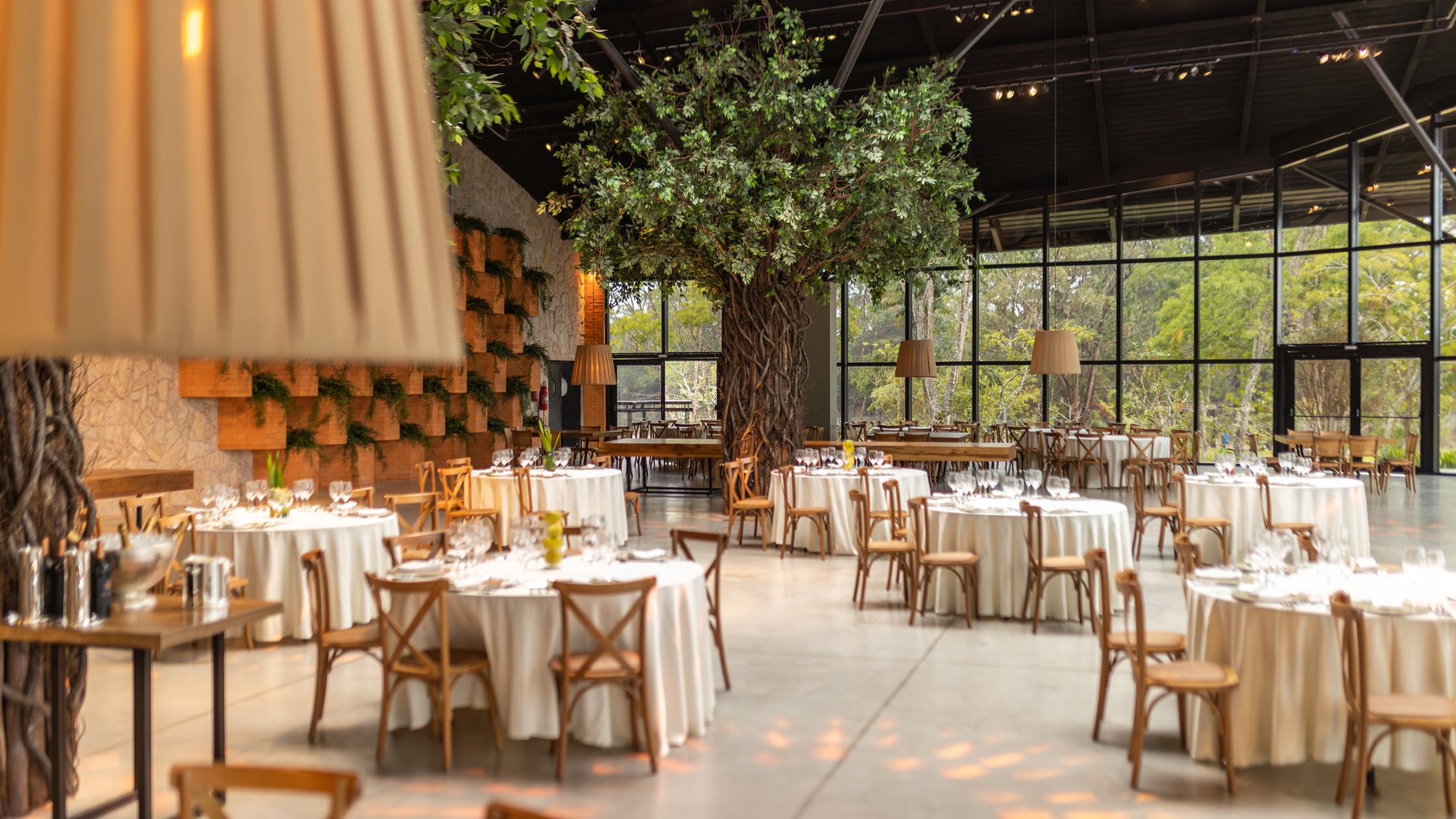

Restaurant discovery has become increasingly visual. Before making a reservation, diners often want to see the food, atmosphere, presentation, and overall experience they can expect.
That makes short-form video particularly valuable for restaurants.
Instead of posting a static menu graphic, restaurants can use menu spotlight reels to show signature dishes being prepared, plated, served, and enjoyed. A 15-second video of pasta being finished tableside or a dessert being sliced can communicate an experience that a written menu description cannot.
Short-form video is also one of the strongest-performing marketing formats. HubSpot’s 2025 marketing research found that 21.02% of marketers identified short-form video as the content format delivering the highest ROI.
This raises an important question:
How can menu spotlight reels increase bookings for restaurants?
Menu spotlight reels can increase bookings by creating appetite appeal, reducing uncertainty about the dining experience, giving customers specific reasons to visit, and connecting that interest directly to a reservation call-to-action.
For restaurants competing for local attention, the reel is not simply content. Done correctly, it becomes a visual bridge between discovery and reservation.
Direct Answer
Menu spotlight reels can increase restaurant bookings by transforming individual dishes into visual reasons to visit, building desire through short-form video, showcasing the quality of the dining experience, and directing interested viewers toward reservations.
A strong menu reel can help a restaurant:
- Showcase signature dishes
- Generate cravings and interest
- Introduce new menu items
- Build familiarity before a visit
- Increase shares and saves
- Promote limited-time dishes
- Drive viewers toward reservation links
The opportunity is particularly strong because younger diners increasingly discover restaurants socially. Recent reporting on a 2025 survey found that 73% of Gen Z and millennial respondents had visited a restaurant based on a social media review within the previous three months, while nearly 44% primarily used social media for restaurant discovery.
Restaurants therefore need content that does more than accumulate views. It should make viewers think, “I want to try that.”
Step-by-Step Breakdown: How Menu Spotlight Reels Generate Restaurant Bookings
Step 1: Feature One Dish Instead of the Entire Menu
One of the easiest mistakes is attempting to fit too much into a single reel.
A stronger approach is giving one dish the spotlight.
For example:
“Meet our slow-braised short rib.”
The reel could show:
- The ingredients
- The cooking process
- Final preparation
- Plating
- Sauce being added
- The finished dish
Focusing on one item gives viewers enough time to understand and remember it.
Restaurants can then build a recurring series around individual menu items rather than constantly searching for completely new content ideas.
Step 2: Create Appetite Appeal Immediately
The opening seconds matter.
Instead of beginning with a logo animation, start with the most visually compelling moment.
That could be:
- Cheese pulling from a pizza
- Sauce being poured
- Steak being sliced
- Pasta being tossed
- A cocktail being garnished
- Chocolate flowing from a dessert
- Steam rising from a fresh dish
The purpose is to make the food itself the hook.
HubSpot reports that short-form video is the top-performing content format in 2025, noting its strong engagement, shareability, and ability to capture attention quickly.
For restaurants, that attention should immediately center on what customers can actually order.
Step 3: Explain Why the Dish Is Special
Beautiful food footage creates attention, but context creates differentiation.
A reel should quickly communicate what makes the item worth visiting for.
Instead of simply writing:
“Our signature pasta.”
Try:
“House-made pasta finished with slow-cooked tomato sauce, parmesan, and fresh basil.”
Other differentiators could include:
- Locally sourced ingredients
- House-made sauces
- Family recipes
- Unique preparation methods
- Seasonal ingredients
- Chef-created combinations
- Limited availability
These details give diners a reason to choose one restaurant over another.
Step 4: Show the Human Side of the Dish
Food content becomes more distinctive when viewers see the people behind it.
Include clips of:
- Chefs preparing ingredients
- Bartenders mixing drinks
- Servers presenting dishes
- Owners explaining family recipes
- Pastry chefs decorating desserts
This turns a menu item into a story.
For example, a 20-second reel could begin with a chef saying:
“This is the dish I’ve been making since we opened.”
The remainder of the video shows its preparation.
The restaurant is no longer advertising food alone. It is giving diners a reason to become emotionally interested in the people and story behind it.
Step 5: Connect Menu Reels Directly to Reservations
A high-performing reel has limited commercial value if interested viewers do not know what to do next.
The final frames should contain a specific CTA such as:
“Reserve your table this weekend.”
“Available Friday through Sunday. Book your table.”
“Try our new summer menu. Reservations now open.”
The profile should also make the reservation path easy to find.
Reducing the number of steps between discovering a dish and making a reservation helps capture high-intent viewers while their interest is strongest.
Step 6: Use Scarcity for Seasonal and Limited Menu Items
Menu spotlight reels become particularly persuasive when the dish has genuine availability constraints.
Examples include:
- Weekend specials
- Chef’s tasting menus
- Seasonal dishes
- Holiday menus
- Limited brunches
- Valentine’s Day menus
- Restaurant anniversary specials
Instead of:
“Try our seafood special.”
Use:
“Our weekend seafood special is available Friday through Sunday.”
The second version provides a reason to act now.
Scarcity should always be genuine. Artificial urgency can damage trust.
Step 7: Use AI to Identify Which Dishes Deserve More Promotion
Restaurants do not need to guess which menu items should appear most frequently.
AI-supported analytics can help evaluate:
- Reel watch time
- Saves
- Shares
- Comments
- Reservation clicks
- Online orders
- Customer preferences
- Historical purchasing patterns
AI can then help marketers identify patterns and adapt content accordingly.
McKinsey reported in 2026 that AI-driven personalization can improve customer satisfaction by 15% to 20% and revenue by 5% to 8% when supported by the right data and operating systems.
The restaurant industry is already experimenting with this approach. Flynn Group, which operates more than 2,900 restaurants, is investing in AI-powered consumer insights intended to personalize menus and digital experiences based on what customers are likely to want and when.
A local restaurant can apply the principle at a smaller scale.
If seafood reels repeatedly generate more saves and reservation clicks than other content, the restaurant can create more seafood-focused videos rather than simply posting every dish equally.
Supporting Data and Real-World Examples
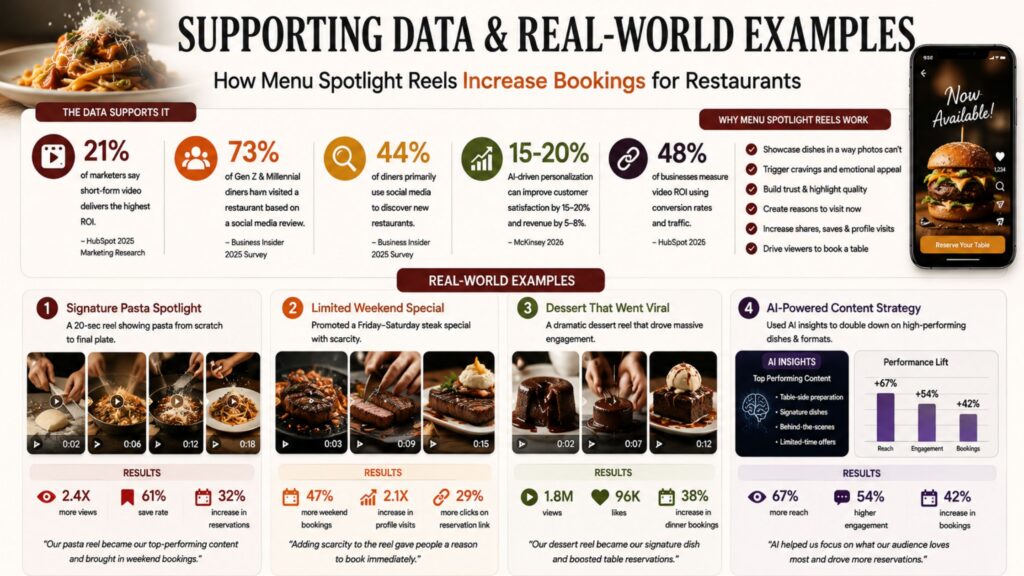
Example 1: Signature Pasta Reel
An Italian restaurant wants to promote a signature pasta.
Instead of posting a finished photograph, it creates a 20-second reel showing dough preparation, pasta being tossed in sauce, parmesan being grated, and the final plate arriving at the table.
The caption directs viewers to reserve a table and specifically mentions the featured dish.
This connects visual desire with an immediate action.
Example 2: Limited Weekend Steak Special
A steakhouse introduces a dish available only on Friday and Saturday.
Its reel begins with the steak hitting the grill, followed by slicing, plating, and the finished dish.
Text on screen states:
“Available Friday + Saturday.”
The reel ends with:
“Reserve your table.”
The restaurant now has a specific, time-sensitive reason for viewers to book.
Example 3: Dessert That Becomes the Social Hook
A restaurant has a visually dramatic dessert that performs particularly well on social media.
Instead of treating dessert as an afterthought, the restaurant creates a dedicated series showing its preparation and customer reactions.
Real restaurants have experienced this kind of social amplification. Reporting by The Guardian highlighted how restaurant content, including viral dishes such as Onda Pasta Bar’s tiramisu, has helped generate substantial attention and interest around restaurants.
A signature menu item can therefore become a discovery asset for the entire restaurant.
Example 4: AI-Assisted Menu Content Strategy
A restaurant publishes reels for eight different menu categories over several months.
Performance analysis reveals that videos featuring tableside preparation generate significantly more saves, shares, profile visits, and reservation-page clicks.
Instead of increasing content volume indiscriminately, the restaurant produces more videos around that experience.
This is where AI-assisted analysis becomes practical: use performance signals to decide what to film next.
Turn Menu Spotlights Into a Repeatable Reel Series
One menu spotlight may generate attention.
A recognizable series builds anticipation.
Restaurants can rotate recurring concepts such as:
- Dish of the Week
- Chef’s Pick
- Behind the Plate
- What’s Cooking Tonight?
- Weekend Special
- Cocktail of the Week
- Dessert Spotlight
- New on the Menu
A restaurant with 30 menu items already has dozens of potential reels without inventing unrelated content.
These videos can also support a broader social media strategy. Restaurants that need help creating consistent short-form campaigns can connect menu content with professional social media marketing services, content production, paid campaigns, and local audience targeting.
Measure Whether Menu Reels Actually Generate Bookings
Views alone should not determine success.
Restaurants should track:
- Reel reach
- Average watch time
- Saves
- Shares
- Profile visits
- Reservation link clicks
- Direct messages
- Bookings attributed to campaigns
HubSpot reports that while 74% of companies use engagement metrics to measure video ROI, 48% also use conversion rates and 48% track traffic.
Restaurants should adopt the same principle.
A reel with 100,000 views but almost no reservation activity may be less valuable than a locally targeted reel with 8,000 views and dozens of reservation clicks.
The objective is not viral reach for its own sake.
The objective is qualified local attention that contributes to occupied tables.
Conclusion
Menu spotlight reels can increase restaurant bookings because they transform a menu from a list of dishes into a visual experience.
They allow diners to see preparation, presentation, ingredients, chef expertise, and atmosphere before deciding where to eat.
The strongest strategy is straightforward: feature one compelling dish, capture attention immediately, explain what makes it special, show the people behind it, and provide a clear path to reserve.
AI can strengthen the process by helping restaurants identify which dishes, formats, and audience segments produce the strongest response. But technology does not replace the fundamental creative advantage restaurants already possess.
They have visually compelling products being created every day.
Instead of simply telling potential customers what is on the menu, menu spotlight reels show them what they could be eating tonight.
When that craving is paired with an easy reservation path, social engagement has a much better chance of becoming a booked table.