
Choosing a tattoo artist involves more than liking a design. Clients also want to know whether the studio is clean, whether the artist understands their ideas, how the process works, and whether they will feel comfortable during their appointment.
A portfolio can demonstrate artistic ability, but it may not answer these practical questions. Behind-the-scenes Instagram Reels can help by showing the artist at work, the preparation process, the studio environment, and the care taken before a tattoo begins.
So, how do behind-the-scenes Reels build trust for tattoo studios?
They build trust by making the studio more familiar, demonstrating professional practices, showing the people behind the artwork, and answering questions that might otherwise stop someone from booking.
Video is well suited to this task. According to Wyzowl’s 2026 video marketing research, 89% of consumers say video quality affects their trust in a brand, while 96% have watched an explainer video to learn about a product or service.
For tattoo studios, the opportunity is not to film every moment of a tattoo session. It is to show the right details so prospective clients can make a more informed decision.
Direct Answer: Why Do Behind-the-Scenes Reels Build Trust?
Behind-the-scenes Reels help clients understand what it is like to choose and visit a tattoo studio before they arrive.
A finished tattoo photograph shows the result. A behind-the-scenes Reel can show the consultation, design preparation, workspace, artist’s approach, and aftercare guidance that contribute to the experience.
This matters because tattoos are permanent, personal, and often emotionally significant. A client might love an artist’s work but hesitate because they are unfamiliar with the studio or unsure what to expect.
Useful Reels reduce that uncertainty by showing real processes rather than relying on broad claims such as “professional service” or “high standards.”
The format also fits current marketing trends. HubSpot’s 2026 State of Marketing report identifies short-form video as the highest-ROI content format, with 49% of surveyed marketers naming it their top-return format.
These are general marketing benchmarks, not a guarantee of tattoo bookings. The practical goal is to use video to answer questions, demonstrate credibility, and encourage suitable clients to enquire.
Step 1: Show the Studio Before the Client Arrives
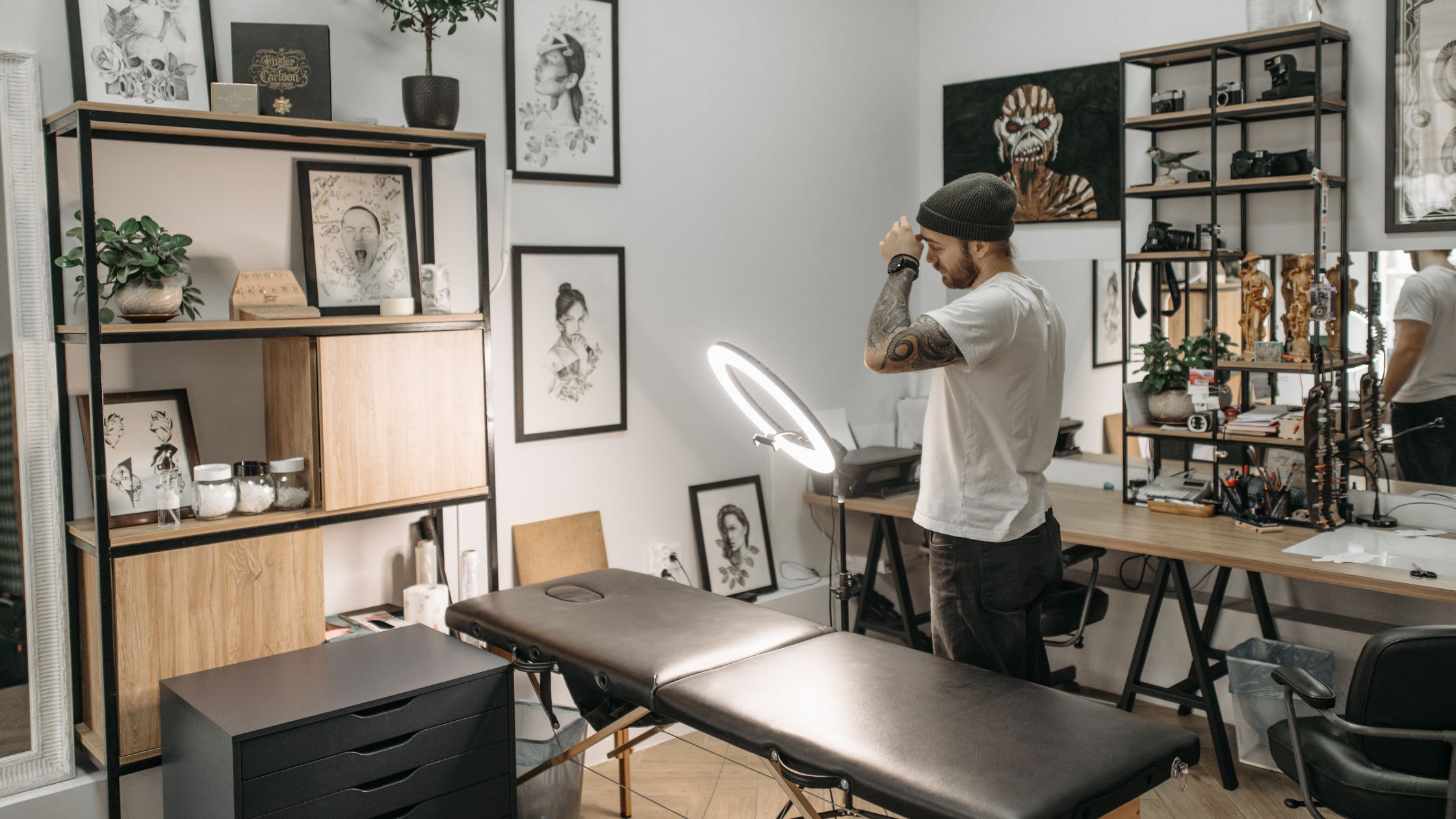
For someone visiting a tattoo studio for the first time, the environment can be a major source of uncertainty.
Create a short studio tour showing the entrance, reception area, artist stations, lighting, and general workspace. Keep the footage clear and realistic instead of relying on dramatic edits that conceal the actual environment.
A simple opening hook could be:
- “Your first visit to our tattoo studio? Take a look inside.”
- “Here’s what to expect when you arrive for your appointment.”
- “A quick tour of our workspace before your next tattoo.”
Show the details that help visitors orient themselves and feel more prepared. Avoid filming private client conversations or other customers without permission.
The aim is to make the first visit feel less unfamiliar, especially for people considering their first tattoo.
Step 2: Demonstrate Hygiene and Preparation
Hygiene is one of the most important subjects a tattoo studio can address through behind-the-scenes content.
The US Food and Drug Administration warns that infections can result from unhygienic practices, non-sterile equipment, and contaminated tattoo inks.
A studio can use Reels to demonstrate appropriate preparation, including:
- Cleaning and preparing the work area
- Setting up the station before an appointment
- Using sterile, single-use items where appropriate
- Showing safe handling and disposal procedures
- Following the studio’s established hygiene protocols
The footage must reflect actual practice. Do not stage a setup solely for social media or imply that a short clip proves every aspect of safety.
A useful Reel could open with: “Here’s how we prepare the station before a tattoo appointment.”
Explain what viewers are seeing with short captions. Educational context makes the content more useful than a silent montage.
Also follow applicable local health and licensing requirements. US FDA guidance is a useful reference for ink safety, but it does not replace local rules governing tattoo studios elsewhere.
Step 3: Introduce the Artist Behind the Work
Clients are not only choosing a design. They are choosing the person who will create it on their skin.
Use short Reels to introduce each artist’s specialisms, artistic influences, preferred styles, and approach to working with clients.
For example:
- “Meet the artist behind our fine-line tattoos.”
- “How I approach custom blackwork designs.”
- “Three things I discuss with every first-time client.”
Let artists speak naturally rather than memorising a promotional script. A brief explanation of how they approach a design can reveal more about their expertise than a long list of credentials.
Make sure any qualifications, experience claims, and specialisms mentioned are accurate. The goal is to help potential clients identify an artist whose style and approach suit their needs.
Step 4: Film the Design Consultation Process
Many clients arrive with a saved image, a rough sketch, or an idea they cannot quite explain.
A behind-the-scenes Reel can show how an artist turns that starting point into a workable concept. Film the artist reviewing references, sketching alternatives, discussing placement, or adjusting proportions.
A useful hook is:
“What happens when you bring us a tattoo idea?”
Explain how the studio considers size, placement, detail, and how a design will fit the client’s preferences. Do not suggest that every design can be copied exactly or that every request will be accepted.
With the client’s permission, you can document a real design journey from initial idea to stencil. If the work is confidential or the client prefers privacy, demonstrate the process using a fictional example clearly labelled as such.
This type of content helps prospective clients understand that a consultation is a conversation, not simply an instruction to choose a picture.
Step 5: Show the Process Without Making It the Entire Story
Tattooing footage can be compelling, but process clips need context.
Show selected moments such as stencil placement, the artist checking positioning, a close-up of linework, or a brief explanation of a technique. Avoid excessive footage of needles entering skin, blood, or graphic details that could make viewers uncomfortable or violate platform rules.
A better Reel might follow this structure:
- Opening: The design and the client’s goal
- Middle: Stencil placement and selected working moments
- Explanation: One detail about the technique or design
- Ending: The finished tattoo, with permission
The purpose is to demonstrate focus and communication, not simply to show the procedure.
Step 6: Explain Aftercare Before Clients Have to Ask
Aftercare is another useful subject for trust-building content because clients need to understand how to care for a new tattoo.
Create short educational Reels covering topics such as:
- Why following the artist’s aftercare instructions matters
- What clients should ask before leaving the studio
- Why clients should avoid improvising their own care routine
- When to contact the studio with an aftercare question
- Why healing experiences can vary
Keep guidance consistent with the studio’s written instructions and reputable health guidance. Do not promise that a tattoo will heal in a fixed number of days or offer a diagnosis through social media.
These Reels demonstrate that the studio considers the client experience beyond the appointment itself. They also give prospective customers a preview of the guidance they can expect when booking.
Step 7: Answer Questions That Prevent Bookings
Use comments, direct messages, consultations, and frequently asked questions to identify where people get stuck.
Common topics include:
- How to prepare for a first tattoo
- How to choose a placement
- How custom designs are priced
- Whether a consultation is required
- How to prepare reference images
- What information is needed for a quote
- How to request a design change
Turn each question into a separate Reel.
For example, a video titled “What should you send when requesting a tattoo quote?” could explain that clients should share the approximate size, placement, preferred style, and reference images, while noting that final pricing depends on the project.
This is more helpful than repeatedly posting “DM us to book.” It makes the enquiry process easier and helps potential clients approach the studio with realistic expectations.
Step 8: Use Real Client Experiences to Build Familiarity
With explicit permission, feature short client testimonials or clips showing the experience around an appointment.
A client might explain why they chose a particular artist, how they prepared for their first tattoo, or how the artist helped them refine an idea.
Other useful formats include:
- A first-visit walkthrough
- A client explaining the inspiration behind a tattoo
- A finished design reveal
- A short discussion about the consultation experience
- A client sharing why they chose a custom design
Do not script testimonials to make them sound more positive than they are. Avoid revealing personal stories or identifying details without consent.
Real experiences can help prospective clients imagine what their own appointment might be like. They also give the studio a way to demonstrate its communication style without making unsupported claims about customer satisfaction.
Step 9: Use AI to Plan Reels and Identify What Builds Trust
AI can help a tattoo studio produce educational content more efficiently and understand which topics generate meaningful enquiries.
Start by grouping existing content into categories such as studio tours, artist introductions, hygiene preparation, design consultations, process footage, and aftercare education.
Then compare each category using:
- Average watch time
- Saves and shares
- Profile visits
- Website clicks
- Direct messages
- Consultation requests
- Confirmed bookings
AI tools can summarise recurring questions, suggest caption variations, transcribe artist explanations, and help turn one longer recording into several short clips.
HubSpot’s 2026 marketing research reports widespread AI adoption across marketing, with content creation and media production among the common applications. It also highlights the importance of distinctive, human-led content as AI makes publishing easier.
For tattoo studios, that means using AI to organise genuine footage and improve communication, not to invent client testimonials, fabricate hygiene practices, or create misleading tattoo transformations.
A Reel that earns fewer views but generates relevant consultation requests may be more valuable than one that attracts a large audience with little booking intent.
Supporting Data and Real-World Examples
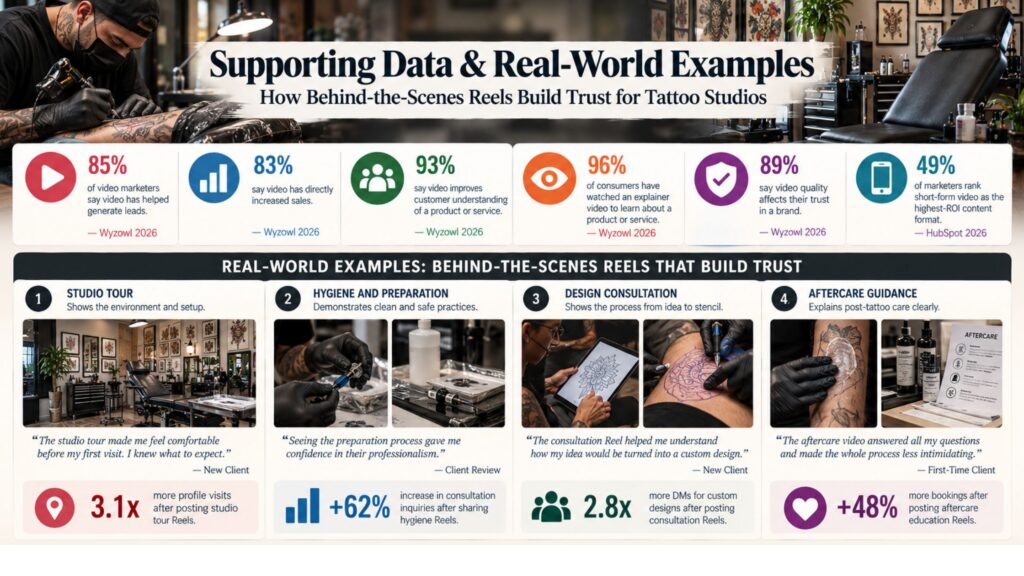
Video benchmarks explain why behind-the-scenes content is worth testing, but the studio should measure its own results rather than assume general statistics guarantee more bookings.
Wyzowl’s 2026 survey found that:
- 85% of video marketers say video has helped generate leads.
- 83% say video has directly increased sales.
- 93% say video has improved customer understanding of their product or service.
- 82% say video has delivered a good return on investment.
These results cover a broad range of businesses, not tattoo studios specifically. They support video as a marketing format, while studio-level enquiry and booking data will show which content works locally.
Example 1: The First-Tattoo Experience
A studio creates a Reel showing the reception area, a short artist introduction, design consultation, and station preparation.
The caption invites first-time clients to send questions before booking. This content addresses unfamiliarity and helps people understand what to expect.
Example 2: From Reference Image to Custom Design
An artist explains how a client’s reference images were used to develop a personalised design. The Reel shows sketching, stencil placement, and the finished tattoo, with the client’s consent.
The content demonstrates collaboration and attracts people looking for custom work rather than a ready-made design.
Example 3: Hygiene Preparation
A studio records its normal pre-appointment setup and adds captions explaining the procedures shown. It links the Reel to its appointment information and invites prospective clients to ask about its practices.
The result is practical transparency, not a claim that one video proves every aspect of safety.
Example 4: AI-Assisted Content Review
After several weeks, the studio compares Reels and discovers that artist introductions generate profile visits, aftercare videos receive saves, and consultation walkthroughs generate the most booking enquiries.
The team can use these insights to plan the next month’s content around both audience questions and business outcomes.
How to Turn One Studio Session Into Multiple Reels
A single recording session can produce several useful posts:
- A studio tour
- An artist introduction
- A design consultation walkthrough
- A station preparation video
- A short technique explanation
- A frequently asked question
- An aftercare reminder
- A finished tattoo reveal
This makes content production more manageable without staging extra activities for the camera.
For broader guidance on creating consistent social media content, explore Socinova and its relevant social media marketing, content creation, and Instagram marketing services. You can also link this article internally to related posts about transformation Reels, educational video content, and customer journey storytelling.
Conclusion: Can Behind-the-Scenes Reels Really Build Trust for Tattoo Studios?
Yes. Behind-the-scenes Reels can help tattoo studios build trust by making the experience more transparent, introducing the artists, showing genuine preparation practices, explaining design decisions, and answering questions before a client books.
The strongest content is not necessarily the most elaborate. It is the content that helps a prospective client understand the studio and make a confident, informed decision.
Use real footage, obtain consent before filming clients, represent hygiene practices accurately, and avoid exaggerated promises. Then track which Reels generate meaningful enquiries and confirmed appointments, not just views.
Video is an established marketing format, and HubSpot’s 2026 research ranks short-form video as the leading format for reported marketing ROI.
Show the studio. Explain the process. Introduce the artist. Answer the questions.
That is how behind-the-scenes Reels can turn an unfamiliar tattoo studio into one a potential client feels ready to contact.